01
Inconel X-750 Bar and Rod
Bar, rod, and wire to ASTM B637 and the AMS bar documents, with three heat-treatment routes.
View Inconel X-750 Bar and Rod →Precipitation-hardening nickel-chromium alloy with gamma-prime strength to 704 °C, three heat-treatment routes, and one ASTM product standard.
The grade carries ASTM B637 for bar and forgings, while flat, tubular, and wire forms sit in the AMS system.
Therefore, the same chemistry delivers 965 MPa, 1103 MPa, or 1170 MPa depending on the cycle you order.
Moreover, titanium and aluminium carry the strengthening here, and the specification lists no molybdenum at all.
Inconel X-750 is a precipitation-hardening nickel-chromium-iron alloy carrying the UNS designation N07750. Titanium and aluminium form gamma prime, which lifts strength far above the solid-solution grades. Three heat-treatment routes take that same chemistry to different strength levels.
Bar and rod sit on the Inconel X-750 Bar and Rod page, tubular product on Inconel X-750 Pipe and Tube, and flat product on Inconel X-750 Plate and Sheet. Therefore, one heat covers every route.
However, the trade also sells the grade under names such as Pyromet X750 and Nicrofer 7016 TiNb, and those trademarks belong to other companies.
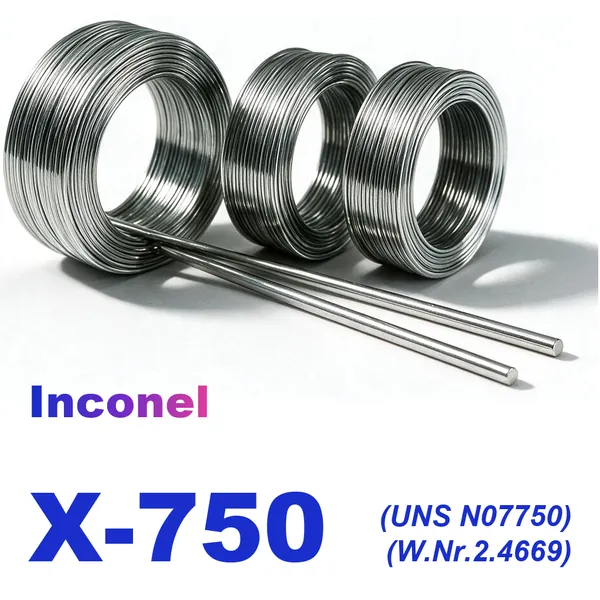
Inconel X-750 carries the UNS N07750 designation and answers to W.Nr. 2.4669. Titanium at 2.25 to 2.75% and aluminium at 0.40 to 1.00% form the gamma prime that carries the load, and niobium at 0.70 to 1.20% slows its coarsening at temperature. Three heat-treatment routes take the same chemistry to 965 MPa, 1103 MPa, or 1170 MPa minimum tensile, so one grade covers springs, fasteners, rings, and high-temperature structural parts. Southerly Alloy supplies and exports UNS N07750 bar, seamless tube, and flat product to ASTM B637, AMS 5542, AMS 5582, and AMS 5667.
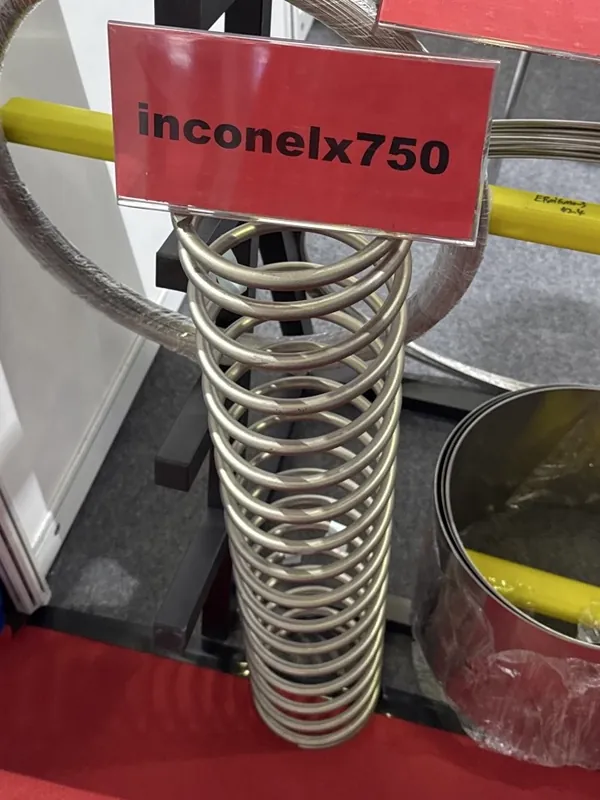
Titanium at 2.25 to 2.75% and aluminium at 0.40 to 1.00% form the gamma prime that carries the load.
Therefore, one chemistry covers 965 MPa, 1103 MPa, or 1170 MPa minimum tensile as the order requires.
Specifically, the bar standard requires 262 MPa at 649 °C for a hundred hours.
Moreover, cold-drawn wire keeps its load at temperature far better than a solid-solution alloy does.
Also, no ductile-brittle transition appears, so the grade serves from −196 °C upward.
Welding runs in the solution-treated condition, because aged material cracks under the arc.
In addition, each lot ships with the solution treatment and aging record for its own heat number.
In fact, ASTM covers bar and forgings only, and the flat, tube, and wire forms sit in the AMS system.
Start with the temperature and the load together. Where a spring or a bolt must hold force above 500 °C, gamma prime precipitation earns its place. Where the duty stays cool and static, a solid-solution grade costs less.
Below about 593 °C the Type 2 cycle gives the highest strength, and above it the stabilised Type 1 route holds creep life.
Consequently, spring temper wire suits service to 371 °C, while No. 1 temper reaches 538 °C.
In addition, parts form in the solution-treated condition and harden in the final furnace cycle.
Because only bar and forgings carry an ASTM document, flat and tubular forms need the AMS number on the order.
Each form names its own document set, so lead the enquiry with the shape you need. Therefore, the standard and the heat treatment follow from that choice.
Bar, rod, and wire to ASTM B637 and the AMS bar documents, with three heat-treatment routes.
View Inconel X-750 Bar and Rod →Seamless tube to AMS 5582 and AMS 5583, from 3.18 mm outside diameter upward.
View Inconel X-750 Pipe and Tube →Flat product to AMS 5542 and AMS 5598, from light strip through 101.6 mm plate.
View Inconel X-750 Plate and Sheet →High-temperature springs and gas turbine hardware are where this grade has served longest. Meanwhile, the cryogenic side of its envelope keeps it in cryogenic and nuclear assemblies.
Discuss Your Application →Rotor blades, wheels, and rings that hold shape under sustained heat.
Coil, disc, and flat springs in exhaust and afterburner sections.
Bolts and studs that keep preload through thermal cycling.
Springs, spacers, and hold-down hardware inside the vessel.
Thrust chamber and nozzle hardware exposed to hot gas.
Support rings and seals for high-temperature vessels.
Trays, baskets, and jigs that survive repeated furnace cycles.
Parts that serve well below −100 °C without a ductile-brittle transition.
Detailed technical information including chemical composition, mechanical properties, standards and available dimensions.
The limits below come from ASTM B637, which shares one composition table with the AMS documents for UNS N07750. Titanium and aluminium set the gamma prime volume, and niobium slows its coarsening in service. Iron balances the matrix, and the nickel plus cobalt floor keeps the alloy austenitic. The mill certificate governs final acceptance.
| Element | Content |
|---|---|
| Nickel plus Cobalt (Ni + Co) | 70.00% min. |
| Chromium (Cr) | 14.00–17.00% |
| Iron (Fe) | 5.00–9.00% |
| Titanium (Ti) | 2.25–2.75% |
| Aluminum (Al) | 0.40–1.00% |
| Niobium + Tantalum (Nb + Ta) | 0.70–1.20% |
| Manganese (Mn) | 1.00% max. |
| Silicon (Si) | 0.50% max. |
| Copper (Cu) | 0.50% max. |
| Cobalt (Co) | 1.00% max. |
| Carbon (C) | 0.08% max. |
| Tantalum (Ta) | 0.05% max. |
| Sulfur (S) | 0.010% max. |
One chemistry covers three acceptance levels, and the ordered heat treatment fixes which one applies. The bar rows follow ASTM B637, and the flat, tubular, and wire rows follow their own AMS documents. Every value below is a minimum unless the row states a range.
| Product Form | Condition | Tensile Strength, min. | Yield Strength (0.2%), min. | Elongation, min. | Hardness |
|---|---|---|---|---|---|
| Bar and rod, ASTM B637 Type 2 | Solution treated at 982 °C, aged | ≥170 ksi (1170 MPa) | ≥115 ksi (790 MPa) | 18% | 302–363 HB |
| Bar and rod, ASTM B637 Type 3 | Solution treated at 1093 °C, aged | ≥160 ksi (1103 MPa) | ≥100 ksi (689 MPa) | 20% | 267–363 HB |
| Bar and rod, ASTM B637 Type 1 | Solution treated at 1149 °C, stabilised, aged | ≥140 ksi (965 MPa) | ≥90 ksi (620 MPa) | 8% | 262 HB min. |
| Plate, AMS 5542 | Annealed, then aged at 704 °C | ≥155 ksi (1069 MPa) | ≥100 ksi (689 MPa) | 20% | Rc 30 min. |
| Sheet, AMS 5542 | Annealed, then aged at 704 °C | ≥165 ksi (1138 MPa) | ≥105 ksi (724 MPa) | 20% | Rc 32 min. |
| Strip, AMS 5542 | Annealed, then aged at 704 °C | ≥155 ksi (1069 MPa) | — | 15% | Rc 30 min. |
| Seamless tube, AMS 5582 | Solution treated, aged at 704 °C | ≥155 ksi (1069 MPa) | ≥100 ksi (689 MPa) | 15% | — |
| Seamless tube, AMS 5583 | Vacuum melted, solution treated, aged | ≥170 ksi (1172 MPa) | — | — | — |
| No. 1 temper wire, AMS 5698 | Cold drawn, aged at 732 °C | 165–220 ksi (1138–1517 MPa) | — | — | — |
| Spring temper wire, AMS 5699 | Cold drawn, aged at 649 °C | 180–250 ksi (1241–1793 MPa) | — | — | — |
The Type 2 row holds over sections up to 63.5 mm, and heavier bar relaxes to 15% elongation and 15% reduction of area. Type 1 trades tensile strength for creep life above 593 °C, which is why its elongation floor is lower. Also, hardness ranges are informative only, and the standards bar their use as a basis for rejection.
The figures below come from the published data for the grade and serve design work rather than acceptance testing. Moreover, the magnetic behaviour changes with heat treatment, so the Curie temperature depends on the cycle applied.
| Property | Value |
|---|---|
| Density | Approx. 8.28 g/cm³ |
| Melting range | Approx. 1393–1427 °C |
| Curie temperature, hot rolled | Approx. −143 °C |
| Curie temperature, fully heat treated | Approx. −125 °C |
| Modulus of elasticity at 20 °C | Approx. 214 GPa |
| Modulus of rigidity at 20 °C | Approx. 76 GPa |
| Poisson's ratio | 0.29 |
| Thermal conductivity at 20 °C | Approx. 12.0 W/m·K |
| Specific heat at 20 °C | Approx. 431 J/kg·K |
| Electrical resistivity at 20 °C | Approx. 1.22 µΩ·m |
| Thermal expansion, 20–100 °C | Approx. 12.6 µm/m·K |
| Strengthening route | Precipitation hardening only |
ASTM covers bar, forgings, and forging stock through one document. Everything else sits in the AMS system, so the flat, tubular, and wire forms take their acceptance values from those numbers. The designations below serve cross-reference only.
| Standard | Product or Application |
|---|---|
| ASTM B637 / ASME SB637 | Bars, forgings, and forging stock for moderate or high temperature service |
| ASTM B880 | General requirements for chemical analysis of nickel alloys |
| AMS 5667 / AMS 5668 | Bars, forgings, and rings, equalized or solution and precipitation heat treated |
| AMS 5669 / AMS 5670 / AMS 5671 / AMS 5747 | Bars, forgings, and rings by melting route and solution treatment |
| AMS 5542 | Sheet, strip, and plate, annealed |
| AMS 5598 | Sheet, strip, and plate, remelted or vacuum induction melted |
| AMS 5582 | Seamless tubing, precipitation hardenable to 1069 MPa |
| AMS 5583 | Seamless tubing, vacuum melted, precipitation hardenable to 1172 MPa |
| AMS 5698 / AMS 5699 | Wire in No. 1 temper and in spring temper |
| NACE MR0175 / ISO 15156-3 | Sour service qualification where the order requires it |
| BS HR 505 / GE B14H41 | British and gas turbine designations |
| UNS N07750 · W.Nr. 2.4669 · NiCr15Fe7TiAl | Material designations |
| GB/T 14992 GH4145 · JIS NCF 750 | Chinese and Japanese designations |
| ASTM B168 / ASTM B163 | These documents do not cover UNS N07750 |
Pyromet X750, Nickelvac X750, Nicrofer 7016 TiNb, and Inconel are trademarks of their respective owners. We quote those names for reference only, and our deliveries follow the ASTM and AMS documents listed above.
In fact, the standard text from ASTM International settles any acceptance question.
Because each document prints its own scope, the ranges below follow those texts rather than one house rule. For that reason, state the form and the ordered size on the enquiry.
| Product Form | Typical Supply Range |
|---|---|
| Bar and rod | 6–300 mm diameter to ASTM B637 |
| Forged bar and forging stock | Sections above the agreed bar range, to ASTM B637 |
| Seamless tube | Outside diameter 3.18–219 mm to AMS 5582 |
| Wire | 0.5–12 mm diameter in coils to AMS 5698 and AMS 5699 |
| Plate | 4.76–101.6 mm thick to AMS 5542 |
| Sheet and strip | Under 4.76 mm thick; sheet from 600 mm wide, strip narrower |
Seamless tube starts at 3.18 mm outside diameter, because AMS 5582 sets that as its floor. Therefore, anything smaller needs a different route and should be raised on the enquiry.
Finish follows the operation that comes next rather than a catalogue default. In short, we agree the surface with your order.
| Surface Condition | Typical Use |
|---|---|
| Solution treated and pickled | Standard delivery for high-temperature service |
| Hot-worked | As-rolled or as-forged surface for parts that will be machined |
| Cold drawn | Close diameter control with a brighter surface |
| Peeled | Uniform diameter with a machined skin for further turning |
| Centerless ground | Tight diameter and straightness for shafting |
| Polished | Reduced roughness for product-contact and visible parts |
| Bright annealed | Scale-free surface for instrument and clean circuits |
Get detailed information including specifications, standards, dimensions and material properties.
ASTM B637 covers bar, forgings, and forging stock. AMS 5542 and AMS 5598 cover flat product, AMS 5582 and AMS 5583 cover seamless tube, and the AMS 5667 group covers bar and rings.
No. ASTM B637 reaches bar and forgings only, and neither B168 nor B163 lists UNS N07750 in its scope. Flat product and tube therefore take their acceptance values from the AMS documents.
Type 2 suits service to about 593 °C where strength matters most. Meanwhile, Type 3 is the familiar spring and fastener cycle, and Type 1 takes over above 593 °C where creep life leads.
Useful strength holds to roughly 704 °C, and oxidation resistance extends to 982 °C for intermittent exposure. Creep data governs any duty above 704 °C rather than short-term tensile figures.
Aged material cracks under the arc, because the gamma prime leaves little ductility for weld shrinkage. Fabricate in the solution-treated condition and age the finished assembly.
No. 1 temper is cold reduced 15 to 20% and ages at 732 °C, for service to 538 °C. Spring temper is cold reduced 30 to 65% and ages at 649 °C for service to 371 °C.
One bar or one length covers most stock sizes, and a short cut is enough for a trial.
We quote mainly on FOB terms, and EXW or CIF follow on request.
Meanwhile, stock sizes ship in 7-15 days, and made-to-order material runs about 25 days.
Yes. Every heat ships with an EN 10204 3.1 certificate, and we arrange 3.2 endorsement on request.
Send the form, the ordered size, and the service temperature. Our answer sets out the price, the lead time, and the document package in a single reply. Because the heat treatment fixes the acceptance level, name the Type or the AMS number.
One trial bar costs very little, and it settles the grade question before a plant-wide release.