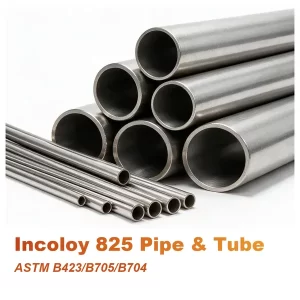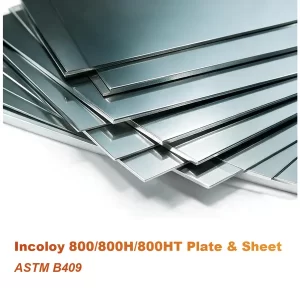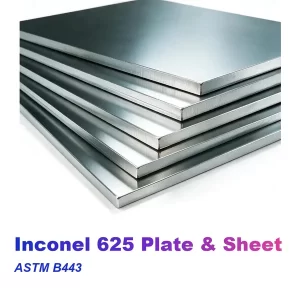
01
Incoloy 825 Hot-Rolled Plate
Plate from 4.76 mm upward for vessels, evaporator shells, and ducting.
Request Availability →Hot-rolled plate, cold-rolled sheet, and strip to ASTM B424, annealed for acid and seawater service.
Hot-rolled plate, cold-rolled plate, hot-rolled sheet, cold-rolled sheet, and strip all share one annealed value, therefore strength never drives the form choice.
Since B906 fixes plate, sheet, and strip by thickness and width together, we confirm the correct product form before we quote a price.
Below 0.51 mm the yield requirement falls away, and below 0.25 mm strip elongation no longer applies.
Incoloy 825 plate and sheet comes in UNS N08825 / W.Nr. 2.4858, a titanium-stabilised nickel-iron-chromium alloy with molybdenum and copper additions. We roll it flat in five forms, and each one carries the same annealed minimum strength.
ASTM B424 governs all five, and B906 supplies the tolerances and the flat-product definitions. Consequently, thickness and width together decide whether you are ordering plate, sheet, or strip. Plate starts at 3/16 in. (4.76 mm) with a width over 10 in. (250 mm), sheet runs under that thickness at 24 in. (600 mm) wide or more, and strip is cold-rolled below both limits. For the tubular side of the same alloy, see Incoloy 825 Pipe and Tube and Incoloy 825 Bar and Rod. Furthermore, the Incoloy 825 material page carries the alloy data behind the flat-product order.
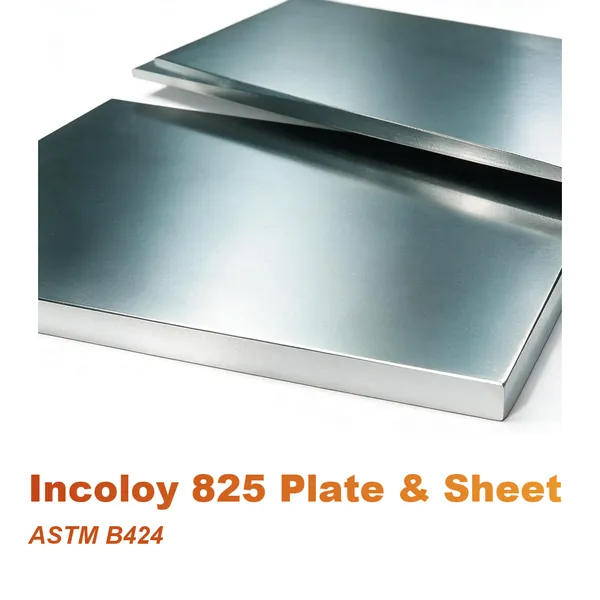
Incoloy 825 plate and sheet is rolled flat product in a titanium-stabilised chemistry, ordered to ASTM B424 with B906 tolerances. Hot-rolled plate, cold-rolled sheet, and cold-rolled strip all share one annealed minimum of 85 ksi (586 MPa) tensile. Two thin-gauge reliefs apply, because the yield requirement drops away below 0.51 mm and strip elongation below 0.25 mm. Chemical vessels, FGD ducting, and phosphoric acid evaporator shells are typical destinations. Southerly Alloy works as a professional supplier and exporter across all three forms, and every order ships with EN 10204 3.1 documentation.

Consequently, a vessel fabricator and a ducting shop order from the same specification and the same annealed value.
Copper and molybdenum carry the reducing-acid duty inside sulfuric and phosphoric acid vessels and evaporator shells.
A nickel content of 38–46% resists chloride stress-corrosion cracking where sheet liners meet seawater.
Cold-rolled sheet and strip take forming and deep drawing, and the anneal leaves enough ductility for tight radii.
Below 0.51 mm thickness the standard drops the yield requirement, therefore thin formed parts avoid an unachievable floor.
Both finishes are available, and the choice fixes how much descaling the fabrication shop must do.
Titanium stabilisation keeps the heat-affected zone resistant to intergranular attack, therefore most vessels release as welded.
Flat-product buying turns on the form definition as much as on the analysis. Above all, an incorrectly named form puts the order under the wrong tolerance table. Therefore, we settle the form, the temper, and the finish before quoting.
We check thickness against width, so plate, sheet, and strip each land in the right tolerance table.
In addition, we shear, plasma-cut, or waterjet blank plate to your drawing instead of shipping a full mill size.
Specifically, we put the flatness and camber limits you need on the order rather than assume them from stock.
Moreover, every plate and sheet carries a mill certificate tied to its heat number.
Flat product starts as a cast slab and finishes at the ordered thickness and finish. As a result, the rolling direction and the final anneal both stay on the record for the lot.
First, we weigh nickel, chromium, iron, molybdenum, and copper into the UNS N08825 window.
Then titanium goes in so carbon stays fixed as carbide through later welding.
Next, the heat is cast to slab and reheated into the hot-working band of 870–1180 °C.
After that, we roll the slab down towards plate thickness or to a coil for later cold reduction.
We then cold-reduce sheet and strip to the ordered gauge, which sets the surface and the tolerance.
Subsequently, we anneal the coil or plate in the 930–980 °C band, quench it, and pickle it.
Finally, we shear or cut to size, check thickness and flatness, and release the lot.
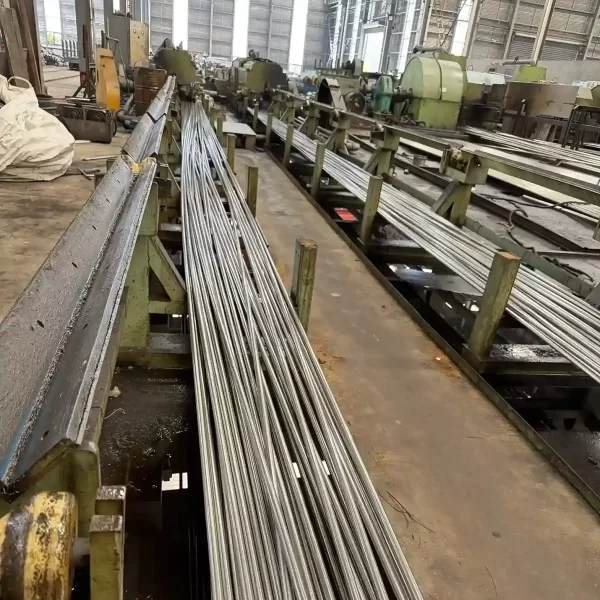
Our flat-product lines cover plate, sheet, and strip, and the figures below describe what stands behind a quotation. In addition, cut-to-size and blanking work runs on the same site.
Rolling, annealing, pickling, and cutting bays share one works.
Specifically, hot mills, cold mills, levellers, and shears cover the flat-product range.
In total, plate, sheet, and strip output spans stock and cut-to-size orders.
Moreover, the flat-product team reviews form definition, flatness, and finish with you.
Consequently, every lot ships against the form definition and tolerance table that the order names.
Release waits on measurement, not on the rolling schedule. Because flatness and thickness drive fabrication cost, we gauge every lot and record the result against the heat. In addition, a spectrometer confirms the analysis before we cut the coil.
We record both against the ordered tolerance table, form by form.
Molybdenum, copper, and titanium appear on the certificate for every lot.
In addition, we check for roll marks, scale, and edge condition before we bundle the sheets.
Consequently, certificates carry the heat number, so incoming inspection can trace any sheet.
The flat range splits by rolling route and by product form, and each one carries its own thickness band. Therefore, name the form as well as the gauge when you enquire.
Plate from 4.76 mm upward for vessels, evaporator shells, and ducting.
Request Availability →Plate rolled cold where a smoother surface and tighter thickness control matter.
Request Availability →Sheet under 4.76 mm for liners, baffles, and general fabrication.
Request Availability →The form most fabrication shops order for forming and deep drawing.
Request Availability →Narrow strip under 600 mm wide for pressed parts and rolled sections.
Request Availability →Annealed and pickled coil for continuous forming lines.
Request Availability →Sheared, plasma-cut, or waterjet blanks to your drawing.
Request Availability →Circular blanks for tube sheets, flanges, and vessel heads.
Request Availability →Acid vessels and chloride-bearing cooling water account for most flat-product enquiries. Consequently, the destinations below also include FGD ducting, pickling lines, and nuclear reprocessing circuits.
Discuss Your Application →Shell plate, baffles, and liners in acid storage and concentration service.
Plate for evaporator bodies and tube-sheet stock in wet-process acid.
Absorber walls, damper blades, and duct liners in chloride-laden slurry.
Baffles, shells, and tube sheets for coastal cooling systems.
Tank linings, covers, and crane parts in steel pickling plants.
Dip tubes, distributor plates, and support grids in mixed-acid reactors.
Vessel plate and internals for nitric acid and solvent extraction duty.
Scrubber plate, ducting, and tankage in waste-treatment circuits.
Detailed technical information including chemical composition, mechanical properties, standards and available dimensions.
The limits below follow ASTM B424 for UNS N08825, and iron balances the melt. Moreover, titanium appears as a controlled range because it fixes carbon as carbide.
| Element | Content |
|---|---|
| Nickel (Ni) | 38.0–46.0% |
| Chromium (Cr) | 19.5–23.5% |
| Iron (Fe) | 22.0% min. |
| Molybdenum (Mo) | 2.5–3.5% |
| Copper (Cu) | 1.5–3.0% |
| Titanium (Ti) | 0.6–1.2% |
| Carbon (C) | 0.05% max. |
| Manganese (Mn) | 1.00% max. |
| Silicon (Si) | 0.50% max. |
| Aluminium (Al) | 0.20% max. |
| Sulfur (S) | 0.03% max. |
B424 gives every rolled form the same annealed value. In addition, two footnotes relax that value at the light end, and the yield minimum stops applying below 0.51 mm thickness.
| Product Form | Standard | Condition | Tensile Strength | Yield Strength (0.2%) | Elongation |
|---|---|---|---|---|---|
| Hot-rolled plate | ASTM B424 | Annealed | 85 ksi (586 MPa) | 35 ksi (241 MPa) | 30% |
| Cold-rolled plate | ASTM B424 | Annealed | 85 ksi (586 MPa) | 35 ksi (241 MPa) | 30% |
| Hot-rolled sheet | ASTM B424 | Annealed | 85 ksi (586 MPa) | 35 ksi (241 MPa) | 30% |
| Cold-rolled sheet | ASTM B424 | Annealed | 85 ksi (586 MPa) | 35 ksi (241 MPa) | 30% |
| Cold-rolled strip | ASTM B424 | Annealed | 85 ksi (586 MPa) | 35 ksi (241 MPa) | 30% |
| Forgings and tube sheets | ASTM B564 | Solution annealed | 85 ksi (586 MPa) | 35 ksi (241 MPa) | 30% |
The yield requirement does not apply to material under 0.020 in. (0.51 mm) thick, and elongation data for cold-rolled strip is not required below 0.010 in. (0.25 mm). Plate is 4.76 mm and over in thickness with a width above 250 mm, sheet is under 4.76 mm and at least 600 mm wide, and strip is cold-rolled under both limits. Coil delivery is a packaging choice, and it does not change the product form under the standard.
Typical room-temperature values follow, and they cover design work rather than acceptance testing. Furthermore, thermal expansion close to 14.1 µm/m·°C keeps mismatch stress low in vessels with carbon-steel shells.
| Property | Value |
|---|---|
| Density | Approx. 8.14 g/cm³ |
| Melting range | Approx. 1370–1400 °C |
| Specific heat at 20 °C | Approx. 440 J/kg·K |
| Modulus of elasticity at 20 °C | Approx. 196 GPa |
| Thermal conductivity at 25 °C | Approx. 11.1 W/m·K |
| Thermal expansion, 20–100 °C | Approx. 14.1 µm/m·K |
| Electrical resistivity at 25 °C | Approx. 1.13 µΩ·m |
| Curie temperature | Below −196 °C |
| Magnetic behaviour | Non-magnetic at ambient temperature |
ASTM B424 is the product specification for all five rolled forms, and B906 sits underneath it as the general document. Moreover, the designations below act as cross-reference labels rather than separate approvals. ASTM International publishes the current text of each specification.
| Standard / Designation | Scope |
|---|---|
| ASTM B424 / ASME SB424 | Plate, sheet, and strip — UNS N08825 |
| ASTM B906 / ASME SB906 | General requirements and product-form definitions for flat-rolled nickel alloys |
| ASTM B425 / ASME SB425 | Rod and bar in the same grade |
| ASTM B423 / ASME SB423 | Seamless pipe and tube in the same grade |
| ASTM B564 / ASME SB564 | Forgings, including tube sheets and flanges |
| NACE MR0175 / ISO 15156 | Sour service, 35 HRC maximum in the annealed condition |
| BS 3072 NA16 / BS 3073 NA16 | British plate, sheet, and strip standards |
| DIN 17750 | German wrought nickel-alloy plate, sheet, and strip standard |
| DIN 17744 / 17751 | German general wrought nickel standard, and tube standard |
| ISO 6208 | ISO plate, sheet, and strip standard |
| VdTÜV 432 | German pressure-vessel material data sheet |
| UNS N08825 / W.Nr. 2.4858 / NiCr21Mo | Material designations |
| JIS NCF 825 | Japanese designation |
Flat-product sizes below reflect what we normally roll, and availability depends on gauge, width, and quantity. Therefore, please state thickness, width, length, and the product form in the enquiry.
| Product Form | Thickness | Width | Length |
|---|---|---|---|
| Hot-rolled plate | 4.76–100 mm | Up to 2000 mm | Up to 6000 mm, or cut to size |
| Cold-rolled plate | 4.76–20 mm | Up to 1500 mm | Up to 6000 mm, or cut to size |
| Hot-rolled sheet | 1.5–4.76 mm | 600–1500 mm | Coil, or cut to length |
| Cold-rolled sheet | 0.5–4.76 mm | 600–1500 mm | Coil, or cut to length |
| Cold-rolled strip | 0.1–4.76 mm | 10–600 mm | Coil, or cut to length |
| Cut-to-size plate | 4.76–100 mm | To drawing | To drawing |
| Circular blank | 4.76–100 mm | Up to 2000 mm diameter | To drawing |
We review gauges and widths outside this range against the rolling route before quotation. We cut circular blanks with the grain direction stated where the drawing calls for it.
Finish follows the next operation, whether that is forming, welding, or a painted exterior. Furthermore, we agree the finish with the order instead of assuming it from stock.
| Surface Condition | Typical Use |
|---|---|
| Hot-rolled, annealed, and pickled | Standard plate supply for vessels and ducting |
| Cold-rolled and annealed | Sheet and strip headed for forming and deep drawing |
| Bright annealed | Light sheet where an oxide-free surface matters |
| 2B cold-rolled | General sheet work with a smooth, dull surface |
| No. 1 hot-rolled | Heavy plate for industrial and structural duty |
| No. 4 polished | Visible panels and product-contact surfaces |
| Descaled and blast-cleaned | Plate headed for coating or rubber lining |
Get detailed information including specifications, standards, dimensions and material properties.
One coordinator carries your flat-product order from enquiry to shipment. We confirm the product form and the temper before we schedule the rolling, and the technical team reviews the forming route.
First, give the product form, thickness, width, length, and quantity.
Next, we check thickness against width under B906 so the right tolerance table applies.
Then price, lead time, and the document set come back in one reply.
After that, grade, temper, finish, flatness limits, and delivery terms go on the record.
We then roll, anneal, pickle, and cut the lot to the ordered condition.
Consequently, certificates and export papers travel with the bundle.
Finally, the loading date and the full export document set reach you before dispatch.
Feedback from buyers and engineers who source nickel alloy materials from Southerly Alloy.
“The 825 sheet for our phosphoric acid tank arrived with thickness and flatness readings on the lot record, so the forming shop started without re-checking.”
“Cut-to-size plate saved us a band-saw operation on the absorber ducting, and the edges needed no further dressing.”
“The certificate listed molybdenum and copper per heat, which satisfied our incoming inspection on the first pass.”
Our production and inspection processes are certified to international standards, and every delivery ships with EN 10204 3.1 mill test certificates.
Quality Management System
Pressure Equipment Directive
Material Standards Compliance
Mill Test Certificates
ASTM B424 for the product, with ASTM B906 supplying tolerances and form definitions. ASME SB424 covers pressure-equipment orders.
Plate is 4.76 mm or more thick and over 250 mm wide, sheet is thinner and at least 600 mm wide, and strip is cold-rolled under both limits.
No. Below 0.51 mm thickness the standard drops the yield requirement, and strip elongation is not required below 0.25 mm.
Cold-rolled sheet and strip carry the anneal that deep drawing needs, and the practical working range stops around 4.76 mm.
4.76–100 mm as standard, with heavier sections reviewed against the rolling route before quotation.
Yes. Shearing, plasma cutting, waterjet cutting, and circle blanking are all available to your drawing.
One sheet or one plate for most stock gauges.
Mostly FOB, and we quote EXW or CIF when you ask.
7-15 days for stock gauges, and about 25 days for made-to-order annealed plate.
Yes. A 3.1 certificate comes with every lot, and we can add 3.2 with a nominated third party.
Send the form, the thickness, the width, and the finish, and the reply carries price, lead time, and the mill document set. Because we confirm the product form against B906 before quoting, the sheet or plate you approve is the one that ships.
Moreover, we carry Incoloy 825 plate, sheet, and strip in common gauges and blank to your drawing. We also accept trial quantities for most gauges.