01
Hastelloy B-3 Bar and Rod
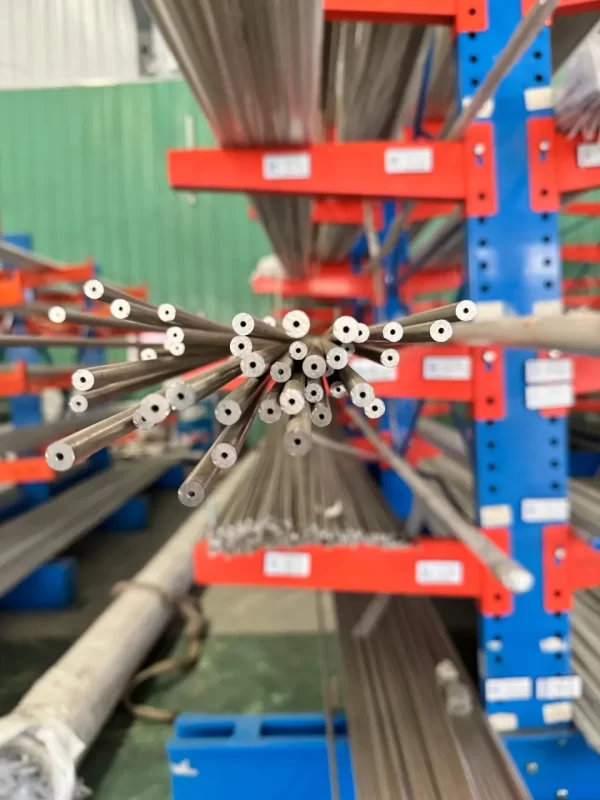
Rod to ASTM B335 from 7.94 to 88.9 mm diameter, with larger sections supplied as forged bar.
View Hastelloy B-3 Bar and Rod →Nickel-molybdenum grade that keeps its ductility through welding heat, for reducing-acid plant built by fabrication.
The page sets out the chromium range that slows Ni4Mo ordering and the carbon ceiling that supports it.
Consequently, the quench and cooling records that keep a joint ductile travel with the heat number.
Bar, tube, and flat product trace to a single heat and ship under one documentation set.
Hastelloy B-3 is a nickel-molybdenum alloy carrying the UNS designation N10675. Chromium between 1 and 3% slows the ordered phases that shorten the life of earlier B-type grades. Consequently, a welded vessel keeps its ductility without a post-weld anneal.
Fabricators reach this grade from three directions, and each form page carries its own ordering detail. Bar sits on the Hastelloy B-3 Bar and Rod page, tubular product on Hastelloy B-3 Pipe and Tube, and flat product on Hastelloy B-3 Plate and Sheet. Above all, one melt serves all three routes under the same certificate practice.
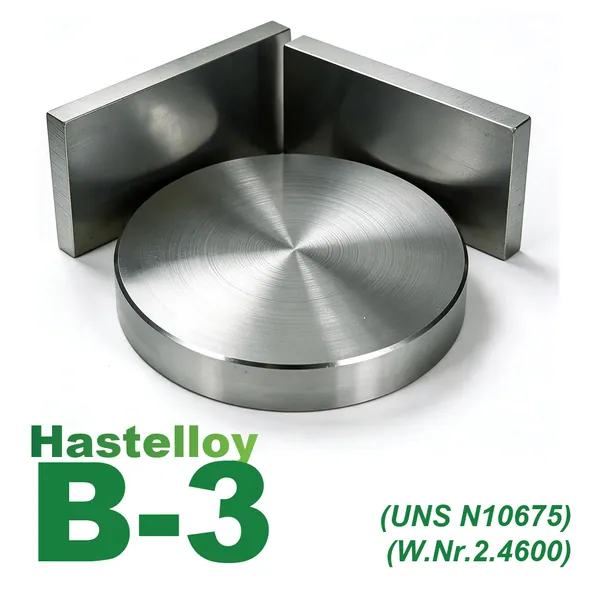
Hastelloy B-3 is a nickel-molybdenum alloy carrying the UNS N10675 grade, with chromium held between 1 and 3 percent. That window slows the ordered phases which embrittle earlier B-type grades, so welded fabrications keep their ductility. The chemistry still resists hydrochloric, sulfuric, and phosphoric acid wherever the stream reduces, and it still rules out oxidants. Southerly Alloy works as a professional supplier and exporter of UNS N10675 bar, tube, and flat product under ASTM B335, B622, and B333.
The 1 to 3% window slows Ni4Mo ordering, so fabricated parts keep their toughness.
Moreover, carbon at 0.01% maximum lets most joints enter service as welded.
Concentration and temperature both sit inside the envelope while the stream reduces.
Consequently, non-oxidizing sulfuric, phosphoric, formic, and acetic media remain within reach.
A nickel-rich matrix resists cracking wherever chlorides concentrate.
Nickel plus molybdenum runs 94.0 to 98.0%, which is the pairing that resists reducing acids.
Nitric acid, wet chlorine, and hypochlorite attack the metal, so those duties need a chromium-rich alloy.
No aging treatment applies, so drawing and rolling set yield above the annealed floor.
Start with the fabrication route, because that is where B-3 separates itself. If the vessel is welded and cannot be re-annealed afterwards, this grade carries the margin. If it is machined from solid, the choice is narrower.
The 1 to 3% chromium range slows the ordering reaction, so heat from welding costs less ductility than it does in earlier grades.
In addition, most joints hold their properties as welded, which removes a furnace cycle from the shop schedule.
Molybdenum at 27.0 to 32.0% keeps hydrochloric and sulfuric acid inside the window while oxidants stay out.
ASTM B335 covers rod, B333 flat product, and B622 seamless tube, so one chemistry reaches three routes.
Three supply routes carry this grade, and each one names its own ASTM document. Consequently, the order should state the form before the size.
Rod to ASTM B335 from 7.94 to 88.9 mm diameter, with larger sections supplied as forged bar.
View Hastelloy B-3 Bar and Rod →Seamless tube to B622 up to 88.9 mm outside diameter, plus welded pipe to B619 and welded tube to B626.
View Hastelloy B-3 Pipe and Tube →Flat product to ASTM B333, from 4.76 mm plate down through light sheet and strip.
View Hastelloy B-3 Plate and Sheet →Welded plant built for pure reducing acids is where the grade earns its place. Meanwhile, fabrication-heavy projects benefit most from the stability margin.
Discuss Your Application →Shells and heads for hydrochloric acid service that cannot be re-annealed after welding.
Internals and trays in chlorinated organics service.
Reactors and columns where the acid stream reduces.
Equipment handling hydrochloric acid as a reactant or a by-product.
Tank linings and immersion hardware in hydrochloric pickling lines.
Exchanger parts and transfer lines at non-oxidizing concentrations.
Vessels for acid-bearing process streams where clean surfaces matter.
Hardware exposed to hot reducing gas rather than air.
Detailed technical information including chemical composition, mechanical properties, standards and available dimensions.
The limits below come from ASTM B335 and B333, which share one composition table for UNS N10675. Chromium is the deliberate addition behind the grade, and nickel plus molybdenum carries the corrosion duty. The mill certificate governs final acceptance.
| Element | Content |
|---|---|
| Nickel (Ni) | 65.0% min. |
| Molybdenum (Mo) | 27.0–32.0% |
| Chromium (Cr) | 1.0–3.0% |
| Iron (Fe) | 1.0–3.0% |
| Tungsten (W) | 3.0% max. |
| Cobalt (Co) | 3.0% max. |
| Manganese (Mn) | 3.0% max. |
| Carbon (C) | 0.01% max. |
| Silicon (Si) | 0.10% max. |
| Phosphorus (P) | 0.030% max. |
| Sulfur (S) | 0.010% max. |
| Vanadium (V) | 0.20% max. |
| Aluminum (Al) | 0.50% max. |
| Titanium (Ti) | 0.20% max. |
| Copper (Cu) | 0.20% max. |
| Columbium (Nb) | 0.20% max. |
| Tantalum (Ta) | 0.20% max. |
| Zirconium (Zr) | 0.10% max. |
| Nickel plus Molybdenum | 94.0–98.0% |
The rod document sets one annealed condition across its whole size range, and the flat-product document matches it. As a result, the table below separates the routes rather than the grades.
| Product Form | Condition | Tensile Strength | Yield Strength, 0.2% Offset | Elongation | Hardness |
|---|---|---|---|---|---|
| Rod, ASTM B335, 7.94–88.9 mm | Solution annealed | ≥110 ksi (760 MPa) | ≥51 ksi (350 MPa) | 40% | 100 HRB max. |
| Plate, ASTM B333, 4.76–63.5 mm | Solution annealed | ≥110 ksi (760 MPa) | ≥51 ksi (350 MPa) | 40% | 100 HRB max. |
| Sheet and strip, ASTM B333, under 4.76 mm | Solution annealed | ≥110 ksi (760 MPa) | ≥51 ksi (350 MPa) | 40% | 100 HRB max. |
| Seamless tube, ASTM B622, to 88.9 mm | Solution annealed | ≥110 ksi (760 MPa) | ≥45 ksi (310 MPa) | 40% | 100 HRB max. |
The grade is not age hardenable, so cold work is the only route above those floors. Typical annealed sheet reaches about 125 ksi tensile with 53% elongation, well above the acceptance minimum.
Values below are typical room-temperature figures for design work rather than acceptance criteria. In addition, the alloy stays essentially non-magnetic, which suits instrument assemblies in acid duty.
| Property | Value |
|---|---|
| Density | Approx. 9.22 g/cm³ |
| Melting range | Approx. 1370–1418 °C |
| Modulus of elasticity | Approx. 216 GPa |
| Modulus of rigidity | Approx. 83 GPa |
| Thermal conductivity at 20 °C | Approx. 11.2 W/m·K |
| Electrical resistivity at 20 °C | Approx. 1.37 µΩ·m |
| Thermal expansion, 25–100 °C | Approx. 10.6 µm/m·K |
| Magnetic behaviour | Essentially non-magnetic in the annealed condition |
| Strengthening route | Cold work only |
The forms divide between seven ASTM documents, and the ASME editions take over under pressure-code jurisdiction. Specifically, no SAE aerospace specification reaches UNS N10675. Meanwhile, the European and Chinese designations below serve cross-reference only.
| Standard | Product or Application |
|---|---|
| ASTM B335 / ASME SB335 | Nickel-molybdenum alloy rod, 7.94–88.9 mm |
| ASTM B333 / ASME SB333 | Plate, sheet, and strip |
| ASTM B622 / ASME SB622 | Seamless pipe and tube to 88.9 mm outside diameter |
| ASTM B619 / ASME SB619 | Welded pipe in Schedule 5S, 10S, 40S, and 80S and larger |
| ASTM B626 / ASME SB626 | Welded tube, 3.2–88.9 mm outside diameter |
| ASTM B564 / ASME SB564 | Nickel alloy forgings |
| ASTM B366 / ASME SB366 | Factory-made wrought fittings |
| ASTM B462 | Forged or rolled flanges and forged fittings |
| ASTM B472 | Forging billets and bars for reforging |
| DIN 17743 / 17750 / 17751 / 17752 / 17753 / 17754 | Wrought nickel alloys, flat product, tube, bar, wire, and forgings |
| ISO 6207 / 6208 / 9723 / 9724 / 9725 | Tube, flat product, bar, wire, and forgings |
| UNS N10675 | Unified Numbering System designation |
| W.Nr. 2.4600 / NiMo29 | European designation for Alloy B-3 |
| GB/T 15007 NS3203 | Chinese designation |
| SAE AMS | No aerospace specification covers this grade |
The product documents come from ASTM International, and their text settles any acceptance question.
Ranges below follow the scope each standard defines, and oversize bar moves to the forging document. For that reason, give the form and the ordered size on the enquiry.
| Product Form | Typical Supply Range |
|---|---|
| Rod | 7.94–88.9 mm diameter to ASTM B335 |
| Forged bar | Diameters above 88.9 mm, supplied to ASTM B564 |
| Seamless tube | Outside diameter to 88.9 mm |
| Welded pipe | Schedule 5S, 10S, 40S, and 80S to 8 in nominal and larger |
| Welded tube | Outside diameter 3.2–88.9 mm, wall 0.41–3.7 mm |
| Plate | 4.76–63.5 mm thick to ASTM B333 |
| Sheet | Under 4.76 mm thick, from 600 mm wide |
| Strip | Under 4.76 mm thick, under 600 mm wide |
Finish follows the next operation rather than a catalog default. In short, we agree it with the order so the surface suits the fabrication you have planned.
| Surface Condition | Typical Use |
|---|---|
| Solution annealed and pickled | Standard delivery for reducing-acid service |
| Hot-worked | As-rolled or as-forged surface for parts that will be machined |
| Cold drawn | Close diameter control with a brighter surface |
| Peeled | Uniform diameter with a machined skin for further turning |
| Centerless ground | Tight diameter and straightness for shafting |
| Polished | Reduced roughness for product-contact and visible parts |
| Bright annealed | Scale-free surface for instrument and clean circuits |
Get detailed information including specifications, standards, dimensions and material properties.
B335 for rod, B333 for plate, sheet, and strip, and B622 for seamless tube.
No. The SAE aerospace series stops short of UNS N10675.
Chromium between 1 and 3%, plus carbon at 0.01% maximum. Together they slow the ordered phases that embrittle the older grade.
Usually yes. However, severe acid duty still calls for a solution anneal and a fast quench after welding.
Roughly −200 to +400 °C depending on load and medium. Beyond that, verify the duty before ordering.
Ferric and cupric ions, wet chlorine, and hypochlorite. All of them attack the low-chromium matrix.
One piece covers most stock sizes.
We quote mainly on FOB terms, and EXW or CIF follow on request.
Stock sizes ship in 7-15 days, and made-to-order material runs about 25 days.
Yes. Every heat ships with an EN 10204 3.1 certificate, and we arrange 3.2 endorsement on request.
Give us the form, the ordered size, and the acid duty. Price, lead time, and the document set come back in a single message. Because the welding route changes what we can certify, tell us whether the part sees fabrication heat.
Trial quantities are welcome, so a single bar or one plate is enough to prove the grade before a plant-wide order.