01
Monel K-500 Bar and Rod
Round, hex, square, and forged sections for shafts, fasteners, and downhole tools.
View Monel K-500 Bar and Rod →Age-hardenable nickel-copper alloy whose aluminium and titanium additions triple Monel 400 yield strength.
First, aluminium and titanium precipitate during the heat treatment, and yield ends up near three times the Monel 400 figure.
Moreover, permeability stays close to unity through machining and aging, so instrument and survey parts read clean.
Hydrofluoric and other de-aerated streams fall inside the envelope, while oxidizing acids sit outside it.
Monel K-500 is a precipitation-hardenable nickel-copper alloy carrying aluminium and titanium in the UNS N05500 balance. An aging cycle then lifts yield strength to roughly three times the Monel 400 figure. Strength therefore arrives through heat treatment rather than cold work.
Three routes carry this grade. Monel K-500 Bar and Rod serves machined shafts and fasteners, Monel K-500 Pipe and Tube covers process and marine lines, and Monel K-500 Plate and Sheet supplies fabricated vessels and linings.
ASTM B865 writes both the composition and the aged acceptance values for this grade. Because its scope stops at bar, rod, wire, and forgings, tube and flat-rolled orders name QQ-N-286, DIN, or ISO documents alongside it. In addition, we fix that reference list at quotation rather than after cutting.
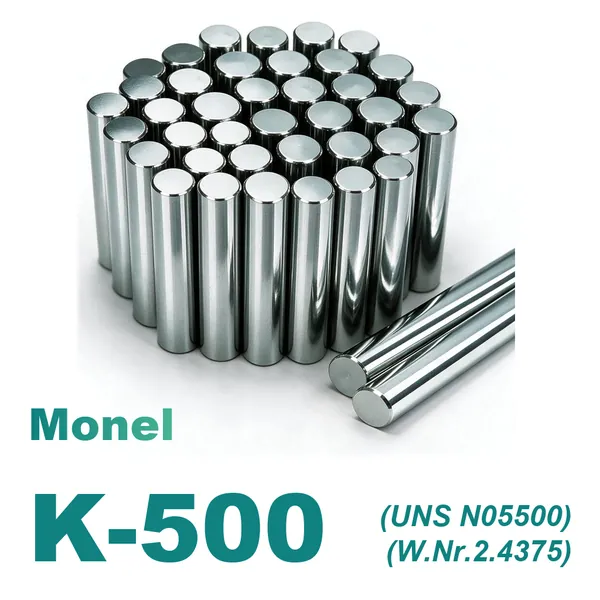
Monel K-500 is a precipitation-hardenable nickel-copper alloy whose aluminium and titanium additions lift yield strength to roughly three times the Monel 400 level once aging is complete. Southerly Alloy supplies it as bar, tube, and flat-rolled product against ASTM B865 chemistry and aged acceptance values, in solution-annealed or age-hardened condition, with NACE hardness control and EN 10204 3.1 records. Marine shafts, sour-gas tools, and non-magnetic instrument parts are the usual destinations.
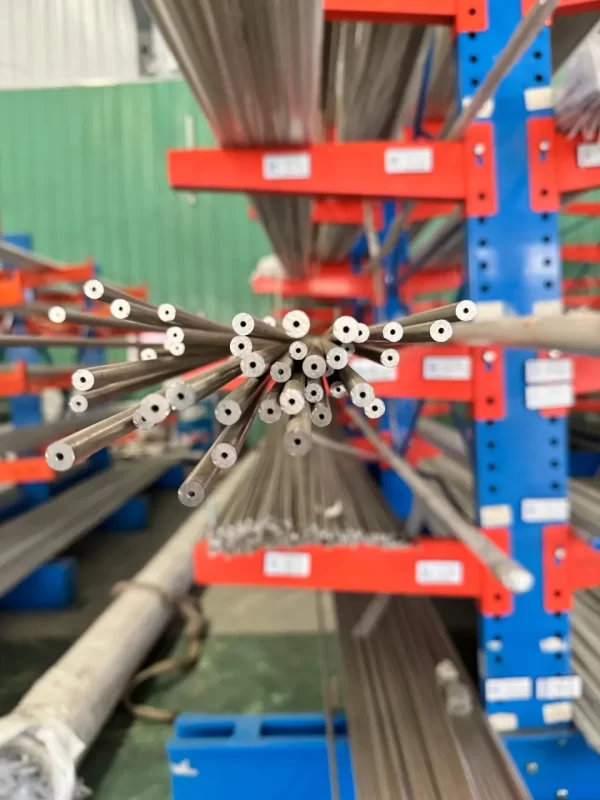
Aged stock reaches about 100 ksi yield, near three times the Monel 400 figure, with no cladding or plating involved.
Precipitation hardening sets the final properties, so drawing becomes a pre-treatment instead of the strengthening step.
Permeability stays close to unity at ambient temperature, which keeps magnetometers and compasses honest.
Solution-annealed stock sits at 185 HB or below, and the aging cycle then lands hardness inside the band your order names.
Seawater, brine, and de-aerated reducing acids meet a material that carries design load at the same time.
Hardened surfaces resist galling and cyclic loading in pump stems, valve trim, and threaded fasteners.
Also, no ductile-to-brittle transition appears, so the alloy keeps its toughness down to liquid-hydrogen temperatures.
However, hydrofluoric, mercury-bearing, and sour streams deserve review, since aged material cracks more readily than Monel 400 in some of them.
Selection turns on four questions rather than on price alone. Because aging trades part of the toughness away for strength, each question deserves an answer before the purchase order lands.
The alloy holds up in seawater, brine, and de-aerated hydrofluoric acid, whereas oxidizing acids and wet chlorine fall outside its range.
Strength holds to about 480 °C continuous, although longer exposure overages the precipitates and returns the section toward annealed behaviour.
Rough machine before aging and finish afterwards, since the section contracts slightly during the cycle and hardened stock cuts slowly.
ASTM B865 stops at bar, rod, wire, and forgings, so tube and flat-rolled orders need QQ-N-286, DIN, or ISO references beside it.
Three forms carry Monel K-500 from the works, and each one leaves in the condition your drawing calls for. Meanwhile, the same chemistry and aging route sit behind all of them.
Round, hex, square, and forged sections for shafts, fasteners, and downhole tools.
View Monel K-500 Bar and Rod →Seamless pipe and heat-exchanger tube for process lines and marine systems.
View Monel K-500 Pipe and Tube →Hot-rolled and cold-rolled flat product for fabricated vessels, linings, and gaskets.
View Monel K-500 Plate and Sheet →Billets, forging stock, and welding wire complete the list, and we quote each against the same heat.
Request Availability →Offshore work takes the largest share of this grade, and marine and chemical plants follow close behind. As a result, most enquiries name a shaft, a fastener, or an instrument housing.
Discuss Your Application →Propeller and pump shafts carry torque in flowing seawater with no corrosion allowance added.
Drill collars and survey housings stay non-magnetic while meeting NACE hardness limits.
Sensor bodies and housings hold permeability low enough for precise measurement.
Stems, impellers, and seats resist wear and galling in corrosive flow.
High-strength bolting and elastic parts keep preload in splash-zone and subsea service.
Paper-mill blades hold an edge in corrosive pulp liquors.
Furthermore, valves, fittings, and heat-exchanger components serve once-through cooling loops.
Engine fasteners and structural components use the strength-to-weight ratio at moderate temperature.
Detailed technical information including chemical composition, mechanical properties, standards and available dimensions.
ASTM B865 fixes the limits below for UNS N05500, and nickel balances the melt. Aluminium and titanium drive the aging response, so both elements matter as much as the base. Therefore the mill test certificate decides final acceptance.
| Element | Content |
|---|---|
| Nickel (Ni) plus Cobalt (Co) | 63.0% min. |
| Copper (Cu) | 27.0–33.0% |
| Aluminium (Al) | 2.30–3.15% |
| Titanium (Ti) | 0.35–0.85% |
| Iron (Fe) | 2.0% max. |
| Manganese (Mn) | 1.5% max. |
| Carbon (C) | 0.18% max. |
| Silicon (Si) | 0.50% max. |
| Sulfur (S) | 0.010% max. |
Aging turns Monel K-500 into a structural material, and the table below lists the acceptance values B865 attaches to each aged condition. Before aging, the same document accepts by hardness alone, with a 185 HB ceiling on annealed stock. Hence confirm the ordered condition before comparing quotes.
| Condition / Section | Tensile Strength, min. | Yield Strength (0.2%), min. | Elongation, min. |
|---|---|---|---|
| Hot-worked and age-hardened, all sizes | ≥140 ksi (965 MPa) | ≥100 ksi (690 MPa) | 20% |
| Cold-worked and age-hardened, rounds 6.4–25.4 mm (1/4–1 in.) | ≥145 ksi (1000 MPa) | ≥110 ksi (760 MPa) | 15% |
| Cold-worked and age-hardened, rounds 25.4–76.2 mm (1–3 in.) | ≥140 ksi (965 MPa) | ≥100 ksi (690 MPa) | 17% |
| Cold-worked and age-hardened, rounds 76.2–101.6 mm (3–4 in.) | ≥135 ksi (930 MPa) | ≥95 ksi (655 MPa) | 20% |
| Annealed and age-hardened, rounds to 25.4 mm (1 in.) | ≥130 ksi (895 MPa) | ≥90 ksi (620 MPa) | 20% |
| Annealed and age-hardened, rounds over 25.4 mm (1 in.) | ≥130 ksi (895 MPa) | ≥85 ksi (585 MPa) | 20% |
Sections above 108 mm (4-1/4 in.) in diameter relax to a 17% elongation minimum, and the standard prints its hardness rows for guidance rather than acceptance.
Values below are typical room-temperature figures intended for design work rather than acceptance. Moreover, the alloy stays essentially non-magnetic well below ambient temperature.
| Property | Value |
|---|---|
| Density | Approx. 8.44 g/cm³ |
| Melting range | Approx. 1315–1350 °C |
| Modulus of elasticity | Approx. 179 GPa |
| Thermal conductivity at 20 °C | Approx. 17.5 W/m·K |
| Specific heat at 20 °C | Approx. 419 J/kg·K |
| Electrical resistivity at 20 °C | Approx. 0.615 µΩ·m |
| Thermal expansion, 20–100 °C | Approx. 13.7 µm/m·K |
| Magnetic behaviour | Essentially non-magnetic down to approx. -101 °C |
| Curie temperature | Approx. -101 °C (-150 °F) |
No single ASTM document covers every form of this grade, so the list below separates what each reference governs. Naming the form beside the standard keeps a quotation accurate.
| Standard / Designation | Scope |
|---|---|
| ASTM B865 | Nickel-copper-aluminium alloy bar, rod, wire, and forgings — UNS N05500 |
| ASME SB865 | ASME edition for bar, rod, wire, and forgings |
| SAE AMS 4676 | Nickel-copper alloy bars, forgings, and rings |
| AMS-QQ-N-286 | Federal specification covering plate, sheet, strip, bar, and tube |
| DIN 17750 / ISO 6208 | Flat-rolled nickel-copper product — plate, sheet, and strip |
| DIN 17751 / BS 3074 NA18 | Nickel-copper seamless pipe and tube |
| DIN 17743 | Wrought nickel-copper alloys — chemical composition |
| UNS N05500 | Material designation for Monel K-500 |
| W.Nr. 2.4375 / NiCu30Al | European designation for Monel K-500 |
| NACE MR0175 / ISO 15156-3 | Material guidance for H2S-bearing service |
Ranges below describe normally produced stock, and exact availability follows condition, finish, and quantity. In addition, tolerances track the standard named for the ordered form rather than a single plant rule.
| Product Form | Typical Supply | Length |
|---|---|---|
| Bar and Rod | 6–500 mm dia. | Cut to length or random |
| Seamless Pipe | 6–219 mm outside dia. | Random or fixed |
| Heat-Exchanger Tube | 6–25.4 mm outside dia., wall 0.5–2 mm | Fixed |
| Plate | 4.76–100 mm thick | Up to 6000 mm |
| Sheet | 0.46–6.4 mm thick | Up to 6000 mm |
| Strip | 0.13–6.4 mm thick | Coil or cut length |
Sizes past these ranges go through a route review before we quote.
Finish follows the next operation, whether that means machining allowance, welding, or a visible part. Additionally, availability tracks form, condition, and order quantity.
| Surface Condition | Typical Use |
|---|---|
| Hot-worked | Parts that will be machined to final size |
| Solution annealed | Soft condition for forming and rough machining |
| Annealed and pickled | Scale-free stock for fabrication |
| Age-hardened | Full-strength delivery for finished parts |
| Cold drawn | Close diameter control with a bright surface |
| Descaled and ground | Uniform surface for inspection and coating |
| Bright annealed | Oxide-free tube for instrument and food lines |
| Pickled flat product | Clean plate and sheet for welded assemblies |
Get detailed information including specifications, standards, dimensions and material properties.
ASTM B865 governs bar, rod, wire, and forgings, and it supplies the chemistry for every other form.
Nickel plus cobalt runs 63.0% minimum, copper 27.0–33.0%, aluminium 2.30–3.15%, and titanium 0.35–0.85%.
Aluminium and titanium stay in solution after quenching, and a controlled aging cycle precipitates them as fine particles that block dislocation movement.
It can wherever higher strength or hardness decides the design, although aged stock is more crack-sensitive in some media.
Continuous service runs to about 480 °C, and longer exposure above that ceiling overages the precipitates.
Stock sizes start at one bar, one length of tube, or one plate, and we scale from there.
Quotations default to FOB, and EXW or CIF terms are available when you ask.
Finished weight drives the quote, and we lock nickel, copper, and aluminium rates at the quotation date.
Stock items leave in 7–15 days, and custom diameters or thick plate need about 25 days.
Yes. A 3.1 certificate accompanies each heat, and third-party witness for 3.2 follows on request.
Send the form, size, quantity, and delivery condition, and one reply carries price, lead time, and the document list. We settle the aging route and hardness band before production starts, so the material you approve is the material that loads.
Both stock and custom sizes stay open for order, and a trial length before volume keeps risk low.