
01
Hastelloy C-22 Round Bar
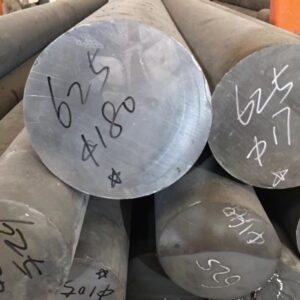
Solid rounds from 6 to 340 mm serve nitric-acid agitator shafts, absorber spindles and machined reactor parts.
View Hastelloy C-22 Round Bar →Chromium-rich bar and rod for oxidizing acids, wet chlorine, and mixed-acid process duty.
Because the certificate carries chromium, molybdenum, and tungsten for each heat, your incoming check compares figures rather than a grade name.
Moreover, the solution anneal and water quench behind your bar appear on the release document, and the lot number ties every test to its charge.
NACE MR0175 / ISO 15156 review needs hardness proof, so we build that record per heat before dispatch.
Hastelloy C-22 bar and rod arrives in UNS N06022, a nickel-chromium-molybdenum-tungsten alloy. Because chromium stays above 20%, nitric acid, wet chlorine, and ferric chloride meet a stable passive film. Molybdenum and tungsten carry the reducing-acid and pitting side.
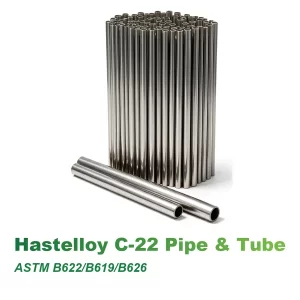
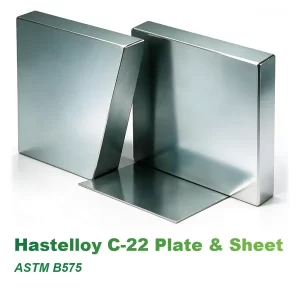
Bar stock runs to ASTM B574 in solution-annealed, hot-finished, and cold-drawn condition. Each lot leaves with an EN 10204 3.1 certificate keyed to its heat. The Hastelloy C-22 hub holds the grade file itself, while tubular and flat-rolled product have Hastelloy C-22 Pipe and Tube and Hastelloy C-22 Plate and Sheet pages of their own.

Hastelloy C-22 bar and rod reaches UNS N06022 service in ASTM B574 round, hex, square, and forged sections, solution annealed and water quenched at 1121 °C. Chromium at 20.0–22.5% holds nitric acid, wet chlorine, and ferric chloride at bay, while molybdenum and tungsten keep reducing acids and chloride pitting in check. Cold-drawn, peeled, and ground conditions come with EN 10204 3.1 heat records, so FGD, chemical, and pharmaceutical plants can trace every bar back to its melt.

Chromium at 20.0–22.5% gives about six points more than C-276, so nitric acid and ferric chloride duty lands on this bar first.
Moreover, wet chlorine, chlorine dioxide, and bleach circuits call for stems, shafts, and fittings rather than flat product.
Besides, molybdenum at 12.5–14.5% and tungsten at 2.5–3.5% still carry hydrochloric, sulphuric, and phosphoric streams through the same section.
Therefore, a pitting-resistance number near 70 keeps seawater and brine off thread roots and gasket faces.
Carbon at 0.015% max and silicon at 0.08% max keep carbides out of the grain boundaries, so joints stay sound without a post-weld anneal.
Consequently, annealed bar clears a 310 MPa proof stress with 45% elongation, and cold drawing lifts both figures.
As a result, forged bar and shaped sections arrive from the release route that round stock follows.
Finally, the mill certificate names its heat number beside the chemistry and mechanical results that the melt produced.
Two questions decide a C-22 bar order. Because your stream sets the chromium requirement, the heat record and the inspection file matter as much as the bar itself. We settle both before the saw touches the metal.
A spectrometer pass on every heat confirms the chromium floor and the molybdenum window, so cutting starts on proven metal.
Besides, where H2S duty applies, per-heat hardness and chemistry evidence joins the release file for NACE MR0175 / ISO 15156 review.
Moreover, we agree diameter, cut length, straightness, and surface condition against the drawing and the order quantity.
Finally, enquiry, production, inspection, and export documents stay with a single desk from first message to loading.
Each C-22 lot begins as a vacuum-refined heat with chromium and tungsten held high. Then the bar passes a water-quenched anneal before any finishing cut. Because we fix that route at the melt, later cuts follow the same metallurgy.
Nickel, chromium, molybdenum, tungsten, and iron go on the scale inside the UNS N06022 window before the melt begins.
Accordingly, a vacuum or argon treatment pulls carbon, silicon, and gas down to the limits that protect weld zones.
Forging and rolling reduce the ingot to bar section, so the cast structure works out pass by pass.
The bar passes 1121 °C and then takes a water quench, because dissolved intermetallic phases would otherwise cost corrosion resistance.
Moreover, drawing, peeling, or centreless grinding brings the bar to the ordered diameter, tolerance, and surface.
Therefore, we straighten and cut to order, and the machining allowance travels with the job.
Pickling or grinding clears the scale, so the surface is ready for acid and chloride duty.
Finally, chemistry, tensile, hardness, and size all clear before the lot ships with its papers.
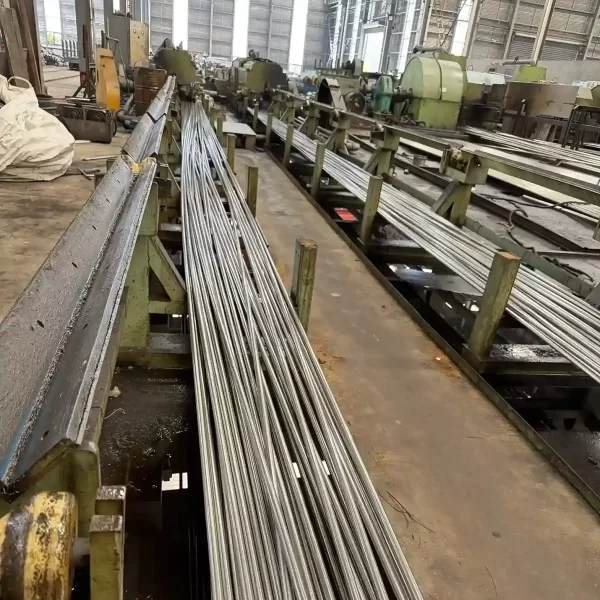
Nickel-alloy bar output here spans stock diameters and made-to-order heats. Consequently, the melting, annealing, and test capacity below sits behind every C-22 lot, and sour-service work shares the same qualified route.
Melting, annealing, and finishing lines for nickel bar share one site.
This count covers the hot-working, annealing, drawing, and grinding equipment behind each bar.
Nickel-alloy bar tonnage per month, spanning stock diameters and order-specific heats.
Metallurgists who settle anneal and test scope against your process medium.
Bar for H2S duty meets NACE MR0175 / ISO 15156, and per-heat hardness and chemistry records support the release file.
No C-22 bar leaves the works until we prove the ordered B574 requirements on the heat. First the spectrometer checks chromium, molybdenum, and tungsten against the N06022 window. Then tensile and hardness results join the file where your specification asks.
Consequently, spectrometry confirms chromium, molybdenum, and tungsten against the ASTM B574 limits for UNS N06022.
Besides, tensile, proof stress, and hardness follow the condition that actually leaves the plant, not a handbook figure.
Meanwhile, our inspectors measure diameter, straightness, and finish to the ordered B574 tolerance, with PMI added where the specification asks.
Therefore, each certificate names its heat number, so any bar traces back to the test results its melt produced.
C-22 bar and rod reaches the works in twelve forms, and each form carries its own page. Meanwhile, those pages set out the section range, the tolerance band and the document route. Therefore, we fix the machining allowance when the order is placed.
Solid rounds from 6 to 340 mm serve nitric-acid agitator shafts, absorber spindles and machined reactor parts.
View Hastelloy C-22 Round Bar →Smaller drawn stock with controlled straightness fits pins, instrument studs and fixture work in acid plants.
View Hastelloy C-22 Round Rod →A peeled, drawn or ground skin gives automatic lathes the diameter control that pharmaceutical parts demand.
View Hastelloy C-22 Bright Bar →A higher proof stress from the as-drawn state, straightened where runout decides the machining pass.
View Hastelloy C-22 Cold-Drawn Bar →Across-flats sections cover nitric-acid flange bolting and multi-flat valve trim with hardness records.
View Hastelloy C-22 Hex Bar →Squares cut to width and length carry absorber duct frames and scrubber skid supports.
View Hastelloy C-22 Square Bar →Rectangular sections to your thickness and width suit absorber internals, damper blades and duct stiffeners.
View Hastelloy C-22 Flat Bar →Heavy valve bodies and shaped sections come from B564 forgings with a controlled wrought structure.
View Hastelloy C-22 Forged Bar →Ground diameter and straightness held for absorber pump spindles and acid metering plungers.
View Hastelloy C-22 Centreless-Ground Rod →Studs and fully threaded bar cut from B574 stock, with F468 coverage and hardness data for sour orders.
View Hastelloy C-22 Threaded Rod →Fine and spring-temper wire to DIN 17753 for demister pads, filtration mesh and bleach-plant springs.
View Hastelloy C-22 Wire →ERNiCrMo-10 bare wire and ENiCrMo-10 electrodes that carry the parent corrosion performance into the joint.
View Hastelloy C-22 Welding Wire →Bar stock for this grade goes where one alloy has to handle oxidizing and reducing attack in the same stream. Most of it reaches FGD, chemical, pharmaceutical, and waste-treatment plants. Name the medium, its concentration, and its temperature in your first message.
Discuss Your Application →Reactor internals and agitator shafts for nitric, sulphuric, and mixed-acid process lines.
Besides, valve trim, stems, and fittings for chlorine dioxide and bleach circuits.
Absorber shafts, damper spindles, and duct supports meet sulphur- and chloride-bearing condensate.
Shafts and baffle supports serve plants where product purity depends on low metallic pickup.
Moreover, hardware for acidic combustion products and wastewater streams.
Tubesheet, baffle, and support parts for seawater-cooled exchangers.
Digester fittings, ClO₂ hardware, and blow-line parts for chlorine service.
Finally, valve, tree, and wellhead bar for H2S duty inside the NACE hardness envelope.
Detailed technical information including chemical composition, mechanical properties, standards and available dimensions.
Limits below follow ASTM B574 for UNS N06022 rod and bar. Because chromium sits about six points above C-276, oxidizing media meet a stronger passive film. Molybdenum and tungsten carry the reducing side, while carbon at 0.015% max protects weld zones.
| Element | Content |
|---|---|
| Nickel (Ni) | Balance |
| Chromium (Cr) | 20.0–22.5% |
| Molybdenum (Mo) | 12.5–14.5% |
| Tungsten (W) | 2.5–3.5% |
| Iron (Fe) | 2.0–6.0% |
| Cobalt (Co) | 2.50% max. |
| Manganese (Mn) | 0.50% max. |
| Vanadium (V) | 0.35% max. |
| Silicon (Si) | 0.08% max. |
| Carbon (C) | 0.015% max. |
| Phosphorus (P) | 0.020% max. |
| Sulfur (S) | 0.020% max. |
Values below separate the ASTM B574 minimums from results typically measured on solution-annealed bar. Moreover, the standard sets one condition for rod and bar, and its mechanical table carries no hardness column at all. Therefore, we agree any hardness ceiling with the order.
| Condition | Tensile Strength | Yield Strength (0.2%) | Elongation | Hardness |
|---|---|---|---|---|
| Annealed — ASTM B574 minimum | ≥100 ksi (690 MPa) | ≥45 ksi (310 MPa) | ≥45% | No requirement in the standard |
| Annealed bar — typical values | 116 ksi (800 MPa) | 53.7 ksi (370 MPa) | 62% | Approx. 90 HRB (241 HB commonly reported) |
C-22 is not age-hardenable, so strength above the annealed floor comes from cold work. Cold-drawn bar therefore quotes to its as-drawn condition when a design needs more proof stress. Besides, sour-service release carries a per-lot hardness record against the 35 HRC ceiling in the solution-annealed state. Aerospace drawings that name an AMS document move to the project specification, because C-22 holds no AMS standard of its own.
Room-temperature figures below support design work rather than acceptance testing. Besides, C-22 stays practically non-magnetic across its working range, so instrument assemblies and magnetically sensitive parts sit comfortably with this bar.
| Property | Value |
|---|---|
| Density | Approx. 8.69 g/cm³ |
| Melting range | Approx. 1357–1399 °C |
| Modulus of elasticity | Approx. 206 GPa |
| Thermal conductivity at 20 °C | Approx. 10.1 W/m·K |
| Specific heat at 20 °C | Approx. 414 J/kg·K |
| Electrical resistivity at 20 °C | Approx. 1.14 µΩ·m |
| Thermal expansion, 20–100 °C | Approx. 12.4 µm/m·K |
| Magnetic behaviour | Practically non-magnetic at ambient temperature |
ASTM B574 governs rod and bar, and ASME SB574 takes over in pressure equipment. Meanwhile, sour-service orders reference NACE MR0175 / ISO 15156 beside the product document. The designations below are cross-reference identifiers rather than separate approvals.
| Standard / Designation | Scope |
|---|---|
| ASTM B574 / ASME SB574 | Nickel-chromium-molybdenum-tungsten rod and bar — UNS N06022 among the grades listed |
| ASTM B564 / ASME SB564 | Nickel alloy forgings in the same grade |
| ASTM B462 / ASME SB462 | Flanges, forged fittings and valve parts in UNS N06022 |
| ASTM F468 | Bolts, hex cap screws, socket head cap screws and studs in nonferrous material |
| ASTM B575 / ASME SB575 | Plate, sheet, and strip in the same grade |
| ASTM B366 / ASME SB366 | Factory-made wrought fittings |
| ASTM B622 / B619 / B626 | Seamless and welded tubular product in the same grade |
| NACE MR0175 / ISO 15156 | Sour service in oil and gas production |
| DIN 17744 | Wrought nickel alloy, W.Nr. 2.4602 / NiCr21Mo14W |
| DIN 17752 | Nickel alloy bar and rod under the German series |
| ISO 9723 | Nickel and nickel alloy bar |
| VdTÜV Werkstoffblatt 479 | German pressure-vessel material sheet for 2.4602 |
| UNS N06022 · W.Nr. 2.4602 · NiCr21Mo14W · NS334 | Designations |
These documents come from ASTM International. Where aerospace work needs an AMS document, C-22 bar follows the project specification or the ASTM document named on the order, since the grade holds no AMS standard of its own.
The windows below cover sections we normally produce, and availability depends on condition, finish, and quantity. Non-standard diameters and lengths go to the mill route for review, so send the drawing with the enquiry and we price it against capacity.
| Product Form | Typical Supply | Length |
|---|---|---|
| Round Bar | 6–340 mm dia. | Cut to length or random |
| Round Rod | 3–50 mm dia. | Cut to length |
| Bright Bar | 6–150 mm dia. | Cut to length or random |
| Square Bar | 10–150 mm | Cut to length or random |
| Hex Bar | 10–150 mm A/F | Cut to length or random |
| Flat Bar | 3–100 mm thick × 10–300 mm wide | Cut to length |
| Forged Bar | 100–340 mm dia. or forged section | Cut to length |
| Precision-Ground Rod | 3–100 mm dia., tight tolerance | Cut to length |
The finish we ship answers the operation that comes next: a machining allowance, direct acid exposure, or a coated assembly. Because availability moves with diameter, condition, and quantity, the order fixes the finish rather than the stock list.
| Surface Condition | Typical Use |
|---|---|
| Solution annealed and pickled | Standard delivery for acid and seawater service |
| Hot-worked (as-rolled or forged) | Parts that will be machined to size |
| Cold drawn | Close diameter control with a brighter surface |
| Peeled | Uniform diameter with a machined skin for further turning |
| Centreless ground | Tight diameter and straightness for shafting |
| Polished | Reduced roughness for product-contact and visible parts |
| Rough turned | Machining allowance held on large or forged bar |
Get detailed information including specifications, standards, dimensions and material properties.
One coordinator carries your C-22 order from enquiry to shipment. Because we fix the anneal route before the first cut, our metallurgists review oxidizing or sour duty early.
Send the medium with its concentration and temperature, plus diameter, length, and quantity.
Next, we match the annealed, hot-finished, or cold-drawn state to your machining plan.
A single reply carries price, lead time, and the document list for the order.
You confirm dimensions, inspection level, and delivery terms before the saw starts.
Then we melt, solution-anneal, and test the bar against the condition on the order.
Finally, the consignment leaves with its certificates and export papers.
Our production and inspection processes are certified to international standards, and every delivery ships with EN 10204 3.1 mill test certificates.
Quality Management System
Pressure Equipment Directive
Material Standards Compliance
Mill Test Certificates
ASTM B574 governs rod and bar, and ASME SB574 applies once equipment falls under pressure-code jurisdiction.
No. The grade holds no AMS standard of its own, so aerospace orders follow the project specification instead.
Yes. Chromium above 20% holds nitric and mixed-acid streams inside the temperature limits the code sets.
Yes. We supply to NACE MR0175 / ISO 15156 with per-heat hardness inside the 35 HRC ceiling.
Round bar from 6 to 340 mm, rod from 3 mm, and hex, square, or flat sections to 150 mm.
Yes. Peeling, centreless grinding, and cut-to-length work cover diameters outside our stock range.
A single bar covers most stock diameters, and trial pieces carry no premium.
FOB serves as our standard term, and we price EXW, CIF, or DAP on request.
Stocked sizes ship in 7-15 days; made-to-order annealed bar runs about 25 days.
Yes. Every heat ships with a 3.1 certificate, and we arrange third-party 3.2 endorsement on request.
Send the medium, its concentration, and the dimensions you need. One reply carries price, lead time, and documents for stock or custom C-22 bar. Because the anneal and inspection level are locked before production starts, what you approve is what arrives.