01
Hot-Rolled Plate
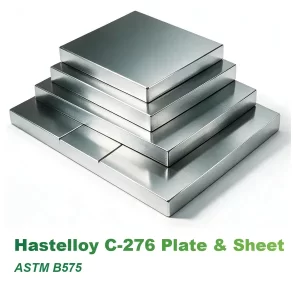
Annealed and pickled plate from 4.76 to 63.5 mm thick.
Request Availability →Flat-rolled product for linings, trays, and vessel internals in reducing acid service, where oxidants are fatal.
Plate and sheet split at 4.76 mm, so the classification is fixed before a price leaves the desk.
Consequently, flatness and edge condition go on the specification rather than staying open.
Each bundle is interleaved and crated so the pickled surface arrives ready for fabrication.
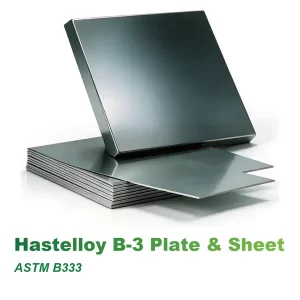
Hastelloy B-2 Plate and Sheet carries the UNS N10665 grade as flat-rolled product. Reducing acids attack the surface very little, while oxidants do the opposite. Exposure between 540 and 815 °C orders the metal into Ni4Mo and costs ductility.
Flat product from this grade reaches fabricators as plate, sheet, and strip. The Hastelloy B-2 hub holds the alloy data, and the Hastelloy B-2 Bar and Rod and Hastelloy B-2 Pipe and Tube pages cover the other two routes.
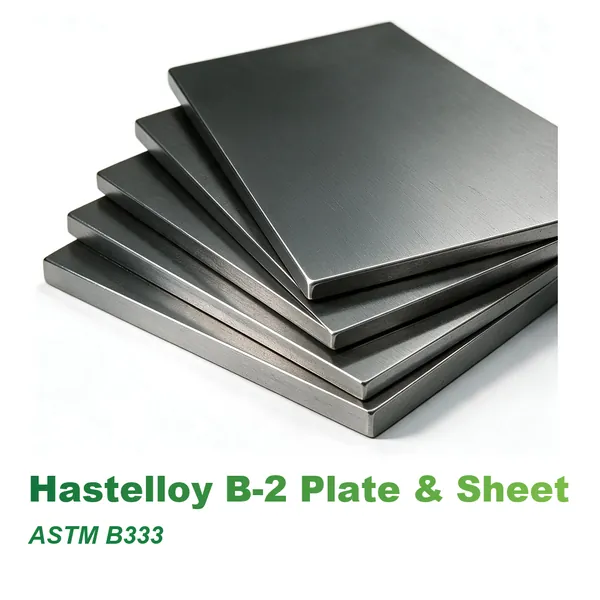
Hastelloy B-2 plate and sheet carries the UNS N10665 grade as flat-rolled product to ASTM B333. The nickel-molybdenum chemistry resists hydrochloric and sulfuric acid while the stream reduces, and it tolerates no oxidant at all. Ni4Mo orders between 540 and 815 °C, so forming and welding heat must pass through that band quickly. Southerly Alloy works as a professional supplier and exporter of flat product from 4.76 to 63.5 mm plate down through light sheet and strip.
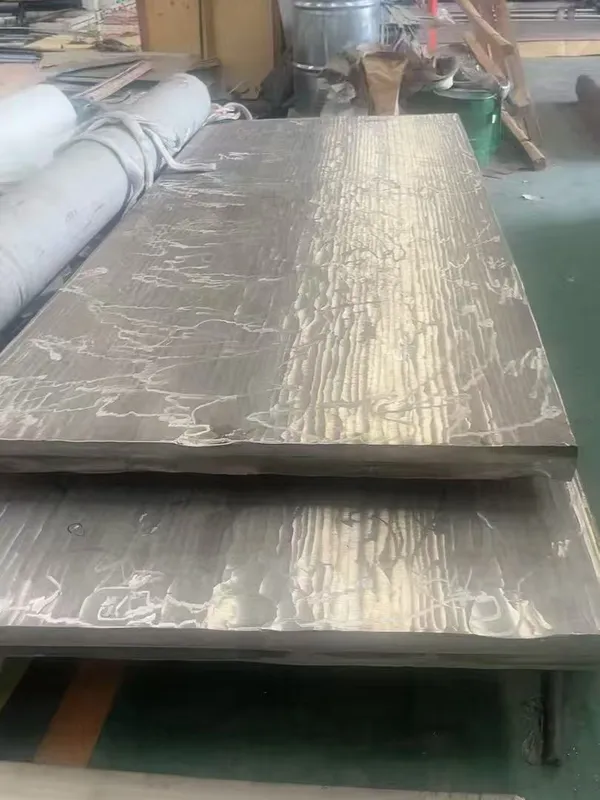
Moreover, concentration and temperature stay inside the envelope while the stream reduces.
Consequently, non-oxidizing sulfuric, phosphoric, and organic acids stay within reach of the flat product.
Nickel dominance keeps chloride-bearing media from cracking the plate face.
Therefore, ASTM B333 covers plate from 4.76 to 63.5 mm thick.
Meanwhile, sheet and strip run under 4.76 mm for liners and formed parts.
Carbon at 0.02% or less limits weld-zone precipitation, so many linings need no further anneal.
In addition, we fix flatness and edge condition at quotation rather than leaving them open.
Ni4Mo ordering between 540 and 815 °C governs how we schedule annealing after forming.
Hastelloy B-2 plate and sheet orders hinge on two things. First, the thickness band that decides whether the mill calls the product plate or sheet. Then, the flatness and edge condition the fabrication shop needs.
Consequently, we confirm the plate or sheet classification before quoting, because thickness and width together decide it.
EN 10204 3.1 certificates carry chemistry, tensile results, and the anneal record.
In addition, plate is cut to your length and width, so offcuts stay at our works.
We protect the face and the edge, then quote FOB, CIF, or DAP against your port.
Flat product starts as a slab that must reach one annealed condition across the whole plate. Consequently, the mill holds thickness and temperature together through rolling.
We dress and inspect the slab before the rolling line takes it.
The mill reduces the slab toward plate gauge at temperature.
A furnace cycle softens the plate so the next pass can bite.
Sheet and strip reach final gauge on cold mills, where thickness holds tightly.
The mill returns the product to a single phase near 1065 °C before the final cool.
A fast drop through the mid range keeps the ordered phases from returning.
Acid cleaning leaves a scale-free surface ready for fabrication.
Flatness, thickness, and edge condition clear before the plate is packed.
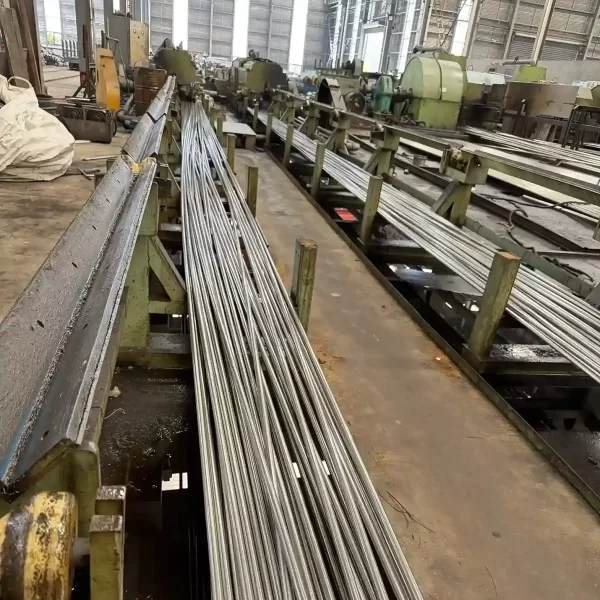
Flat-rolled capacity draws on the same melting and annealing equipment as our tubular and bar lines. Therefore, a project that needs all three forms ships under one certificate.
Hot mills, cold mills, and annealing furnaces share one site.
Rolling, shearing, and grinding equipment sit in this base.
Plate and sheet draw on the same melting campaign.
Forming, welding, and heat-treatment questions reach a metallurgist.
Release evidence follows the flat-product document on your order. Chemistry runs against the N10665 window, and gauge plus flatness records accompany the plate.
The lab measures molybdenum, iron, and carbon against the B333 limits.
Meanwhile, thickness, width, and flatness readings travel with the release papers.
The lab reports grain size against ASTM E112 when the order asks for it.
Each report names the heat, so inspection can trace one plate.
Flat product splits by thickness and width, and the split decides which name the mill uses. Consequently, the enquiry should give both measurements.
Annealed and pickled plate from 4.76 to 63.5 mm thick.
Request Availability →Tighter gauge control and a smoother face for vessel internals.
Request Availability →Under 4.76 mm, used for ducting and loose linings.
Request Availability →Annealed sheet with a uniform surface for formed parts.
Request Availability →In addition, strip runs cold-rolled under 4.76 mm and under 600 mm wide, for coils and press work.
Request Availability →Therefore, plate arrives sheared or plasma cut to your ordered length and width.
Request Availability →Flat product lines vessels and ducting, so the exposed surface carries the corrosion duty. Meanwhile, chemical and pickling plants take most of the tonnage.
Discuss Your Application →Loose and clad linings for hydrochloric acid reactors.
Trays, bubble caps, and supports in chlorinated organics service.
Ducting and absorber shells handling acidic flue gas.
Shell and bottom plate for reducing-acid storage.
Baffles and support plates in reducing-side exchangers.
Immersed plate for hydrochloric and sulfuric pickling.
Product-contact plate for acid-bearing process streams.
Formed and clad components for acid transfer duty.
Detailed technical information including chemical composition, mechanical properties, standards and available dimensions.
Limits below follow ASTM B333 for UNS N10665 flat product, with nickel making up the balance. Iron and chromium stay low because they drive Ni4Mo formation. The mill certificate governs final acceptance.
| Element | Content |
|---|---|
| Nickel (Ni) | Balance |
| Molybdenum (Mo) | 26.0–30.0% |
| Iron (Fe) | 2.0% max. |
| Chromium (Cr) | 1.0% max. |
| Cobalt (Co) | 1.00% max. |
| Manganese (Mn) | 1.0% max. |
| Carbon (C) | 0.02% max. |
| Silicon (Si) | 0.10% max. |
| Phosphorus (P) | 0.04% max. |
| Sulfur (S) | 0.03% max. |
Plate and light flat product share one set of minimums, and the table below separates them by thickness band. As a result, the ordered thickness tells you which row governs acceptance.
| Product Form | Condition | Tensile Strength | Yield Strength, 0.2% Offset | Elongation | Hardness |
|---|---|---|---|---|---|
| Plate, ASTM B333, 4.76–63.5 mm | Solution annealed and descaled | ≥110 ksi (760 MPa) | ≥51 ksi (350 MPa) | 40% | 100 HRB max. |
| Sheet and strip, ASTM B333, under 4.76 mm | Solution annealed and descaled | ≥110 ksi (760 MPa) | ≥51 ksi (350 MPa) | 40% | 100 HRB max. |
The grade is not age hardenable, so cold rolling is the only route to higher strength. Sheet and strip ordered deep-drawing quality carry a grain size requirement beside the tensile figures.
Typical room-temperature values below support design work rather than acceptance testing. In addition, the alloy stays non-magnetic in the annealed condition.
| Property | Value |
|---|---|
| Density | Approx. 9.22 g/cm³ |
| Melting range | Approx. 1330–1380 °C |
| Modulus of elasticity | Approx. 217 GPa |
| Thermal conductivity at 0 °C | Approx. 11.1 W/m·K |
| Thermal conductivity at 100 °C | Approx. 12.2 W/m·K |
| Electrical resistivity at 20 °C | Approx. 1.37 µΩ·m |
| Thermal expansion, 20–93 °C | Approx. 10.3 µm/m·K |
| Magnetic behaviour | Non-magnetic in the annealed condition |
ASTM B333 covers plate, sheet, and strip, and the ASME edition takes over under pressure-code jurisdiction. Specifically, thickness and width together decide which of the three names applies. Meanwhile, the designations below identify the same melt.
| Standard | Product or Application |
|---|---|
| ASTM B333 / ASME SB333 | Plate, sheet, and strip in hot-rolled or cold-rolled condition |
| ASTM B906 | General requirements for flat-rolled nickel alloys |
| ASTM E112 | Grain size determination for sheet and strip |
| ASTM B335 / ASME SB335 | Rod in the same grade |
| ASTM B622 / ASME SB622 | Seamless pipe and tube |
| ASTM B619 / ASME SB619 | Welded pipe |
| ASTM B626 / ASME SB626 | Welded tube |
| ASTM B564 / ASME SB564 | Forgings |
| ASTM B366 / ASME SB366 | Factory-made wrought fittings |
| DIN 17750 | Flat product in wrought nickel alloys |
| ISO 6208 | Nickel alloy plate, sheet, and strip |
| UNS N10665 | Unified Numbering System designation |
| W.Nr. 2.4617 / NiMo28 | European designation for Alloy B-2 |
| GB/T 15007 NS322 | Chinese designation |
| SAE AMS | No aerospace specification covers this grade |
The flat-product documents come from ASTM International, and their text settles any acceptance question.
Ranges below follow the scope ASTM B333 sets, where thickness and width together fix the product name. For that reason, give both measurements on the enquiry.
| Product Form | Typical Supply Range |
|---|---|
| Plate | 4.76–63.5 mm thick, width above 250 mm |
| Sheet | Under 4.76 mm thick, width from 600 mm |
| Strip | Under 4.76 mm thick, width under 600 mm |
| Cut Plate | Sheared or plasma cut to ordered length and width |
| Coil | Strip supplied coiled for press and lining work |
The finish decides how easily a lining cleans and how long it holds in acid service. In short, we agree it with the order rather than assume a default.
| Surface Condition | Typical Use |
|---|---|
| Annealed and pickled | Standard delivery for hydrochloric and sulfuric acid service |
| Hot-rolled and descaled | Parts that will be machined or further formed |
| Cold-rolled, bright finish | Uniform face for vessel internals and visible panels |
| Bright annealed | Scale-free surface for clean and product-contact service |
| Polished | Reduced roughness for high-purity and decorative work |
Get detailed information including specifications, standards, dimensions and material properties.
A single coordinator moves your plate order from enquiry to delivery. We fix the thickness band, the flatness, and the edge condition before the mill starts.
Give the acid, its temperature, the thickness, and the cut size.
We agree whether the mill calls the item plate, sheet, or strip.
Price, lead time, and the document set arrive in one reply.
Grade, thickness, cut size, and delivery terms go on record before rolling.
We roll, anneal, quench, and test the plate to the ordered condition.
Certificates and export papers travel with the plate under the agreed terms.
Finally, the desk tracks the load and mails the documents before arrival.
Feedback from buyers and engineers who source nickel alloy materials from Southerly Alloy.
“The plate arrived flat and pickled, so our liners went together without rework.”
“Gauge and flatness readings came with the certificate, which cleared our receipt inspection quickly.”
“A trial sheet settled the surface finish before we released the tank order.”
Our production and inspection processes are certified to international standards, and every delivery ships with EN 10204 3.1 mill test certificates.
Quality Management System
Pressure Equipment Directive
Material Standards Compliance
Mill Test Certificates
ASTM B333 / ASME SB333, for plate, sheet, and strip alike.
Thickness and width together. Plate starts at 4.76 mm thick with a width above 250 mm.
Yes, at every concentration up to boiling, provided no oxidant reaches the surface.
Ni4Mo orders between 540 and 815 °C, so the plate must pass through that band quickly.
ERNiMo-7 wire to AWS A5.14 or ENiMo-7 electrodes to AWS A5.11.
One plate covers most stocked thicknesses.
We quote FOB by default, and add EXW or CIF on request.
Mainly on weight, with the nickel and molybdenum share fixed at the order date.
Stocked thicknesses ship in 7-15 days, and made-to-order plate needs about 25 days.
Yes. 3.1 certificates accompany every lot, and 3.2 witness testing is available.
Send the medium, its temperature, the thickness, and the cut size you need. Our engineers then reply with price, lead time, and the document set. We confirm the classification and the flatness before rolling, so the plate matches the drawing.
Trial plate is welcome, and one sheet of a stocked thickness proves the surface before a plant-wide order.