01
Alloy 20 Bar and Rod
Bar and rod to ASTM B473, from 6 to 300 mm diameter, stabilised annealed and quenched.
View Alloy 20 Bar and Rod →Niobium-stabilised nickel-iron-chromium alloy with copper, for sulphuric and phosphoric acid duty and for vessels that stay as welded.
In fact, the 3 to 4% copper addition is what brings sulphuric and phosphoric acid into range.
Consequently, niobium at eight times the carbon content keeps weld zones clean without a furnace cycle.
Moreover, bar, tube, pipe, and flat product ship under one heat record and one documentation set.
Alloy 20 is an austenitic nickel-iron-chromium alloy with copper, and it carries the UNS designation N08020. Niobium at eight times the carbon content stabilises the grade against sensitisation. Copper at 3 to 4% then widens the acid range it can handle.
Three routes reach the market, and each route names its own document. Bar and rod sit on the Alloy 20 Bar and Rod page, tubular product on Alloy 20 Pipe and Tube, and flat product on Alloy 20 Plate and Sheet. Therefore, one heat covers all three routes.
However, the trade also sells the grade as 20Cb-3, and that name belongs to Carpenter Technology.
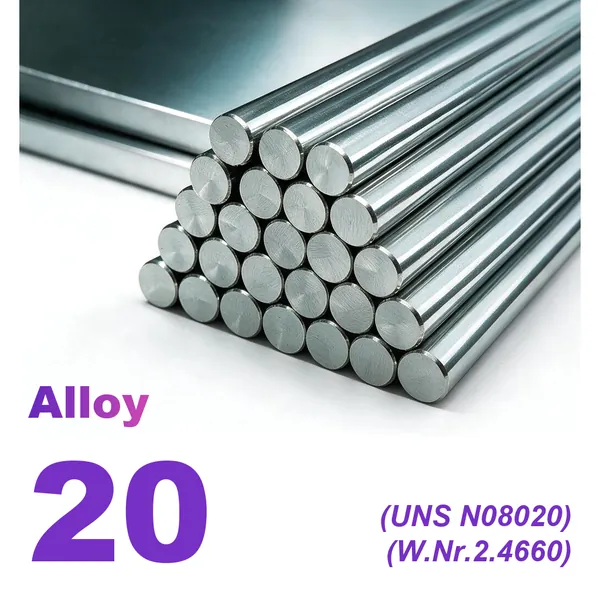
Alloy 20 carries the UNS N08020 designation and answers to W.Nr. 2.4660. Copper runs 3 to 4%, which is what puts sulphuric and phosphoric acid within reach, while niobium at eight times the carbon content ties up the carbon that would otherwise sensitise a weld. Nickel at 32 to 38% keeps chloride stress-corrosion cracking away, and molybdenum at 2 to 3% adds localised-attack margin. Southerly Alloy supplies UNS N08020 bar, tube, pipe, and flat product to ASTM B463, B473, B729, B464, and B468.
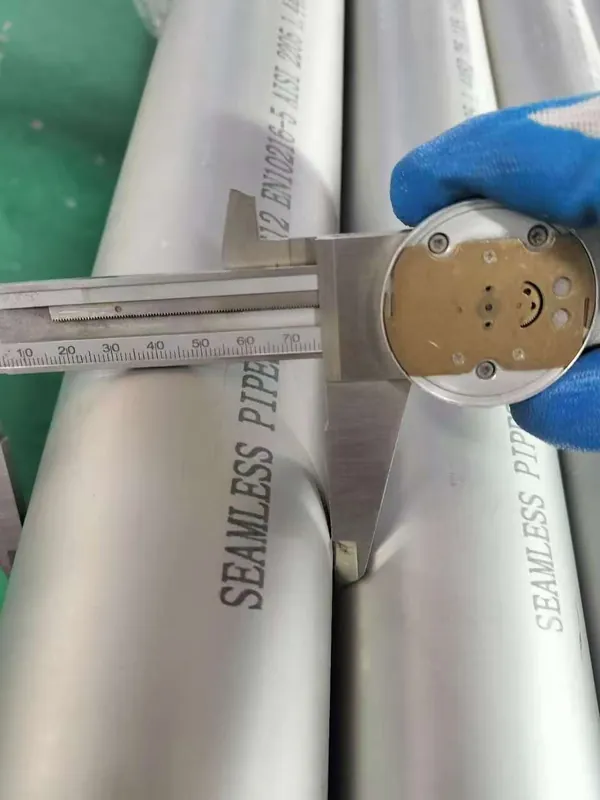
Copper at 3 to 4% gives the alloy its grip on sulphuric and phosphoric acid duty.
Nb+Ta at eight times the carbon content stops carbide precipitation at the grain boundary.
Specifically, nickel at 32 to 38% keeps the grade free of chloride stress-corrosion cracking.
Moreover, molybdenum at 2 to 3% lifts localised attack resistance clear of 316L.
Also, no ferrite phase forms, so the alloy avoids the sigma embrittlement that duplex grades risk.
Meanwhile, plate, sheet, and strip divide at the thickness and width lines the flat-product standard sets.
Therefore, the grade sits between 316L and the nickel-molybdenum family on price.
Niobium stabilisation removes the post-weld anneal that unstabilised grades need.
Start with the acid, because that decides whether this grade fits. Where sulphuric acid runs dilute and the chlorides stay low, copper and molybdenum do the work at a modest cost. Above those limits, a nickel-molybdenum grade earns its premium.
Indeed, copper at 3 to 4% holds up in dilute sulphuric and phosphoric acid far beyond 316L.
Consequently, welded shells hold their corrosion resistance without a full furnace cycle.
Moreover, nickel at 32 to 38% keeps chloride stress-corrosion cracking off the failure list.
In fact, the grade has served acid plant, pickling, and synthetic fuel service for decades.
Each form follows a separate ASTM document, so lead the enquiry with the shape you need. That document then settles the size range and the delivery condition.
Bar and rod to ASTM B473, from 6 to 300 mm diameter, stabilised annealed and quenched.
View Alloy 20 Bar and Rod →Seamless tube to ASTM B729, plus welded pipe to B464 and welded tube to B468.
View Alloy 20 Pipe and Tube →Flat product to ASTM B463, from plate at 4.76 mm through light sheet and strip.
View Alloy 20 Plate and Sheet →Chemical plant that handles acid is the natural home for this grade. In addition, chloride-bearing streams benefit from the high nickel content.
Discuss Your Application →Absorber, cooler, and pump hardware in dilute and moderate acid duty.
Reactor and transfer line parts exposed to wet-process acid.
Tanks, racks, and heating coils in steel and stainless pickling baths.
Piping and vessels in hydrofluoric and mixed-acid circuits.
Vessels that survive alternating acid and caustic cleaning.
Product-contact parts that need corrosion resistance and hygiene together.
Equipment qualified under NACE MR0175 and ISO 15156-3.
Terminal vessels and road tanker barrels for acid handling.
Detailed technical information including chemical composition, mechanical properties, standards and available dimensions.
The limits below come from ASTM B463, B473, and B729, which share one composition table for UNS N08020. Copper is the deliberate addition behind the acid performance, and the niobium range scales with the carbon content. The mill certificate governs final acceptance.
| Element | Content |
|---|---|
| Nickel (Ni) | 32.0–38.0% |
| Chromium (Cr) | 19.0–21.0% |
| Copper (Cu) | 3.0–4.0% |
| Molybdenum (Mo) | 2.0–3.0% |
| Niobium + Tantalum (Nb+Ta) | 8 × C min., 1.00% max. |
| Manganese (Mn) | 2.00% max. |
| Silicon (Si) | 1.00% max. |
| Carbon (C) | 0.07% max. |
| Phosphorus (P) | 0.045% max. |
| Sulfur (S) | 0.035% max. |
| Iron (Fe) | Balance |
The product documents set one stabilised annealed condition across every form, so the table below repeats one row set rather than splitting the grades. Two footnotes matter more than the table itself, and both are noted underneath.
| Product Form | Condition | Tensile Strength | Yield Strength, 0.2% Offset | Elongation | Hardness |
|---|---|---|---|---|---|
| Bar and rod, ASTM B473 | Stabilised annealed | ≥80 ksi (551 MPa) | ≥35 ksi (241 MPa) | 30% | 217 HB or 95 HRB max. |
| Plate, sheet, and strip, ASTM B463 | Stabilised annealed | ≥80 ksi (551 MPa) | ≥35 ksi (241 MPa) | 30% | 217 HB or 95 HRB max. |
| Seamless pipe and tube, ASTM B729 | Stabilised annealed | ≥80 ksi (550 MPa) | ≥35 ksi (240 MPa) | 30% | Not specified |
| Welded pipe, ASTM B464 | Stabilised annealed | ≥80 ksi (551 MPa) | ≥35 ksi (241 MPa) | 30% | Not specified |
| Welded tube, ASTM B468 | Stabilised annealed | ≥80 ksi (551 MPa) | ≥35 ksi (241 MPa) | 30% | Not specified |
| Forgings and forged flanges, ASTM B462 | Stabilised annealed | ≥80 ksi (551 MPa) | ≥35 ksi (241 MPa) | 30% | Not specified |
The seamless document prints 80 and 35 ksi against 550 and 240 MPa, where the other documents round those figures to 551 and 241 MPa. Still, we keep each standard exactly as printed rather than forcing one number set.
Two further notes travel with the grade. Flat product thinner than 0.015 in. (0.38 mm) takes a 20% elongation floor over a 1 in. gauge length. Bar and forgings each carry an extra 50% minimum reduction of area. The grade is not age hardenable, so cold work is the only route above the annealed floors.
The figures in this table are typical design values, and they are not acceptance limits. In addition, the alloy stays non-magnetic, and that suits instrument assemblies in acid circuits.
| Property | Value |
|---|---|
| Density | Approx. 8.08 g/cm³ |
| Melting range | Approx. 1385–1443 °C |
| Modulus of elasticity | Approx. 193 GPa |
| Shear modulus | Approx. 76 GPa |
| Thermal conductivity at 20 °C | Approx. 12.3 W/m·K |
| Electrical resistivity at 20 °C | Approx. 1.08 µΩ·m |
| Specific heat at 20 °C | Approx. 500 J/kg·K |
| Thermal expansion, 25–100 °C | Approx. 14.7 µm/m·K |
| Magnetic response | Essentially non-magnetic |
| Strengthening route | Cold work only |
Eight ASTM documents split the forms between them, and the ASME editions govern once a pressure code applies. In addition, no SAE aerospace specification reaches UNS N08020. The European and Chinese designations below serve cross-reference only.
| Standard | Product or Application |
|---|---|
| ASTM B463 / ASME SB463 | Plate, sheet, and strip |
| ASTM B473 / ASME SB473 | Bar, rod, and wire |
| ASTM B729 / ASME SB729 | Seamless pipe and tube |
| ASTM B464 / ASME SB464 | Welded pipe |
| ASTM B468 / ASME SB468 | Welded tube |
| ASTM B462 / ASME SB462 | Forgings and forged flanges |
| ASTM B366 / ASME SB366 | Factory-made wrought fittings |
| ASTM B472 | Forging billets and bars for reforging |
| ASTM B906 | Flat product thickness and width definitions |
| NACE MR0175 / ISO 15156-3 | Sour service qualification for oil and gas |
| UNS N08020 | Unified Numbering System designation |
| W.Nr. 2.4660 / NiCr20CuMo | European designation |
| GB/T 15007 NS1403 | Chinese designation |
| SAE AMS | No aerospace specification covers this grade |
20Cb-3 and Carpenter 20 are trademarks of Carpenter Technology, and Incoloy is a trademark of Special Metals Corporation. We quote those names for reference only, and our deliveries follow the ASTM and ASME documents listed above.
In fact, the standard text from ASTM International settles any acceptance question.
Because the standards set different scope limits, the ranges below follow each document rather than one house rule. For that reason, state the form and the ordered size on the enquiry.
| Product Form | Typical Supply Range |
|---|---|
| Bar and rod | 6–300 mm diameter to ASTM B473 |
| Forged bar and forging stock | Sections above the agreed bar range, supplied to ASTM B462 |
| Seamless tube | Outside diameter 6–219 mm to ASTM B729 |
| Welded pipe | NPS 1/8 to 6 in Schedule 5S, 10S, and 40S to ASTM B464 |
| Welded tube | Outside diameter 3.2–88.9 mm to ASTM B468 |
| Plate | 4.76–63.5 mm thick to ASTM B463 |
| Sheet | Under 4.76 mm thick, from 600 mm wide |
| Strip | Under 4.76 mm thick, under 600 mm wide |
Finish follows the operation that comes next rather than a catalogue default. In short, we agree the surface with your order.
| Surface Condition | Typical Use |
|---|---|
| Stabilised annealed and pickled | Standard delivery for acid and chloride service |
| Hot-worked | As-rolled or as-forged surface for parts that will be machined |
| Cold drawn | Close diameter control with a brighter surface |
| Peeled | Uniform diameter with a machined skin for further turning |
| Centerless ground | Tight diameter and straightness for shafting |
| Polished | Reduced roughness for product-contact and visible parts |
| Bright annealed | Scale-free surface for instrument and clean circuits |
Get detailed information including specifications, standards, dimensions and material properties.
B463 for plate, sheet, and strip, B473 for bar and rod, and B729 for seamless tube. Welded pipe and tube follow B464 and B468.
No. The SAE aerospace series does not reach UNS N08020.
Copper at 3 to 4% and nickel at 32 to 38% widen the acid range and remove the chloride cracking risk that limits 316L.
Niobium at eight times the carbon content ties carbon up as a stable carbide, so grain boundaries hold their chromium through welding.
Usually yes. The stabilised chemistry means most joints need no post-weld anneal before service.
ASME pressure-vessel rules allow up to 538 °C. In dilute sulphuric acid the practical ceiling sits far lower, near 93 °C.
One piece covers most stock sizes.
We quote mainly on FOB terms, and EXW or CIF follow on request.
Stock sizes ship in 7-15 days, and made-to-order material runs about 25 days.
Yes. Every heat ships with an EN 10204 3.1 certificate, and we arrange 3.2 endorsement on request.
Tell us the form, the ordered size, and the acid concentration. We answer with price, lead time, and the full document set in one reply. Since a thin gauge changes the elongation floor, include the ordered thickness.
A trial lot costs very little, so one bar or one plate settles the question before a plant-wide order.