
01
Monel 400 Round Bar
Solid sections from 6 to 500 mm serve shafts, stems, and machined fittings.
View Monel 400 Round Bar →Nickel-copper bar and rod for seawater pumps, fasteners, and chemical plant shafting in four delivery conditions.
Every heat record prints copper inside the 28.0–34.0% window, so your incoming check reads figures instead of a grade name.
Because F467 and F468 projects need hardness proof, we add per-heat hardness figures to the release file whenever you ask.
Moreover, we write hot-worked, annealed, stress-relieved, or cold-drawn delivery into the melt plan before production starts.
Monel 400 bar and rod serve pumps, shafts, and bolting where seawater and reducing chemicals beat stainless steel. Stock arrives in UNS N04400, a solid-solution nickel-copper alloy holding copper between 28.0 and 34.0 percent. Thus strength comes from the base metal and cold work.
Sections follow ASTM B164 and ASME SB164 across hot-worked, annealed, stress-relieved, and cold-drawn conditions. Hence the supply route matches your machining drawing instead of a fixed shelf list.
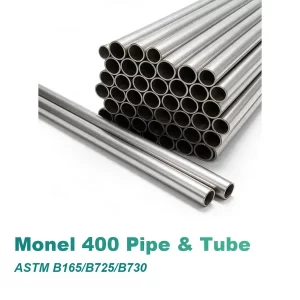
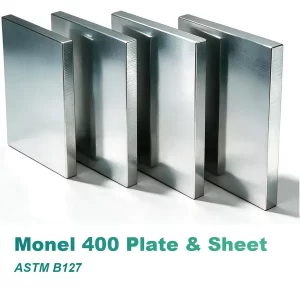
The Monel 400 grade file sits on the material hub, while tubular and flat-rolled needs land on Monel 400 Pipe and Tube and Monel 400 Plate and Sheet. Where aging raises the strength floor, we quote Monel K-500 bar as the companion grade.
Where the two nickel-copper grades need setting out side by side — solid-solution strength against aged strength — the Monel 400 and K-500 overview tabulates both.

Monel 400 bar and rod arrives in UNS N04400 stock cut to ASTM B164, covering hot-worked, annealed, stress-relieved, and cold-drawn delivery from one melt route. Copper held inside the 28.0 to 34.0 percent window keeps seawater, hydrofluoric acid, and alkaline streams off the steel list. Round, hex, square, flat, and forged sections ship with EN 10204 3.1 heat records, so marine yards and chemical plants can trace every bar.

Impellers, shafts, and fasteners keep clean surfaces in moving seawater, where 300-series stainless pits within a few seasons.
However, crevices and silt traps under static conditions attack this alloy too, so design drain-and-flush paths or move to a chromium grade.
Besides, HF handling across all concentrations stays on this alloy, a niche few stainless or high-nickel grades share.
In turn, strong caustic and acid-salt streams suit this bar, so evaporator and brine hardware holds tolerance longer.
Cold drawing lifts yield from the 25 ksi annealed floor toward 85 ksi in light sections, without any heat treatment.
Impact strength stays flat through sub-zero and cryogenic plant, so deep-service bolting keeps its margin.
Standard carbide practice machines annealed stock, and ERNiCu-7 filler joins sections with no post-weld anneal.
Finally, EN 10204 3.1 documents tie chemistry and tensile results to the heat number on every delivery.
Bar buying turns on condition control and document quality. Because we schedule each heat into the route that matches your ordered condition, promises about size and finish stay realistic. One desk follows the order from quote to loading.
We review diameter, condition, tolerance, and finish against the B164 tables before we book a heat, so quotes reflect real capability.
We fix stress-relieved and cold-drawn stock to the ordered temper, since strength data only compares within one condition.
Moreover, single trial bars and container loads run through the same qualified nickel-copper route.
Finally, each quotation lists size, condition, documents, and lead time, not a bare price.
Refined nickel and cathode copper set the UNS N04400 balance at the melt. Then mechanical work and the ordered heat treatment build the final condition. Because we record each stage, the certificate retraces the whole route.
We weigh refined nickel and cathode copper to the 28.0–34.0% copper window, with impurity caps drawn from ASTM B164.
Induction or electric-arc practice melts the charge under controls that limit gas pickup and oxide content.
Meanwhile, solidification controls limit segregation, so each ingot machines evenly after cropping.
The mill then reduces ingots to billets and bar, refining the cast structure with every pass.
Annealing or stress relief sets the ordered condition, fixing strength, ductility, and machinability together.
Afterwards, drawing, peeling, or centreless grinding brings cold-drawn stock to final diameter and tolerance.
Pickling, polishing, or rough turning delivers the finish your drawing calls out.
Finally, we check chemistry, tensile, dimensions, and surface against the purchase specification before dispatch.
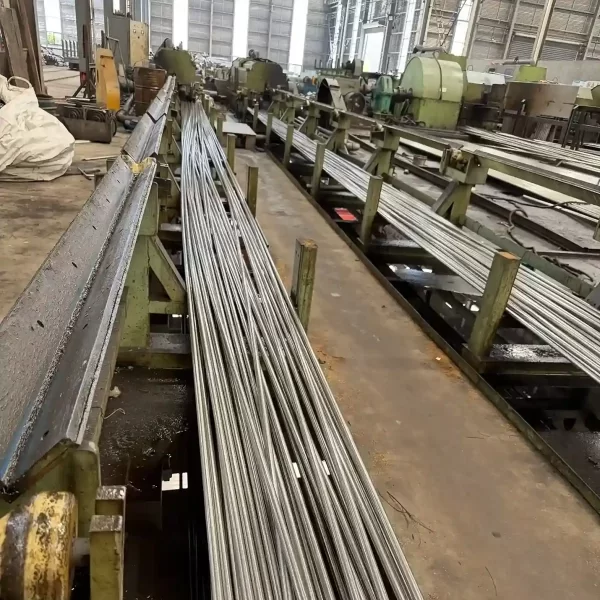
We produce standard and custom diameters, and we fix condition, finish, and cut length before melting. Therefore the figures below describe the capacity standing behind that promise. Mixed-condition orders run as one campaign.
Melting, forging, drawing, and inspection shops sit on one site.
Hot-working, cold-finishing, and final-inspection equipment covers the bar route.
The works turns out nickel-copper and nickel alloy bar across stock and custom sizes.
Metallurgists set condition, tolerance, and document scope at quotation.
Hot-worked, annealed, stress-relieved, and cold-drawn stock leaves one route.
No bar leaves the works before we demonstrate the ordered B164 requirements on its heat. Because composition, tensile, and dimensions all trace to the heat number, incoming verification stays simple.
The lab confirms melt chemistry against the B164 window before any bar enters finishing.
We measure diameter, straightness, and length to the tolerance class your condition requires.
Tensile runs on the delivered condition, and we add UT or PMI where your order specifies.
Finally, certificates keyed to heat numbers join every shipment for your records.
Round bar and rod carry most enquiries, while square, hex, flat and forged sections cover fabrication and machining routes. In addition, the twelve forms below each have their own page with condition and tolerance detail.
Solid sections from 6 to 500 mm serve shafts, stems, and machined fittings.
View Monel 400 Round Bar →We draw lighter diameters to controlled straightness for precision turning.
View Monel 400 Round Rod →Square sections feed frames, clamps, and blocks for marine and chemical plant.
View Monel 400 Square Bar →Moreover, across-flats sizing feeds nuts, bolting, and multi-flat machining.
View Monel 400 Hex Bar →We cut rectangular sections to your width, thickness, and length.
View Monel 400 Flat Bar →Larger diameters and custom sections arrive with a controlled wrought structure.
View Monel 400 Forged Bar →Besides, cold-drawn bright stock suits automatic lathes and appearance-critical parts.
View Monel 400 Bright Bar →As-drawn strength arrives with stress relief where straightness matters.
View Monel 400 Cold-Drawn Bar →Ground diameter and straightness support shafting and spindle work.
View Monel 400 Centreless-Ground Rod →Moreover, we supply studs and full-thread rod that F468 and F467 projects accept.
View Monel 400 Threaded Rod →In addition, coil and spool wire runs from annealed to spring temper for mesh and heading.
View Monel 400 Wire →Furthermore, ERNiCu-7 rod and spool, plus ENiCu-7 electrodes, join this alloy family.
View Monel 400 Welding Wire →Marine, chemical, and hydrocarbon projects place most Alloy 400 bar work. Meanwhile, fastener shops and machine houses buy rod for seawater and sour-service production runs.
Discuss Your Application →Above all, propeller, pump, and rudder shafts hold finish in flowing seawater.
Shops cut studs, bolts, and nuts from bar for splash-zone and immersion duty.
Stems, sleeves, and impellers run in reducing and alkaline media.
Qualified process designs specify this bar for hydrofluoric acid handling.
Wellhead and valve parts in H2S duty ship with agreed hardness limits.
Machinists turn bars into tubesheet, baffle, and fixture parts for steam plant.
Impellers, sleeves, and trim feed machining cells that buy rod in bulk.
Also, evaporator supports and fasteners resist salt concentration systems.
Detailed technical information including chemical composition, mechanical properties, standards and available dimensions.
The limits below restate ASTM B164 for UNS N04400 bar and rod, with nickel as the melt balance. We can melt tighter impurity caps when your specification asks. However, the mill test certificate governs acceptance.
| Element | Content |
|---|---|
| Nickel (Ni) plus Cobalt (Co) | 63.0% min. |
| Copper (Cu) | 28.0–34.0% |
| Iron (Fe) | 2.5% max. |
| Manganese (Mn) | 2.0% max. |
| Carbon (C) | 0.30% max. |
| Silicon (Si) | 0.50% max. |
| Sulfur (S) | 0.024% max. |
We read the minimums below from the ASTM B164 tables, and they move with condition and section size. Stress-relieved figures cover 12.7–88.9 mm rounds, while as-worked values apply under 12.7 mm. Therefore confirm the ordered condition before you compare quotes.
| Condition / Section | Tensile Strength, min. | Yield Strength (0.2%), min. | Elongation, min. |
|---|---|---|---|
| Hot-worked, rounds to 305 mm (12 in.) | ≥80 ksi (552 MPa) | ≥40 ksi (276 MPa) | 30% |
| Hot-worked, annealed, all sizes | ≥70 ksi (480 MPa) | ≥25 ksi (170 MPa) | 35% |
| Cold-worked, stress-relieved, rounds 12.7–88.9 mm (1/2–3-1/2 in.) | ≥87 ksi (600 MPa) | ≥60 ksi (415 MPa) | 20% |
| Cold-worked, as-worked, rounds under 12.7 mm (1/2 in.) | ≥110 ksi (760 MPa) | ≥85 ksi (585 MPa) | 8% |
Hardness plays no part in B164 acceptance, so the tensile minimums and the ordered edition decide the release.
Typical room-temperature figures below support design work rather than acceptance. Monel 400 stays slightly ferromagnetic near room temperature, and its Curie range sits just above ambient.
| Property | Value |
|---|---|
| Density | Approx. 8.80 g/cm³ |
| Melting range | Approx. 1300–1350 °C |
| Modulus of elasticity | Approx. 179 GPa |
| Thermal conductivity at 20 °C | Approx. 21.8 W/m·K |
| Specific heat at 20 °C | Approx. 427 J/kg·K |
| Electrical resistivity at 20 °C | Approx. 0.51 µΩ·m |
| Thermal expansion, 20–100 °C | Approx. 13.9 µm/m·K |
| Curie temperature | Approx. 21–49 °C |
| Magnetic behaviour | Slightly ferromagnetic at ambient temperature |
ASTM B164 governs bar and rod, and ASME SB164 takes over inside pressure equipment. The designations below serve as cross-reference identifiers rather than separate approvals. Also state the standard together with condition and section in your inquiry.
| Standard / Designation | Scope |
|---|---|
| ASTM B164 | Nickel-copper alloy rod, bar and wire — UNS N04400 |
| ASME SB164 | ASME edition for rod, bar and wire |
| SAE AMS 4675 | Nickel-copper alloy bars, forgings and rings |
| UNS N04400 | Material designation for Monel 400 |
| W.Nr. 2.4360 / NiCu30Fe | European designation for Monel 400 |
| JIS NW 4400 | Japanese designation |
| BS 3076 NA13 | British nickel-copper bar standard |
| DIN 17743 / DIN 17752 | Nickel-copper wrought alloys — chemistry and bar |
The ranges below describe normally produced sections, and exact availability follows condition, finish, and quantity. Tolerances follow ASTM B164 for the ordered condition. Give diameter, section, length, and finish in the inquiry.
| Product Form | Typical Supply | Length |
|---|---|---|
| Round Bar | 6–500 mm dia. | Cut to length or random |
| Round Rod | 3–50 mm dia. | Cut to length |
| Bright Bar | 6–150 mm dia. | Cut to length or random |
| Square Bar | 10–150 mm | Cut to length or random |
| Hex Bar | 10–150 mm A/F | Cut to length or random |
| Flat Bar | 3–100 mm thick × 10–300 mm wide | Cut to length |
| Forged Bar | 100–500 mm dia. or forged section | Cut to length |
| Precision-Ground Rod | 3–100 mm dia., tight tolerance | Cut to length |
Sizes outside these ranges go through a production-route review before we issue a quotation.
We choose finish for the next operation, whether machining allowance, fabrication, or a finished appearance. Availability follows diameter, condition, and order quantity. Also, we agree each finish with the order rather than assume it from stock.
| Surface Condition | Typical Use |
|---|---|
| Hot-worked (as-rolled or forged) | Parts that will be machined to size |
| Annealed and pickled | Scale-free surface for fabrication |
| Cold drawn | Close diameter control with a bright surface |
| Stress relieved | Straightness and dimensional stability for drawn bar |
| Peeled | Uniform diameter with machined skin for further turning |
| Centreless ground | Tight diameter and straightness for shafting |
| Polished | Reduced roughness for product-contact and visible parts |
| Rough turned | Controlled machining allowance on large or forged bar |
Get detailed information including specifications, standards, dimensions and material properties.
A single coordinator follows your bar order from first message to loading. Also, we agree specification changes in writing before any metal is cut.
State grade, B164 condition, diameter, length, quantity, and finish.
We match the ordered condition and tolerance to the production route.
Price, lead time, and documents arrive in one reply.
We record grade, dimensions, inspection level, and terms before cutting.
The mill then works, heat-treats, and tests the heat to the specified condition.
Certificates and export papers travel with the bar, and we confirm terms with you.
Feedback from buyers and engineers who source nickel alloy materials from Southerly Alloy.
“Propeller shaft blanks arrived pickled and straight, and the heat records matched our class-society review without a follow-up query.”
“Stress-relieved bar held straightness through our machining cycle, so the pump rebuild kept its original delivery window.”
“The quotation listed condition, documents, and lead time on one page, which made internal approval straightforward.”
Our production and inspection processes are certified to international standards, and every delivery ships with EN 10204 3.1 mill test certificates.
Quality Management System
Pressure Equipment Directive
Material Standards Compliance
Mill Test Certificates
ASTM B164 governs the bar, and ASME SB164 applies inside pressure equipment.
We accept a single bar for stock diameters, and larger orders follow the quotation.
FOB is standard, and we quote EXW or CIF on request.
By finished weight, and we fix the copper content at the quotation-day rate.
Stock diameters ship in 7–15 days, and custom sizes take about 25 days.
Yes. Every heat carries 3.1, and we arrange 3.2 witness on request.
Yes. Bar for ASTM F467 and F468 bolting ships with hardness records where the project calls for them.
Yes. We book PMI, hardness testing, and third-party witness with the order.
Yes. Drawing, peeling, and grinding reach diameters beyond the stock list.
Commercial invoice, packing list, B/L, and the mill certificate travel together, and we add origin papers on request.
Send grade, B164 condition, diameter, quantity, and finish, and one reply returns price, lead time, and the document list. We fix specifications before production, so the bar you approve is the bar that loads.
We accept stock diameters and made-to-order sections alike, and single-bar trials run on many common sizes.