
01
Round Bar
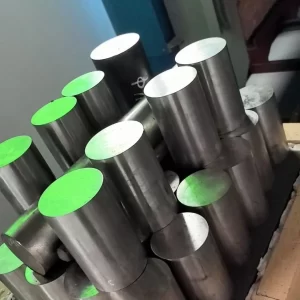
Hot-worked or annealed rounds for machined furnace parts, supports, and general high-temperature work.
View Round Bar →Iron-nickel-chromium bar, rod, and forged sections to ASTM B408, in hot-worked, cold-drawn, or solution-annealed condition.
We anneal 800H and 800HT bar to ASTM 5 or coarser, and report the E112 rating on the certificate for every lot.
Hot-worked, cold-drawn, peeled, and centreless-ground surfaces are all quoted against the same bar size, so you pick the finish your machining needs.
Bar and forging stock ship against one heat analysis, which keeps the wrought structure continuous from billet to finished part.
Incoloy 800 / 800H / 800HT bar and rod covers three designations on one iron-nickel-chromium base, ordered to ASTM B408. Grade 800 handles general high-temperature work, and the controlled-carbon grades take over where creep governs.
Machined furnace parts, reformer supports, and heat-treatment fixtures absorb most of this bar, and forged sections follow the same route. Southerly Alloy works as a professional supplier and exporter across all three grades, and the Incoloy 800 / 800H / 800HT material page carries the grade data behind the bar selection. Above all, the duty temperature decides which designation and which anneal the order needs.

Incoloy 800 / 800H / 800HT bar and rod covers three designations on one iron-nickel-chromium base, ordered to ASTM B408 in hot-worked, cold-drawn, or solution-annealed condition. Grade 800 handles general high-temperature work and ships as-worked or annealed, while 800H and 800HT arrive grain-controlled for creep duty above 593 °C. Round bar, rod, hex, square, flat, and forged sections all run on the same qualified route. Southerly Alloy works as a professional supplier and exporter across the series, and every bundle ships with EN 10204 3.1 documentation.

Carbon, Al+Ti, and grain size all sit inside the 800H and 800HT windows. Above all, that is what makes long-time creep life predictable.
The same diameter can be quoted hot-worked, cold-drawn, or solution annealed, and we confirm which one your machining route needs.
An ASTM E112 result accompanies every controlled-carbon heat, so the coarse-grain requirement arrives as a number rather than a promise.
Bar machines with standard carbide practice, and it work-hardens less aggressively than the austenitic stainless grades.
Forged sections come from bar stock of the ordered heat, so chemistry and grain control carry through the forging.
A chromium oxide scale resists scaling in air and combustion gas across the furnace range.
The nickel-rich matrix slows carbon pickup in carburizing atmospheres and resists sulfur attack in furnace gas.
Condition and finish decide as much of a bar order as the grade, so we confirm all three before quoting. Moreover, a single coordinator stays with the enquiry through to packing. As a result, the delivery date we state is one we can hold.
The quote names the grade, the anneal, and the standard behind the bar, so nothing shifts between offer and shipment.
800H and 800HT bar waits for the E112 rating, and we reject a fine grain rather than ship it with a note.
One trial bar and a full container run through the same qualified route, so a sample shows what production will deliver.
Bright and ground bar travels in sleeved bundles, so the surface arrives as it left the works.
Bar making adds remelting, working, and a finishing pass that flat and tubular routes never touch. Therefore, the sequence below runs from charge selection to a marked and packed bundle. Moreover, the route records every result against the heat.
We weigh nickel, chromium, and iron into the ordered UNS window, with carbon set at the level your grade calls for.
The melt runs through AOD or VOD refining, which holds chemistry and gas content inside the ordered limits.
ESR or VAR refines the electrode and reduces segregation across a heavy section.
Forging and rolling reduce the cast structure toward the ordered section size.
800H takes 1121 °C minimum and 800HT takes 1149 °C minimum, which grows the grain to the coarse structure the duty needs.
The finishing line draws, peels, or centreless-grinds the bar to its final diameter and surface.
Chemistry, tensile, dimensional, and surface checks run against the ordered specification before the bundle leaves.
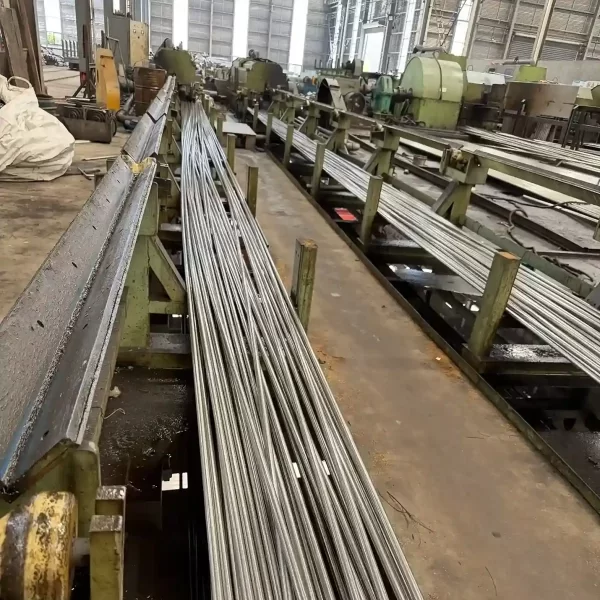
Bar output follows the melting schedule and the annealing campaign, because those two steps set the delivery date. Therefore, the capacity figures below stand behind every promise we make. In addition, we group grades into one campaign whenever the anneal temperatures allow it.
Melting, forging, annealing, and finishing halls share one site.
Forging presses, draw benches, and finishing units run the bar line daily.
Nickel-iron-chromium bar and rod output across the three grades.
Metallurgists who set grade, condition, and grain size with you.
Hot-worked, cold-drawn, and solution-annealed finishes on one diameter.
Round, rod, bright, cold-drawn, hex, square, flat, forged, and ground stock.
We hold a bundle until the ordered tests prove out on the heat behind it. Moreover, diameter and straightness readings stay with the piece record. Consequently, an out-of-tolerance bar cannot hide inside a shipment.
Spectrometer analysis confirms carbon, the Al+Ti total, and each residual against the ordered limits.
Tensile and hardness values reflect the bar you will receive, not a reference sample from the cast.
Diameter, straightness, and cut length meet the tolerance class that the ordered condition carries.
We file E112 ratings, mechanical results, and PMI where ordered against the heat number.
Round bar and rod carry most of the enquiries, and each form below now has a dedicated page of its own. Meanwhile, every form is still quoted with its own condition and tolerance route.
Hot-worked or annealed rounds for machined furnace parts, supports, and general high-temperature work.
View Round Bar →Smaller-diameter stock with controlled straightness for fasteners and turned components.
View Round Rod →Multi-flat sections sized across flats for nut blanks and furnace bolting. In addition, drawn and annealed routes share one size list.
View Hex Bar →Square sections for fixture posts, guide rails, and machined blocks that see furnace heat.
View Square Bar →Rectangular sections cut to your width and thickness for fabricated assemblies.
View Flat Bar →Heavy sections forged to B564 with a controlled wrought structure for large components.
View Forged Bar →A cold-drawn skin for automatic lathes and for parts where appearance matters.
View Bright Bar →Diameter held tight, with the extra strength that the drawing pass produces.
View Cold-Drawn Bar →Ground stock held to a tight diameter and straightness band for precision shafting. Moreover, ground hexagon sizes are quoted on the same page.
View Centreless-Ground Rod →Fully threaded bar and studs for reformer flanges, furnace doors, and hot ducting.
View Threaded Rod →Fine and spring-temper wire for furnace mesh, baskets, and hot fixture springs. Besides, woven and straightened forms are listed with the tempers.
View Wire →ERNiCr-3 bare wire and ENiCrFe-3 electrodes that keep the hot strength of the parent metal.
View Welding Wire →Furnace and reformer work absorbs most of this bar, because the part often carries load at a temperature where stainless steels sag. Furthermore, the same grades serve fastener and support duty in power and petrochemical plants.
Discuss Your Application →Rolls, hangers, and manifolds machined from bar for steam-methane reforming units.
Baskets, trays, and retorts that cycle through carburizing and annealing furnaces.
Support and fixture parts inside transfer-line exchangers and cracking furnaces.
Supports, fittings, and valve trim in reforming and hydrogen service.
Tube sheet and baffle fittings inside high-temperature process exchangers.
Supports for superheater and reheater tube banks in steam service.
Studs, bolts, and nuts for flanged joints in hot process and steam lines.
Detailed technical information including chemical composition, mechanical properties, standards and available dimensions.
The limits below come from the B408 table for heat analysis, and iron forms the balance of the melt. Three fields separate the designations: the carbon window, the Al+Ti total, and the annealed grain size. In addition, the mill certificate governs acceptance.
| Element | Alloy 800 (UNS N08800) | Alloy 800H (UNS N08810) | Alloy 800HT (UNS N08811) |
|---|---|---|---|
| Nickel (Ni) | 30.0–35.0% | 30.0–35.0% | 30.0–35.0% |
| Chromium (Cr) | 19.0–23.0% | 19.0–23.0% | 19.0–23.0% |
| Iron (Fe) | 39.5% min. | 39.5% min. | 39.5% min. |
| Carbon (C) | 0.10% max. | 0.05–0.10% | 0.06–0.10% |
| Aluminium (Al) | 0.15–0.60% | 0.15–0.60% | 0.25–0.60% |
| Titanium (Ti) | 0.15–0.60% | 0.15–0.60% | 0.25–0.60% |
| Aluminium + Titanium | 0.30–1.20% | 0.30–1.20% | 0.85–1.20% |
| Copper (Cu) | 0.75% max. | 0.75% max. | 0.75% max. |
| Manganese (Mn) | 1.50% max. | 1.50% max. | 1.50% max. |
| Silicon (Si) | 1.00% max. | 1.00% max. | 1.00% max. |
| Sulfur (S) | 0.015% max. | 0.015% max. | 0.015% max. |
| Annealed Grain Size | Not specified | ASTM 5 or coarser | ASTM 5 or coarser |
The B408 minimums change with grade and condition, and the ordered condition decides which row applies. Grade 800 ships hot-worked as-worked or annealed, while 800H and 800HT always arrive solution annealed. Consequently, the same UNS number can carry two different yield values.
| Grade and Condition | Tensile Strength, min. | Yield Strength (0.2%), min. | Elongation, min. |
|---|---|---|---|
| N08800 — hot-worked, as-hot-worked | 80 ksi (550 MPa) | 35 ksi (240 MPa) | 25% |
| N08800 — cold-worked and hot-worked, annealed | 75 ksi (515 MPa) | 30 ksi (205 MPa) | 30% |
| N08810 / N08811 — cold-worked and hot-worked, annealed | 65 ksi (450 MPa) | 25 ksi (170 MPa) | 30% |
Two footnotes belong with this table. First, bar ordered to forging quality carries chemistry and surface requirements only, and tensile values stay open. Second, rectangular bar supplied hot-worked at 7.94 mm (5/16 in.) or less takes a 20% elongation minimum.
The three grades share one physical base, since carbon does not move these values. Therefore, use the figures below for design work rather than for acceptance testing.
| Property | Value |
|---|---|
| Density | Approx. 7.94 g/cm³ |
| Melting range | Approx. 1357–1385 °C |
| Specific heat, 0–100 °C | Approx. 460 J/kg·°C |
| Modulus of elasticity at 20 °C | Approx. 196.5 GPa |
| Thermal conductivity at 20 °C | Approx. 11.5 W/m·K |
| Thermal expansion, 20–100 °C | Approx. 14.4 µm/m·°C |
| Electrical resistivity at 20 °C | Approx. 0.989 µΩ·m |
| Curie temperature | Approx. −115 °C |
| Magnetic behaviour | Non-magnetic at ambient temperature |
| Hardness, annealed | Approx. 138 HB |
ASTM B408 governs bar and rod for all three designations, and ASME SB408 carries the same text into pressure equipment. In addition, the AMS documents reach only the grade 800 chemistry. Look to ASTM International for the current text of any specification named here.
| Standard / Designation | Scope |
|---|---|
| ASTM B408 / ASME SB408 | Nickel-iron-chromium alloy rod and bar — UNS N08800, N08810, N08811 |
| SAE AMS 5766 | Alloy 800 bars, forgings, and forging stock, solution heat treated — UNS N08800 in sections 4.0 in. (102 mm) and under |
| SAE AMS 5871 | Alloy 800 sheet, strip, and plate — flat product only, so it does not reach bar |
| ASTM B409 / ASME SB409 | Plate, sheet, and strip, for the same vessel package |
| ASTM B407 / ASME SB407 | Seamless pipe and tube, and forging stock for tubular work |
| ASTM B564 / B366 | Forgings, and wrought pipe fittings |
| ASME Code Case 1325 / 1983 | Elevated-temperature design allowables for 800H, Sections I and VIII |
| ASME Code Case 1987 | Maximum allowable stresses for 800HT |
| UNS N08800 / N08810 / N08811 | Material designations for Alloy 800, 800H and 800HT |
| W.Nr. 1.4876 / 1.4958 / 1.4959 | European designations, EN X10NiCrAlTi32-20 / X5NiCrAlTi31-20 / X8NiCrAlTi32-21 |
| DIN 17752 / DIN 17753 | German designations for bar, and for wire |
| BS 3076 (NA 15 series) | British designation for bar and rod of the 800 series |
| JIS NCF 800 / NCF 800H / NCF 800HT | Japanese designations for the series |
| ISO FeNi32Cr21AlTi (NW8800 / NW8810 / NW8811) | ISO designations, the HC and HT suffixes marking the controlled-carbon grades |
| ISO 9723 / ISO 9725 | Bar, and forging stock in nickel and nickel alloys |
| EN 10095 | European heat-resisting materials standard by product form |
Choice inside the series follows the duty temperature and the design code, and one B408 chemistry base carries all three designations. Specifically, only carbon, the combined Al+Ti figure, and grain size move between them.
| Selection Factor | Alloy 800 | Alloy 800H | Alloy 800HT |
|---|---|---|---|
| UNS | N08800 | N08810 | N08811 |
| Carbon window | 0.10% max. | 0.05–0.10% | 0.06–0.10% |
| Al + Ti combined | 0.30–1.20% | 0.30–1.20% | 0.85–1.20% |
| Annealed grain size | Not specified | ASTM 5 or coarser | ASTM 5 or coarser |
| Minimum solution anneal | Not specified | 1121 °C (2050 °F) | 1149 °C (2100 °F) |
| Typical bar duty | General service to about 593 °C | Creep-controlled service above 593 °C | Highest creep-rupture duty above 593 °C |
| Condition as supplied | Hot-worked as-worked or annealed | Solution annealed, grain controlled | Solution annealed, grain controlled |
| Design code reference | ASTM B408 scope | ASME Code Cases 1325 and 1983 | ASME Code Case 1987 |
The sections below reflect what the bar route normally produces, and the grade and condition decide availability. Meanwhile, sizes outside the list go to the forging or grinding route before quotation.
| Product Form | Typical Supply | Length |
|---|---|---|
| Round bar | 6–500 mm dia. | Cut to length or random |
| Round rod | 3–50 mm dia. | Cut to length |
| Bright bar | 6–150 mm dia. | Cut to length or random |
| Cold-drawn bar | 3–100 mm dia., tight tolerance | Cut to length |
| Hex bar | 10–150 mm across flats | Cut to length or random |
| Square bar | 10–150 mm | Cut to length or random |
| Flat bar | 3–100 mm thick × 10–300 mm wide | Cut to length |
| Forged bar and blanks | 100–500 mm dia. or forged section | Cut to length |
| Centreless-ground rod | 3–100 mm dia., tight tolerance | Cut to length |
Finish follows the next machining operation. In addition, 800H and 800HT bar leaves the works solution annealed before finishing starts. Meanwhile, the diameter and the order quantity decide which routes are open.
| Surface Condition | Typical Use |
|---|---|
| Solution annealed | Standard delivery for 800H and 800HT bar, setting the coarse-grain structure |
| Hot-worked, as-rolled | As-worked stock for parts that will be machined to final size |
| Cold drawn | Close diameter control with a brighter surface for automatic lathes |
| Peeled | A machined skin with uniform diameter ahead of further turning |
| Centreless ground | Tight diameter and straightness for precision pins and shafting |
| Polished | Reduced roughness for visible or product-contact parts |
| Rough turned | Machining allowance held on large and forged bar |
Get detailed information including specifications, standards, dimensions and material properties.
Grade, condition, and finish all decide the route, so we settle all three before cutting any bar. Therefore, the quotation carries a confirmed delivery date and a named document set.
Share the grade, UNS number, diameter, section, length, quantity, and duty temperature.
We line the duty temperature up against ASTM B408 scope and the ASME code cases before naming the designation.
Hot-worked, cold-drawn, or solution annealed, and which surface route, become part of the offer.
Price, lead time, and the document list come back in one message, with the packing method named.
Charge selection, refining, hot working, and the grade-specific anneal run in sequence, with grain size checked before release.
Mechanical, dimensional, and surface checks close out against the ordered specification before the bundle leaves.
Marked bundles leave in export packing, with the paperwork travelling alongside.
Our production and inspection processes are certified to international standards, and every delivery ships with EN 10204 3.1 mill test certificates.
Quality Management System
Pressure Equipment Directive
Material Standards Compliance
Mill Test Certificates
ASTM B408 / ASME SB408 for all three designations. In addition, AMS 5766 adds an aerospace route for grade 800 bar and forgings only.
ASTM B408 sets 800HT at 1149 °C minimum against 1121 °C for 800H. The hotter anneal grows the grain further, which is what the Al+Ti window of 800HT is built around.
No. Only UNS N08810 and N08811 carry the coarse-grain clause, so grade 800 bar has no annealed grain size limit.
Chemistry and surface condition only. Therefore, state the properties you need where the part will carry load.
Hot-worked bar machines well on heavy sections. In addition, cold-drawn or ground bar holds tighter diameter when the part comes off an automatic lathe.
Yes. Moreover, drawing, peeling, and grinding cover sizes outside the stock range.
One bar for most stock diameters, and one trial section on made-to-order sizes.
FOB is our standard basis, and we add EXW or CIF terms when your order calls for them.
Stock diameters move in 7-15 days, and grain-controlled 800H or 800HT bar takes about 25 days.
Both. Every heat ships with a 3.1 certificate, and a 3.2 countersignature comes through a third party on request.
Send the grade, UNS number, diameter, quantity, and duty temperature, and we will answer with price, lead time, and documents. In addition, name the condition and finish you want, since those two choices decide the delivery date.
Incoloy 800, 800H and 800HT bar and rod is stocked in common diameters or produced to your drawing, and single-bar trials suit many sizes.