01
Plate
Hot rolled and annealed to ASTM B463, from 4.76 to 63.5 mm thick.
Request Availability →Stabilised nickel-iron-chromium flat product with copper, for acid vessel shells, tank linings, and ductwork.
The offer states whether the order is plate, sheet, or strip against the thickness and width lines.
Therefore, every plate carries a furnace record and a quench log tied to its heat.
Consequently, niobium stabilisation lets a fabricated vessel go to service as welded.
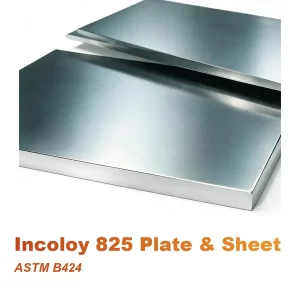
Alloy 20 flat product reaches the fabricator as stabilised austenitic plate, sheet, or strip. Copper at 3 to 4% carries dilute sulphuric and phosphoric acid duty. Nickel at 32 to 38% then removes chloride stress-corrosion cracking from the design review.
Flat product sits beside the bar and the tube in one family, and each route names its own document. Plate, sheet, and strip divide at a thickness line and a width line, so the order has to name the right one. As a result, one heat can supply a vessel shell and the nozzle bar that goes with it.
However, the trade also knows the grade as 20Cb-3, and that name belongs to Carpenter Technology.
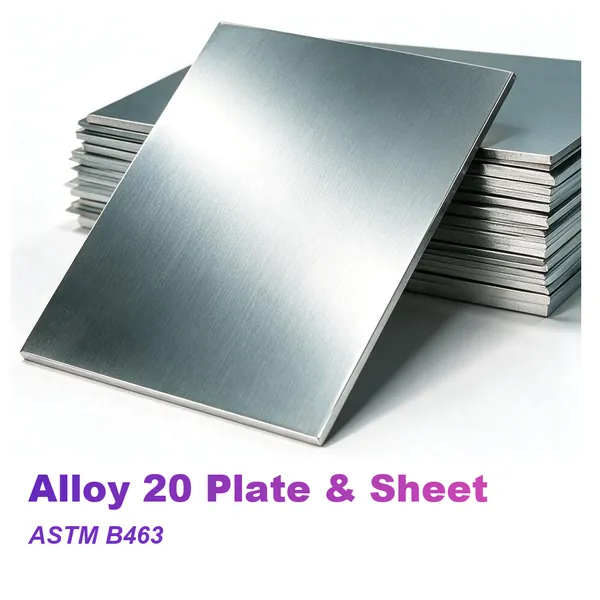
Alloy 20 plate and sheet carries the UNS N08020 grade, an austenitic nickel-iron-chromium alloy stabilised with niobium and alloyed with copper. Copper at 3 to 4% keeps dilute sulphuric and phosphoric acid inside the working envelope, and nickel at 32 to 38% removes chloride stress-corrosion cracking from the design review. Niobium at eight times the carbon content means a welded vessel shell holds its corrosion resistance without a furnace cycle. Southerly Alloy supplies and exports UNS N08020 plate, sheet, and strip to ASTM B463.
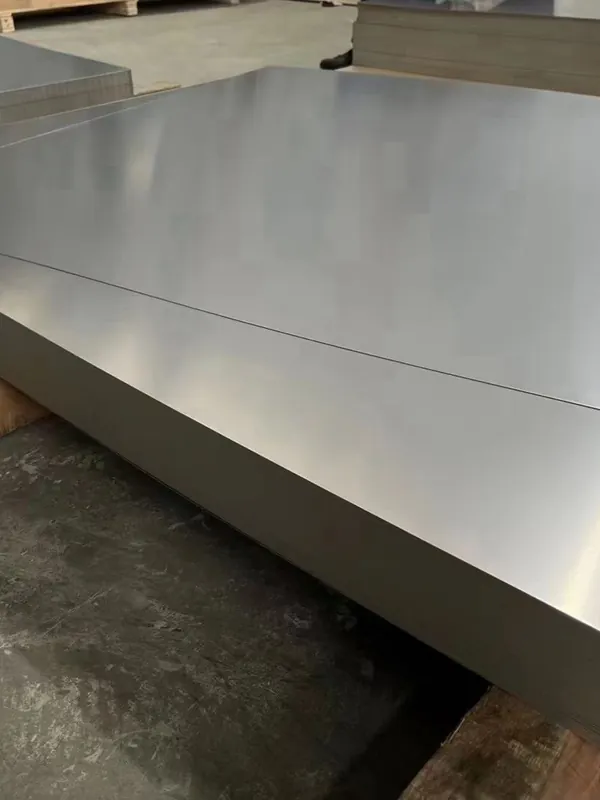
Indeed, copper at 3 to 4% keeps sulphuric and phosphoric acid inside the working envelope.
Nb+Ta at eight times the carbon content holds grain boundaries clean through welding.
Nickel at 32 to 38% removes chloride stress-corrosion cracking from the design review.
Moreover, a stabilised chemistry means a rolled shell needs no post-weld anneal.
Therefore, one document covers plate, sheet, and strip across the thickness range.
Sheet under the thin limit takes the lower elongation floor the standard prints.
Each lot ships with the furnace chart and quench record for its heat.
In addition, the grade appears in NACE MR0175 and ISO 15156-3 for oilfield duty.
Start with the thickness and the acid together. Vessel shells in dilute acid take Alloy 20 plate at a fraction of nickel-molybdenum cost. Where the chloride load climbs, a higher-molybdenum alloy earns its price.
Copper at 3 to 4% covers dilute sulphuric and phosphoric duty that defeats 316L.
Consequently, a rolled and welded shell goes to service without a second anneal.
Nickel at 32 to 38% keeps stress-corrosion cracking off the design review.
In addition, we supply rolled shells, dished heads, and drilled tube sheets to the drawing.
Flat product follows a route of its own once the slab leaves the mill. The anneal and the quench decide the corrosion result, so both steps stay on chart.
We cut a slab from an approved heat to suit the rolling plan for the ordered plate.
A walking-beam furnace brings the slab up to rolling temperature.
Also, the rolls reduce the slab to plate thickness, and the finishing pass stays above the minimum temperature.
The charge holds at 982 to 1010 °C until every plate reaches temperature.
Consequently, the plate enters the quench straight from the furnace to hold carbon in solution.
An acid bath strips the oxide scale and leaves a surface ready for fabrication.
The leveller flattens the plate, and the shear cuts it to the ordered size.
Finally, the laboratory clears chemistry, tensile results, and dimensions before the plate ships.
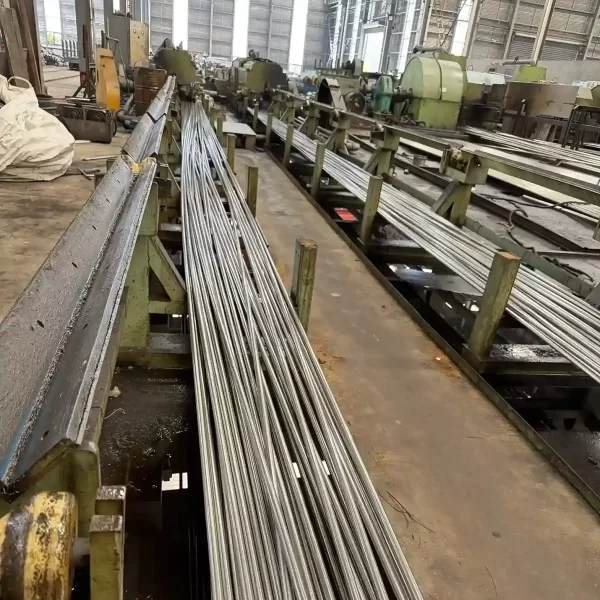
Our manufacturing facility provides reliable production capacity for seamless pipes, tubes, fittings, plates and bars with strict quality management systems.
Rolling, annealing, quenching, and finishing sit inside one boundary.
Levellers, shears, and plasma cutters cover the flat-product range.
Custom heats and stocked thicknesses share one campaign calendar.
A metallurgist reviews every vessel and acid duty enquiry before the offer.
Each plate leaves with a document set that matches the standard behind it. Therefore, the heat number ties the certificate to the melt, the anneal chart, and the test results.
The laboratory reads copper, niobium, and carbon, then records each figure against the flat-product table.
In fact, mechanical values come from the delivered plate, and the hardness check runs on a sample from the same lot.
The inspector measures thickness, width, length, and flatness before the lot clears.
Where the order sits under the thin limit, the certificate records the lower elongation floor.
Five flat-product routes cover what a fabricator asks for. In addition, the standard itself draws the line between plate, sheet, and strip.
Hot rolled and annealed to ASTM B463, from 4.76 to 63.5 mm thick.
Request Availability →Under 4.76 mm thick and 600 mm wide or wider, annealed and pickled.
Request Availability →Cold rolled under 4.76 mm thick and under 600 mm wide, in coil or cut length.
Request Availability →Thick plate cut to the exchanger drawing and drilled on request.
Request Availability →Rolled shells, dished heads, and bent sections made to the fabrication drawing.
Request Availability →Vessels and tanks are where this grade has served longest. Meanwhile, the high nickel content makes chloride-bearing cooling water a second home.
Discuss Your Application →Shells and bottoms for dilute sulphuric and phosphoric acid.
Clad and solid vessels that see acid on one side and steam on the other.
Trays, baffles, and support rings inside acid separation columns.
Wall liners and duct sections exposed to acid condensate.
Cylindrical shells that carry acid on the shell side.
Tank bodies and cover plates for steel pickling lines.
Off-gas ducting that meets acid vapour above the dew point.
Tanks that survive alternating acid and caustic cleaning cycles.
Detailed technical information including chemical composition, mechanical properties, standards and available dimensions.
The limits below come from ASTM B463, B473, and B729, which share one composition table for UNS N08020. Copper is the deliberate addition behind the acid performance, and the niobium range scales with the carbon content. The mill certificate governs final acceptance.
| Element | Content |
|---|---|
| Nickel (Ni) | 32.0–38.0% |
| Chromium (Cr) | 19.0–21.0% |
| Copper (Cu) | 3.0–4.0% |
| Molybdenum (Mo) | 2.0–3.0% |
| Niobium + Tantalum (Nb+Ta) | 8 × C min., 1.00% max. |
| Manganese (Mn) | 2.00% max. |
| Silicon (Si) | 1.00% max. |
| Carbon (C) | 0.07% max. |
| Phosphorus (P) | 0.045% max. |
| Sulfur (S) | 0.035% max. |
| Iron (Fe) | Balance |
One stabilised annealed condition covers every flat form, so a single row carries this page. Two footnotes matter for thin material, and both are noted underneath.
| Product Form | Condition | Tensile Strength | Yield Strength, 0.2% Offset | Elongation | Hardness |
|---|---|---|---|---|---|
| Plate, ASTM B463 | Stabilised annealed | ≥80 ksi (551 MPa) | ≥35 ksi (241 MPa) | 30% | 217 HB or 95 HRB max. |
| Sheet and strip, ASTM B463 | Stabilised annealed | ≥80 ksi (551 MPa) | ≥35 ksi (241 MPa) | 30% | 217 HB or 95 HRB max. |
Material thinner than 0.015 in. (0.38 mm) takes a 20% elongation floor rather than the 30% shown above, measured over a 1 in. gauge length. The hardness figures are informative only, and the standards bar their use as a basis for rejection.
Flat product carries its own definitions rather than a shop convention. Plate starts at 4.76 mm thick and runs wider than 250 mm. Sheet sits under 4.76 mm thick and 600 mm wide or wider. Strip is cold rolled under 4.76 mm thick and under 600 mm wide.
The figures in this table are typical design values, and they are not acceptance limits. Moreover, the alloy stays non-magnetic, which suits instrument parts in acid service.
| Property | Value |
|---|---|
| Density | Approx. 8.08 g/cm³ |
| Melting range | Approx. 1385–1443 °C |
| Modulus of elasticity | Approx. 193 GPa |
| Shear modulus | Approx. 76 GPa |
| Thermal conductivity at 20 °C | Approx. 12.3 W/m·K |
| Electrical resistivity at 20 °C | Approx. 1.08 µΩ·m |
| Specific heat at 20 °C | Approx. 500 J/kg·K |
| Thermal expansion, 25–100 °C | Approx. 14.7 µm/m·K |
| Magnetic response | Essentially non-magnetic |
| Strengthening route | Cold work only |
Four ASTM documents cover the flat-product route and its neighbours, and the ASME editions govern once a pressure code applies. In addition, no SAE aerospace specification reaches UNS N08020. The European and Chinese designations below serve cross-reference only.
| Standard | Product or Application |
|---|---|
| ASTM B463 / ASME SB463 | Plate, sheet, and strip |
| ASTM B906 | Flat product thickness and width definitions |
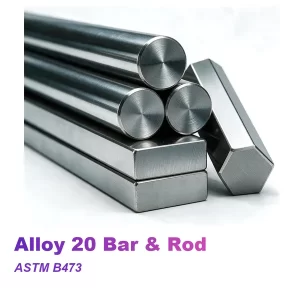
| ASTM B473 / ASME SB473 | Bar cut from the same heat for nozzle and support parts |
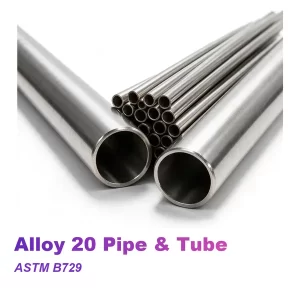
| ASTM B729 / ASME SB729 | Seamless tube for the same vessel |
| NACE MR0175 / ISO 15156-3 | Sour service qualification for oil and gas |
| UNS N08020 | Unified Numbering System designation |
| W.Nr. 2.4660 / NiCr20CuMo | European designation |
| GB/T 15007 NS1403 | Chinese designation |
| SAE AMS | No aerospace specification covers this grade |
20Cb-3 and Carpenter 20 are trademarks of Carpenter Technology, and Incoloy is a trademark of Special Metals Corporation. We quote those names for reference only, and our deliveries follow the ASTM and ASME documents listed above.
The standard text from ASTM International settles any acceptance question.
Because the flat-product document prints its own scope, the ranges below follow that text rather than one house rule. For that reason, state the form and the ordered size on the enquiry.
| Product Form | Typical Supply Range |
|---|---|
| Plate | 4.76–63.5 mm thick to ASTM B463, and wider than 250 mm |
| Sheet | Under 4.76 mm thick, from 600 mm wide |
| Strip | Cold rolled under 4.76 mm thick, under 600 mm wide |
| Cut plate | Sheared or plasma cut to the fabrication drawing |
| Formed plate | Rolled shells and dished heads to the drawing |
Widths run up to 2,500 mm on plate, and length follows the order up to 6,000 mm. Therefore, give the thickness, the width, and the length together so the offer names the right form.
Finish follows the operation that comes next rather than a catalogue default. In short, we agree the surface with your order.
| Surface Condition | Typical Use |
|---|---|
| Stabilised annealed and pickled | Standard delivery for acid and chloride service |
| Hot rolled | As-rolled surface for parts that will be blasted or machined |
| Cold rolled | Smoother sheet and strip for lining and cladding work |
| Polished | Reduced roughness for product-contact and hygienic duty |
| Ground plate | Tight thickness and flatness for tube sheets |
Get detailed information including specifications, standards, dimensions and material properties.
Eight steps carry a plate enquiry from the first message to the delivered bundle. Therefore, give the thickness and the size first, and the rest follows.
State the acid, its concentration, the working temperature, and the pressure class.
Tell us whether the order is plate, sheet, or strip, and quote the thickness and width.
Thickness, width, and length go on the enquiry in one table.
We agree tensile, hardness, and dimensional checks against the standard and your specification.
The offer letter carries price, lead time, and the certificate package on one sheet.
Grade, size, inspection level, and delivery terms enter the order acknowledgement.
The mill takes the lot through rolling, annealing, quenching, and release testing.
Finally, the desk tracks the load and forwards the documents ahead of arrival.
Feedback from buyers and engineers who source nickel alloy materials from Southerly Alloy.
“The shells welded without a post-weld anneal, which removed a furnace cycle from the schedule.”
“In short, plate thickness held across the whole order, so the rolling plan needed no rework.”
“Overall, tank liners in UNS N08020 replaced a 316L set and ran four campaigns without a patch.”
Our production and inspection processes are certified to international standards, and every delivery ships with EN 10204 3.1 mill test certificates.
Quality Management System
Pressure Equipment Directive
Material Standards Compliance
Mill Test Certificates
ASTM B463 covers plate, sheet, and strip. ASTM B906 supplies the thickness and width definitions that separate the three forms.
Plate starts at 4.76 mm thick and runs wider than 250 mm. Sheet sits under 4.76 mm thick at 600 mm wide or more. Strip is cold rolled narrower than 600 mm.
Plate runs from 4.76 to 63.5 mm thick. Also, sheet and strip run under 4.76 mm, from light gauge up to that line.
C-276 tolerates stronger acid and higher chloride levels, and it costs considerably more. Still, Alloy 20 covers dilute acid duty at a lower price.
Usually no. Niobium stabilisation keeps the weld zone clean, so most shells go to service as welded.
One plate covers most stock sizes, and a cut piece is enough for a trial.
We quote mainly on FOB terms, and EXW or CIF follow on request.
Price follows the thickness, the width, the length, and the test level. We quote per piece or per kilogram on request.
Stock thicknesses ship in 7-15 days, and made-to-order plate runs about 25 days.
Yes. Every heat ships with an EN 10204 3.1 certificate, and we arrange 3.2 endorsement on request.
Send the thickness, the width, and the medium. The reply carries price, lead time, and the certificate package together. Because sheet under the thin-gauge limit takes a lower elongation floor, tell us the gauge you plan to use.
A short trial piece costs very little, so one plate settles the question before a plant-wide release.