01
Incoloy 825 Seamless Pipe
Hot-finished or cold-worked product to B423 for process lines and acid transfer.
Request Availability →Seamless pipe, heat-exchanger tube, and welded product for acid plants, seawater cooling, and sour gas duty.
B423 separates the hot-finished and cold-worked anneals, therefore the quotation names the greater yield figure that applies to your line.
Specifically, we state whether the bundle runs a hydrostatic or an electric test, and the fiber stress behind the pressure.
Moreover, U-bent, coiled, and unstraightened tube all fall inside the supplementary requirements of the standard.
Incoloy 825 pipe and tube is supplied in UNS N08825 / W.Nr. 2.4858, a titanium-stabilised nickel-iron-chromium alloy that resists reducing and oxidising acids. Three tubular routes carry the grade, and each one answers a different pressure or heat-transfer duty.
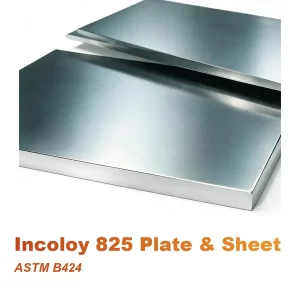
Seamless pipe and tube to B423 handles general corrosive service, and a cold-worked anneal lifts its minimum yield. Heat-exchanger tube to B163 covers outside diameters up to 3 in. (76.2 mm), where the tube must also pass a flare test. Furthermore, welded pipe and tube to B705 and B704 extend the grade into larger diameters. For the bar and flat-rolled side of the same alloy, see Incoloy 825 Bar and Rod and Incoloy 825 Plate and Sheet. In addition, the Incoloy 825 material page holds the full alloy data behind all three tubular routes.
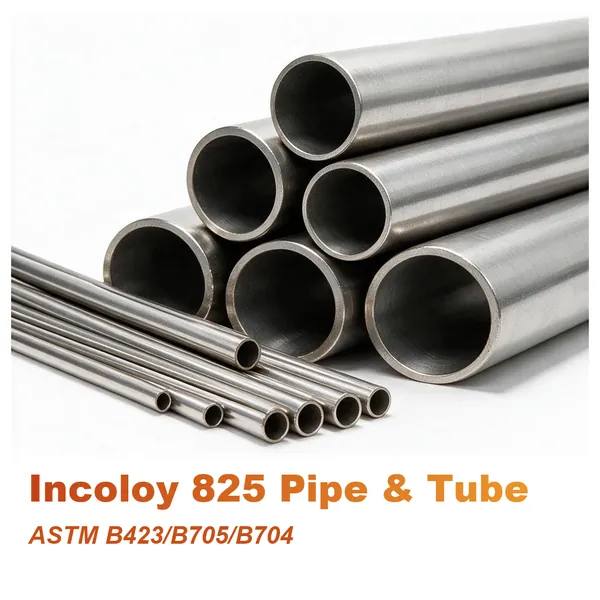
Incoloy 825 pipe and tube covers three tubular routes on one titanium-stabilised chemistry. ASTM B423 governs seamless pipe and tube, B163 covers heat-exchanger tube up to 76.2 mm outside diameter, and B704 with B705 covers welded product. B423 is the only one of the three that splits the anneal, so a cold-worked line carries a higher yield than a hot-finished one. Acid coolers, phosphoric acid evaporators, and sour-service flowlines are the usual destinations. Southerly Alloy works as a professional supplier and exporter across all three routes, and every length ships with EN 10204 3.1 documentation.
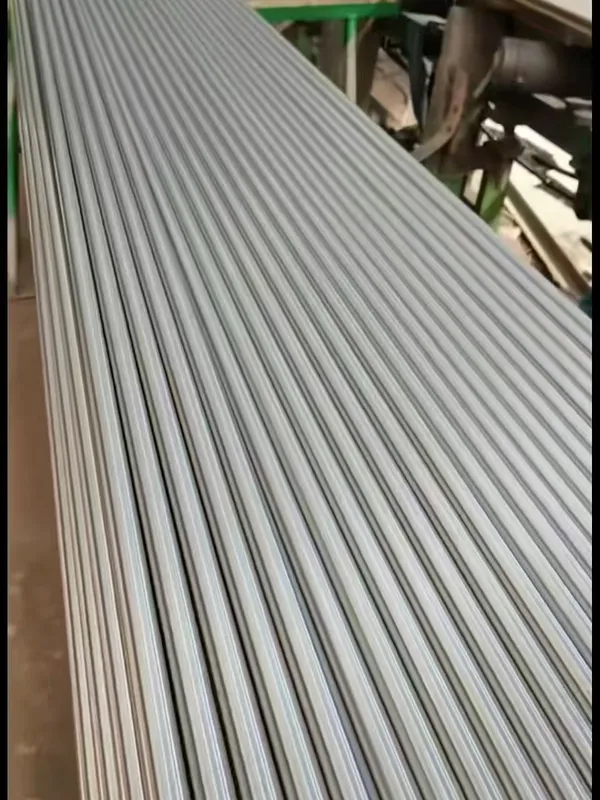
Copper and molybdenum in the chemistry hold up in sulfuric and phosphoric acid circuits at moderate temperature.
Consequently, a 38–46% nickel content resists chloride stress-corrosion cracking in seawater-cooled exchangers.
A hot-finished anneal gives 75 ksi (517 MPa) minimum tensile, and a cold-worked anneal raises that figure to 85 ksi (586 MPa).
The B163 flare test expands a tube end by 30% without through-wall cracking, therefore U-bend and rolled joints stay sound.
B705 and B704 carry the grade past the seamless range, with Class 1 or Class 2 examination on every length.
Below 31.8 mm outside diameter, half-hard and full-hard tempers lift yield to 75 ksi (517 MPa) and 100 ksi (689 MPa).
NACE MR0175 applies in the solution-annealed condition at a 35 HRC ceiling, although cold-worked lines need re-verification.
Tubular buying turns on the test route as much as on the analysis. Therefore, we fix the test method, the fiber stress, and the document set with the quotation. Moreover, one coordinator keeps the bundle moving from enquiry to shipment.
You choose hydrostatic or electric examination, and we write that choice into the order.
Specifically, the quotation carries the allowable fiber stress behind any hydrostatic pressure figure.
In addition, certificates list the heat number of every length inside the bundle.
Bending, stress relief, and end finishing of U-bent bundles stay on one route.
Tube making starts from a pierced or welded shell and ends at the ordered temper. As a result, every stage leaves a record against the heat number for the bundle.
First, we weigh nickel, chromium, iron, molybdenum, and copper to the UNS N08825 window.
Then we add titanium so carbon stays tied up as carbide through welding.
Next, the ingot becomes a pierced shell for seamless routes, or a formed and welded shell for welded routes.
After that, plug or mandrel drawing brings the tube towards its finished wall and diameter.
We anneal in the 930–980 °C band and quench, which restores corrosion resistance after each draw.
Subsequently, we straighten, cut to length, and bevel the ends where the order asks.
Finally, a hydrostatic or electric test runs on every length, and pickling removes the oxide skin.
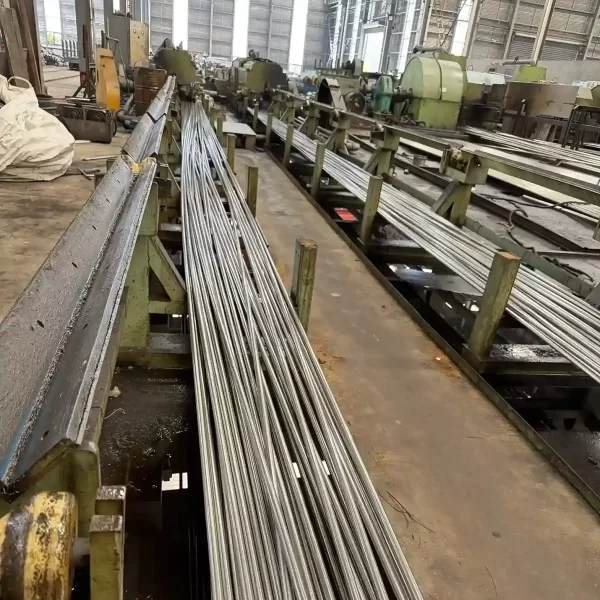
Our tubular lines cover seamless, welded, and U-bent work, and the figures below set out what stands behind a quotation. In addition, we schedule exchanger-tube orders on the same qualified route as pipe.
Tube drawing, annealing, and pickling bays sit on one site.
Furthermore, draw benches, pilger mills, and eddy-current units cover the tubular routes.
In total, seamless and welded output covers pipe, exchanger tube, and U-bends.
Moreover, the tube team reviews pressure, inspection class, and U-bend requirements with you.
Consequently, every seamless and welded length ships with the applicable general-requirements document named on the order.
Release waits on test results, not on the shipping date. Because tube failures are expensive to find in service, a spectrometer confirms chemistry on every heat. In addition, we run the ductility test that the governing standard demands.
We record whether the order ran a hydrostatic or a non-destructive electric test, as B829 requires.
Ductility results on the tube ends sit beside the tensile figure for the lot.
In addition, welded lengths pass a Class 1 or Class 2 examination before dispatch.
Consequently, certificates tie every bundle to a heat number that inspection can trace.
The tubular range splits by manufacturing route, and each route carries its own diameter band and test method. Therefore, name the route as well as the size when you enquire.
Hot-finished or cold-worked product to B423 for process lines and acid transfer.
Request Availability →Drawn tube in normal or heavy wall for exchangers, condensers, and instrument lines.
Request Availability →B163 tube up to 76.2 mm outside diameter, supplied annealed and pickled.
Request Availability →B705 pipe in schedule sizes for larger-bore acid and effluent duty.
Request Availability →B704 tube in coil or straight lengths for exchangers and sheathing.
Request Availability →Bent, stress-relieved, and end-finished to the drawing for exchanger bundles.
Request Availability →Coiled or unstraightened lengths for instrumentation and downhole control lines.
Request Availability →Small-bore tube in the converter-size tempers down to 3.2 mm outside diameter.
Request Availability →Acid duty and chloride-bearing cooling water account for most tubular enquiries. Consequently, the destinations below also include sour gas, phosphoric acid, and nuclear reprocessing circuits.
Discuss Your Application →Tube bundles in acid coolers and concentration plant, where the reducing duty dominates.
Exchanger tube for wet-process evaporators carrying fluoride and chloride impurities.
Condenser and exchanger tube for coastal plants using chlorinated seawater.
Slurry pipe, spray headers, and reheat exchanger tube in FGD trains.
Welded pipe and coiled tube for H2S-bearing production and chemical injection.
Dissolver and extraction equipment that sees nitric acid and radioactive slurries.
Heating coils and transfer pipe in steel pickling and spent-acid recovery.
Reactor tube and transfer lines where mixed acids rule out stainless grades.
Detailed technical information including chemical composition, mechanical properties, standards and available dimensions.
The limits below are those of UNS N08825 in ASTM B423, B163, B704, and B705, with iron as the balance. Furthermore, titanium appears as a controlled range because it fixes carbon as carbide.
| Element | Content |
|---|---|
| Nickel (Ni) | 38.0–46.0% |
| Chromium (Cr) | 19.5–23.5% |
| Iron (Fe) | 22.0% min. |
| Molybdenum (Mo) | 2.5–3.5% |
| Copper (Cu) | 1.5–3.0% |
| Titanium (Ti) | 0.6–1.2% |
| Carbon (C) | 0.05% max. |
| Manganese (Mn) | 1.00% max. |
| Silicon (Si) | 0.50% max. |
| Aluminium (Al) | 0.20% max. |
| Sulfur (S) | 0.03% max. |
B423 is the only tubular standard that splits the anneal into two strength levels, and the table below follows that split. In addition, the converter-size tempers sit in a separate appendix.
| Product Form | Standard | Condition and Size | Tensile Strength | Yield Strength (0.2%) | Elongation |
|---|---|---|---|---|---|
| Seamless pipe and tube | ASTM B423 | Hot-finished, annealed | 75 ksi (517 MPa) | 25 ksi (172 MPa) | 30% |
| Seamless pipe and tube | ASTM B423 | Cold-worked, annealed | 85 ksi (586 MPa) | 35 ksi (241 MPa) | 30% |
| Condenser and exchanger tube | ASTM B163 | Annealed, up to 3 in. (76.2 mm) OD | 85 ksi (586 MPa) | 35 ksi (241 MPa) | 30% |
| Welded pipe | ASTM B705 | Annealed | 85 ksi (586 MPa) | 35 ksi (240 MPa) | 30% |
| Welded tube | ASTM B704 | Annealed | 85 ksi (586 MPa) | 35 ksi (240 MPa) | 30% |
| Converter-size tube | ASTM B423, Table X1.1 | Annealed | 85–115 ksi (586–793 MPa) | 35 ksi (241 MPa) | 30% |
| Converter-size tube | ASTM B423, Table X1.1 | Half-hard | 105 ksi (724 MPa) min. | 75 ksi (517 MPa) | 15% |
| Converter-size tube | ASTM B423, Table X1.1 | Full-hard | 125 ksi (862 MPa) min. | 100 ksi (689 MPa) | 5% |
Converter-size values apply below 31.8 mm outside diameter, and they exclude tube under 3.2 mm outside diameter with a wall under 0.381 mm. B704 and B705 print the same minima in psi, at 85,000 and 35,000. Hot-forming quality ships to chemistry and surface inspection alone.
The values below are typical rather than guaranteed, and they support thermal design of exchanger bundles. Moreover, thermal expansion near 14.1 µm/m·°C keeps mismatch stress low against carbon-steel shells.
| Property | Value |
|---|---|
| Density | Approx. 8.14 g/cm³ |
| Melting range | Approx. 1370–1400 °C |
| Specific heat at 20 °C | Approx. 440 J/kg·K |
| Modulus of elasticity at 20 °C | Approx. 196 GPa |
| Thermal conductivity at 25 °C | Approx. 11.1 W/m·K |
| Thermal expansion, 20–100 °C | Approx. 14.1 µm/m·K |
| Electrical resistivity at 25 °C | Approx. 1.13 µΩ·m |
| Curie temperature | Below −196 °C |
| Magnetic behaviour | Non-magnetic at ambient temperature |
Tubular product answers to two families of document, and the product specification sits above its general-requirements companion. Therefore, the table lists both, along with the welded routes and the design codes. ASTM International publishes the current text of each specification.
| Standard / Designation | Scope |
|---|---|
| ASTM B423 / ASME SB423 | Seamless pipe and tube for general corrosive service |
| ASTM B829 / ASME SB829 | General requirements for seamless nickel and nickel-alloy pipe and tube |
| ASTM B163 / ASME SB163 | Seamless condenser and heat-exchanger tube up to 3 in. (76.2 mm) OD |
| ASTM B704 / ASME SB704 | Welded tube in UNS N06625 and UNS N08825 |
| ASTM B751 / ASME SB751 | General requirements for welded nickel and nickel-alloy tube |
| ASTM B705 / ASME SB705 | Welded pipe in UNS N06625, N06219, and UNS N08825 |
| ASTM B775 / ASME SB775 | General requirements for welded nickel and nickel-alloy pipe |
| ASTM B366 / ASME SB366 | Wrought nickel-alloy pipe fittings |
| ASTM B564 / ASME SB564 | Forgings for flanges, tube sheets, and valve bodies |
| ASME Code Case 1936 | Nuclear construction — pipe and tube |
| NACE MR0175 / ISO 15156 | Sour service, 35 HRC maximum in the annealed condition |
| BS 3074 NA16 | British seamless tube standard |
| DIN 17751 | German wrought nickel-alloy tube standard |
| DIN 17744 | German wrought nickel-alloy general standard |
| ISO 6207 | ISO seamless tube and pipe standard |
| VdTÜV 432 | German pressure-vessel material data sheet |
| UNS N08825 / W.Nr. 2.4858 / NiCr21Mo | Material designations |
| JIS NCF 825 | Japanese designation |
Tubular sizes below describe what we normally produce, and the ordered test method travels with them. Since the route fixes the diameter band, please give the outside diameter, wall, and length together.
| Product Form | Typical Supply | Length |
|---|---|---|
| Seamless pipe | 6–219 mm OD | Random, or cut to length |
| Seamless exchanger tube | 6–76 mm OD × 0.5–3.76 mm wall | Random, U-bent, or cut to length |
| Welded pipe | 10.3–762 mm OD | Random, or cut to length |
| Welded tube | 1.6–101.6 mm OD | Random, coil, or cut to length |
| Converter-size tube | 3.2–31.8 mm OD | Straight, or random |
| Heavy-wall tube | 6–219 mm OD × 3.76 mm wall and over | Random, or cut to length |
Cut lengths carry a plus tolerance of 3.2 mm, and lengths over 9.1 m carry a plus tolerance of 6.4 mm. U-bent bundles are made to your drawing rather than to a stock radius.
Tube finish has to suit the next operation, whether that is rolling into a tube sheet or welding into a spool. Furthermore, we agree the finish with the order instead of assuming it from stock.
| Surface Condition | Typical Use |
|---|---|
| Annealed and pickled | Standard delivery for acid and seawater service |
| Bright annealed | Instrument and control lines where an oxide-free bore matters |
| Ground outside diameter | Tube that will be rolled into a tube sheet |
| Descaled and shot-blasted | Process pipe headed for painting or coating |
| Hot-worked, not pickled | Tube that will be machined before service |
| Machined bore and outside diameter | Heavy-wall tube for machined components |
Get detailed information including specifications, standards, dimensions and material properties.
One coordinator carries your tubular order from enquiry to shipment. We fix the test method and the temper before drawing starts, and the tube team reviews the pressure duty.
First, give the medium, concentration, temperature, outside diameter, wall, and quantity.
Next, agree seamless, welded, or U-bent against your exchanger or piping design.
Then we fix hydrostatic or electric examination, and the pressure figure behind it.
After that, grade, temper, finish, inspection class, and delivery terms go on the record.
We then draw, anneal, straighten, and test the tube to the ordered condition.
Consequently, certificates, test reports, and export papers travel with the bundle.
Finally, we confirm the loading date and the paperwork set with you.
Feedback from buyers and engineers who source nickel alloy materials from Southerly Alloy.
“The U-bent 825 tube for our phosphoric acid evaporator arrived with flare-test results attached to the mill certificate.”
“Seamless 825 pipe replaced a stainless line in our acid coolers, and the pickled finish matched the drawing.”
“The quotation named the hydrostatic test pressure before we placed the order, which made internal approval straightforward.”
Our production and inspection processes are certified to international standards, and every delivery ships with EN 10204 3.1 mill test certificates.
Quality Management System
Pressure Equipment Directive
Material Standards Compliance
Mill Test Certificates
ASTM B423, with ASTM B829 general requirements. ASME SB423 and SB829 cover pressure-equipment orders.
ASTM B163, for outside diameters up to 3 in. (76.2 mm) and minimum walls up to 3.76 mm.
Every length with a 3 mm outside diameter or more and a 0.38 mm wall or more takes a hydrostatic or a non-destructive electric test.
16,600 psi (114 MPa) for hot-finished annealed product, and 21,200 psi (146 MPa) after a cold-worked anneal.
Yes. B163 lists U-bent tubes, high-yield tube, and coiled or unstraightened tube as supplementary requirements.
One length for most stock sizes.
Mostly FOB, and we quote EXW or CIF on request.
7-15 days for stock lengths, and about 25 days for made-to-order tube.
Yes. Each heat carries a 3.1 certificate, and a 3.2 certificate is available when you nominate a witness.
Yes. Cut-to-length, bevelled, or random lengths are all available, and B163 allows a plus tolerance of 3.2 mm on cut lengths.
Send the route, the medium, the outside diameter, and the wall, and the reply carries price, lead time, and the test plan. Because we settle the temper and the inspection class before drawing, the tube you approve is the tube that ships.
Moreover, we carry Incoloy 825 pipe and tube in common sizes and bend U-bundles to your drawing. Trial lengths are available for most routes.