01
Monel 400 Bar and Rod
Round, hex, square, and forged bar to ASTM B164 in hot-worked, annealed, stress-relieved, or cold-drawn condition.
View Monel 400 Bar and Rod →Grade data for Alloy 400 / W.Nr. 2.4360 — chemistry, corrosion envelope, standards, and three supply routes.
Chemistry, corrosion envelope, and mechanical minimums for UNS N04400 sit on one page, so a specification review needs a single reference.
In addition, the page names where the grade works and where it fails, so stagnant seawater and oxidizing acids never reach a quotation by accident.
Finally, bar, tubular, and flat product trace to the same nickel-copper heat and the same certificate practice.
Monel 400 is a nickel-copper alloy carrying about two-thirds nickel with copper in solid solution. It resists flowing seawater, hydrofluoric acid, and strong alkalis, but not nitric acid or wet chlorine. Alloy 400 holds strength through cold work alone.
Buyers arrive from three directions, so the form pages carry the ordering detail. Round bar and rod sits on the Monel 400 Bar and Rod page, tubular product on Monel 400 Pipe and Tube, and flat product on Monel 400 Plate and Sheet. The age-hardened companion grade on the Monel K-500 Bar and Rod page serves duties that need more strength.
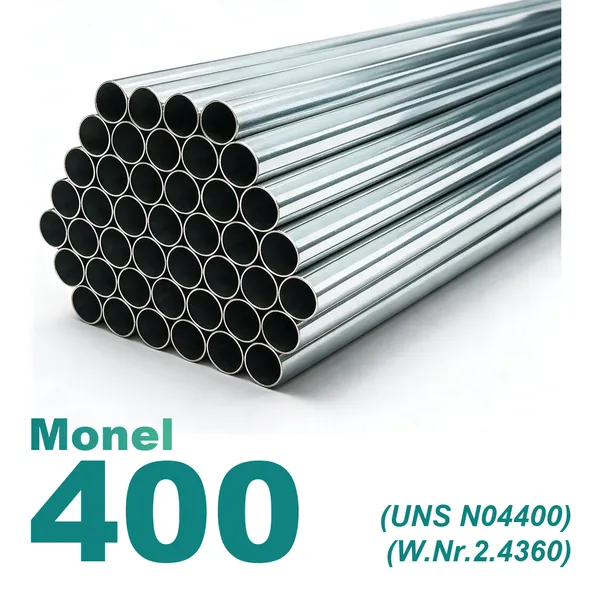
Monel 400 is a nickel-copper alloy supplied as bar and rod, tubular product, and flat-rolled plate, sheet, and strip. Nickel at 63% minimum with copper at 28–34% gives the grade its resistance to flowing seawater, hydrofluoric acid, and strong alkalis, while ruling out nitric acid and wet chlorine. No precipitation-hardening route exists, so cold work sets the strength. This page collects the chemistry, corrosion envelope, standards, and mechanical minimums for UNS N04400.
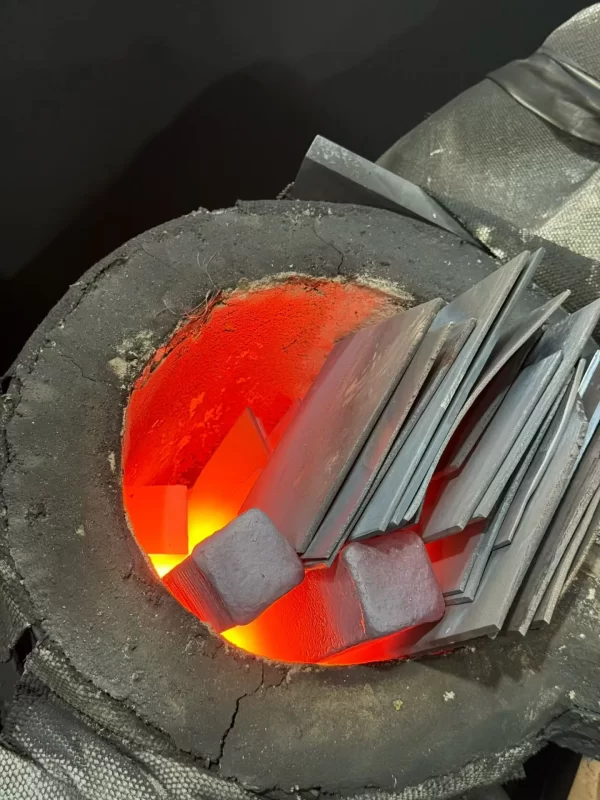
Above all, chloride-rich water in motion leaves the surface intact, so marine parts avoid the pitting that defeats stainless grades.
Still, dead legs and tight crevices concentrate chlorides, so a flow review belongs in the design rather than a blanket approval.
Consequently, hydrofluoric acid at every concentration up to boiling stays inside the envelope, which few metals tolerate.
Moreover, caustic soda and other strong alkalis cause little attack, so evaporator and handling plant lasts.
Nitric acid, wet chlorine, and chlorine dioxide fall outside the envelope, so those duties need a chromium-bearing alloy instead.
Yield strength climbs from 170 MPa annealed toward 585 MPa as-drawn, because no precipitation-hardening route exists.
Therefore, sub-zero service shows no ductile-to-brittle transition, which suits liquefied-gas and pump-shaft work.
ERNiCu-7 filler with interpass control below 150 °C lets joints enter service without further heat treatment.
To begin with, selection turns on one question, which is whether the stream oxidizes. A reducing or neutral duty brings Monel 400 into play. An oxidizing stream, on the other hand, sends the enquiry to a chromium-bearing alloy.
In short, hydrofluoric acid, caustic, and chloride-bearing water define the working window, so a pH review settles the choice before cost enters the discussion.
By contrast, nitric acid and wet chlorine attack the copper-rich matrix, so those streams call for a chromium-bearing grade such as Inconel 600 instead.
Only cold work raises yield strength, because the chemistry carries no aluminium or titanium, so the hardened condition also limits ductility.
For that reason, oxidation sets the continuous limit near 480 °C, so hotter duties belong to a nickel-chromium alloy.
Namely, three supply routes carry this grade, so a buyer fixes the form first and the size second.
Round, hex, square, and forged bar to ASTM B164 in hot-worked, annealed, stress-relieved, or cold-drawn condition.
View Monel 400 Bar and Rod →Similarly, seamless product to B165 and B163, plus welded pipe and tube to B725 and B730.
View Monel 400 Pipe and Tube →Likewise, plate, sheet, and strip to ASTM B127 in hot-rolled and cold-rolled tempers.
View Monel 400 Plate and Sheet →Consequently, the grade serves plants whose streams reduce rather than oxidize, and the medium plus its temperature decide material life.
Discuss Your Application →For example, reactors and columns that handle hydrofluoric acid or caustic streams.
Specifically, pump bodies, impellers, and valves in continuous chloride flow.
Propeller shafts, rudder stock, and deck fittings for hull and dock work.
Moreover, reaction and regeneration sections where HF concentration runs high.
Likewise, heating surfaces and piping for caustic concentration duty.
Structural fasteners and fixtures exposed to wave action and spray.
Meanwhile, evaporator internals and brine piping where chlorides stay concentrated.
Downhole and wellhead parts held inside the NACE hardness envelope.
Finally, components that keep toughness at liquefied-gas temperatures.
Detailed technical information including chemical composition, mechanical properties, standards and available dimensions.
The limits below apply to UNS N04400 across the bar, tubular, and flat-rolled documents, so one window governs every form. Specifically, nickel runs at 63.0% minimum with cobalt counted inside that figure. Copper then sits between 28.0% and 34.0%.
| Element | Content |
|---|---|
| Nickel (Ni) plus Cobalt (Co) | 63.0% min. |
| Copper (Cu) | 28.0–34.0% |
| Iron (Fe) | 2.5% max. |
| Manganese (Mn) | 2.0% max. |
| Carbon (C) | 0.30% max. |
| Silicon (Si) | 0.50% max. |
| Sulfur (S) | 0.024% max. |
The table gives minimum values for every supply form, taken from the bar, seamless tube, and flat-rolled documents. Therefore, condition and section size move those numbers, so name both on the enquiry. Cold work stays the only strengthening route this grade offers.
| Product Form | Standard | Condition | Tensile Strength | Yield Strength, 0.2% Offset | Elongation |
|---|---|---|---|---|---|
| Bar and rod | ASTM B164 | Hot-worked, annealed, all sizes | ≥70 ksi (480 MPa) | ≥25 ksi (170 MPa) | 35% |
| Bar and rod | ASTM B164 | Cold-drawn, as-worked, rounds under 12.7 mm | ≥110 ksi (760 MPa) | ≥85 ksi (585 MPa) | 8% |
| Seamless pipe and tube | ASTM B165 | Annealed, outside diameter to 127 mm | ≥70 ksi (483 MPa) | ≥28 ksi (193 MPa) | 35% |
| Seamless pipe and tube | ASTM B165 | Annealed, outside diameter above 127 mm | ≥70 ksi (483 MPa) | ≥25 ksi (172 MPa) | 35% |
| Seamless pipe and tube | ASTM B165 | Stress-relieved, all sizes | ≥85 ksi (586 MPa) | ≥55 ksi (379 MPa) | 15% |
| Heat-exchanger tube | ASTM B163 | Annealed | ≥70 ksi (483 MPa) | ≥28 ksi (193 MPa) | 35% |
| Plate, sheet, and strip | ASTM B127 | Hot-rolled, annealed | ≥70 ksi (485 MPa) | ≥28 ksi (195 MPa) | 35% |
| Plate, sheet, and strip | ASTM B127 | Cold-rolled, hard | ≥100 ksi (690 MPa) | ≥90 ksi (620 MPa) | 2% |
Welded pipe and tube under B725 and B730 carry their own acceptance tables. As a result, we quote those figures from the edition your order names rather than restating them here.
Values below are typical room-temperature figures for design work rather than acceptance criteria. In fact, magnetic permeability stays low at room temperature, because the Curie point falls just above the usual working band.
| Property | Value |
|---|---|
| Alloy | Monel 400 |
| UNS | N04400 |
| Werkstoff | 2.4360 |
| Density | Approx. 8.80 g/cm³ |
| Melting range | Approx. 1300–1350 °C |
| Modulus of elasticity | Approx. 179 GPa |
| Thermal conductivity at 20 °C | Approx. 21.8 W/m·K |
| Specific heat at 20 °C | Approx. 427 J/kg·K |
| Electrical resistivity at 20 °C | Approx. 0.51 µΩ·m |
| Thermal expansion, 20–100 °C | Approx. 13.9 µm/m·K |
| Curie temperature | Approx. 21–49 °C |
| Magnetic behaviour | Slightly ferromagnetic at ambient temperature |
| Strengthening route | Cold work only |
Three ASTM documents divide the forms between them, and the ASME editions take over where pressure equipment applies. Moreover, equivalent designations appear for cross-reference, so an enquiry may quote any of them.
| Standard | Product / Application |
|---|---|
| ASTM B127 | Plate, sheet, and strip in hot-rolled and cold-rolled tempers |
| ASTM B164 | Rod, bar, and wire in hot-worked and cold-worked conditions |
| ASTM B165 | Seamless pipe and tube |
| ASTM B163 | Seamless heat-exchanger and condenser tube |
| ASTM B725 | Welded pipe in the annealed condition |
| ASTM B730 | Welded tube in the annealed condition |
| ASTM B564 | Forgings |
| ASTM F467 / F468 | Nuts and bolts for general service |
| SAE AMS 4675 | Bars, forgings, and rings, 67Ni - 30Cu |
| SAE AMS 4544 | Plate, sheet, and strip, 67Ni - 30Cu, annealed |
| SAE AMS 4574 | Seamless tubing, 67Ni - 30Cu, annealed |
| ASME SB127 / SB164 / SB165 / SB163 | Counterparts under pressure-code jurisdiction |
| DIN 17743 / 17750 / 17751 / 17752 | Wrought nickel-copper alloys, flat product, tube, and bar |
| ISO 6207 / 6208 / 9723 / 9724 | Nickel alloy tube, flat product, bar, and wire |
| NACE MR0175 / ISO 15156 | Sour service in oil and gas production |
| UNS N04400 · W.Nr. 2.4360 · NiCu30Fe · BS NA 13 · JIS NW 4400 | Designations |
The product documents come from ASTM International. Meanwhile, sour-service projects reference NACE MR0175 / ISO 15156 beside them, and designations such as W.Nr. 2.4360 identify the same melt rather than widening the acceptance window.
| Product Form | Typical Supply Range |
|---|---|
| Bar and rod | 6–500 mm dia. by section and condition |
| Seamless pipe and tube | OD 6–219 mm, wall 0.5–12.7 mm |
| Heat-exchanger tube | OD 6.35–76.2 mm, wall 0.7–6 mm |
| Welded pipe and tube | OD 21.3–610 mm, wall 0.5–12.7 mm |
| Plate and sheet | 0.46–100 mm thick, cut to length and width |
| Strip and coil | 0.13–6.4 mm thick, slit to width |
Ranges above reflect normally produced sizes, and heavy sections depend on ingot or slab supply. Still, thin flat product below 0.51 mm carries no yield requirement in B127, so quote thickness alongside width and length.
| Surface Condition | Typical Characteristics / Applications |
|---|---|
| Annealed and pickled | Standard delivery for seawater, caustic, and HF service |
| Hot-worked | As-rolled or as-forged surface for parts machined to size |
| Cold drawn | Close diameter control with a bright finish |
| Bright annealed | Scale-free surface for instrumentation and clean circuits |
| Descaled plate | Shot-blasted or pickled plate ready for fabrication |
Get detailed information including specifications, standards, dimensions and material properties.
B164 governs bar and rod, B165 seamless pipe and tube, B163 heat-exchanger tube, and B127 plate, sheet, and strip. However, the ASME SB editions replace them under pressure-code jurisdiction.
Nickel runs at 63.0% minimum including cobalt, copper at 28.0–34.0%, and iron stays at 2.5% max. Carbon, silicon, and sulfur stay low to protect ductility and weldability.
Yes, flowing seawater suits the grade well. Still, stagnant seawater and tight crevices concentrate chlorides, so design those areas with a flow review in hand.
ERNiCu-7 wire to AWS A5.14 and ENiCu-7 electrodes to A5.11 cover most joints. Interpass temperature stays below 150 °C. Therefore, most joints need no post-weld anneal.
Continuous service stays near 480 °C, where oxidation rather than melting sets the limit. However, short excursions to 538 °C remain possible where the design allows them.
One piece covers most stock sizes, and we quote trial quantities without a minimum premium.
FOB is standard, and EXW, CIF, or DAP follow once you name the destination.
Weight in kilograms drives the quotation, with the copper share fixed at the order date.
Stock sizes leave in 7-15 days, and we confirm a schedule date for made-to-order items.
Yes. Every consignment ships with an EN 10204 3.1 certificate, and we arrange 3.2 third-party endorsement on request.
Therefore, our engineers answer with price, Incoterm, lead time, and the document set in a single reply. Send the form, the standard, the ordered size, and the quantity, plus the medium when the duty needs a corrosion review.