01
Seamless Pipe and Tube
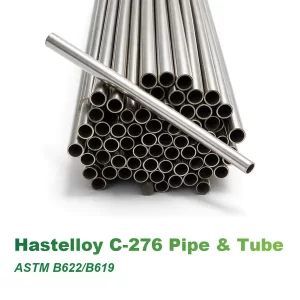
Cold-drawn or hot-finished hollow to ASTM B622, capped at 219 mm outside diameter.
Request Availability →Seamless and welded tubular product in the low-iron nickel-chromium-molybdenum grade, for acid plant and scrubbing circuits.
The page separates seamless, welded pipe, and welded tube, because each one answers to a different document.
Therefore, the annealing log and the pressure test report travel with the tube under one heat number.
Consequently, one mill covers instrument tube through heavy-wall pipe for the same acid circuit.
Alloy 59 Pipe and Tube carries the UNS N06059 grade, a nickel-chromium-molybdenum alloy with a deliberately lean matrix. Iron holds at 1.5% maximum, so the passive film reforms quickly after an upset. Consequently, the tubular forms handle mixed acid streams that pit leaner alloys.
The tube route decides which document governs, so the form pages carry the ordering detail. The tubular range sits beside Alloy 59 Bar and Rod and Alloy 59 Plate and Sheet in the same melt. The corrosion background sits on the Alloy 59 hub page.
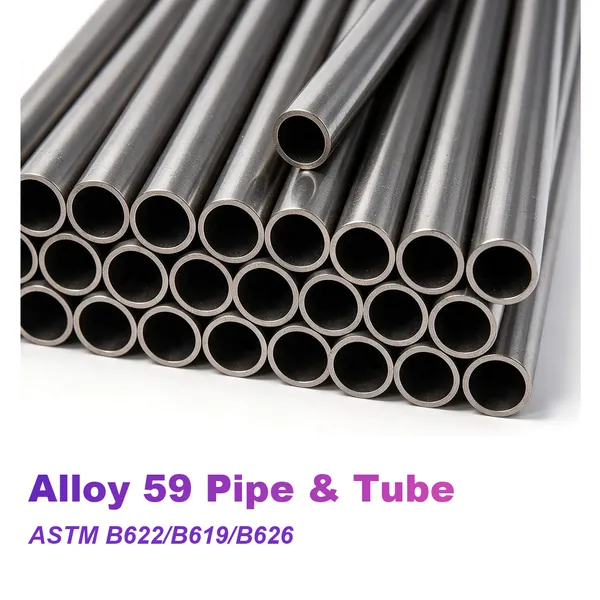
Alloy 59 pipe and tube carries the UNS N06059 grade, a nickel-chromium-molybdenum alloy with iron at 1.5% maximum and silicon at 0.10% maximum. Seamless product runs to ASTM B622, welded pipe to B619, and welded exchanger tube to B626. The grade holds up where a stream alternates between oxidising and reducing steps, and where chlorides would pit a leaner alloy. Southerly Alloy works as a professional supplier and exporter of UNS N06059 tubular product with full traceability.
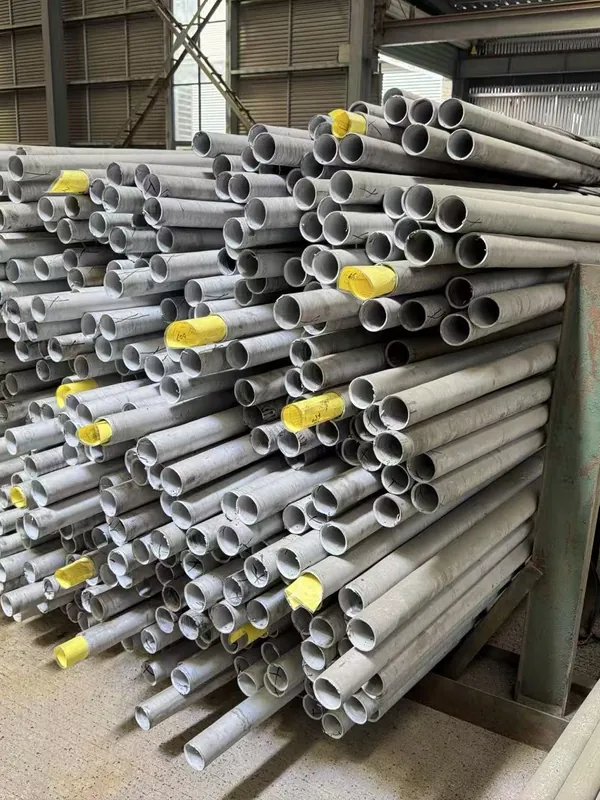
Seamless to B622, welded pipe to B619, and welded tube to B626 all draw on one chemistry.
Moreover, iron at 1.5% maximum separates this grade from C-276, which permits up to 7%.
Consequently, silicon at 0.10% maximum protects the weld seam against phase formation.
Chromium and molybdenum together cover streams that switch between oxidising and reducing chemistry.
A pitting resistance equivalent near 75 suits chlorinated brine and seawater cooling water.
Exchanger tube runs down to 0.41 mm wall without losing the annealed condition.
Every lot enters the quench tank straight from the anneal, including heavy-wall pipe.
Pickled, bright annealed, or polished bores meet hygienic and instrument duty.
The route matters before the size, because a seamless ceiling and a welded size list tell different stories. Therefore, we quote both against the same duty and let you compare. Meanwhile, one mill covers the whole range from instrument tube to heavy-wall pipe.
We compare seamless and welded against your pressure class, then quote the cheaper route.
Pressure test, quench log, and tensile results all name the same melt.
Pickled, bright annealed, or polished bores are quoted with the tube rather than added later.
Straight lengths, coils, or bent bundles leave under one set of papers.
A lean matrix tolerates very little slow cooling, so the tube line quenches every lot straight from the anneal. Meanwhile, the draw benches hold the wall tolerance within the ordered band.
Nickel, chromium, and molybdenum enter the furnace as weighed lots with tramp elements held low.
AOD treatment drives carbon and silicon down to the ceilings the grade allows.
The cast ingot is cut to billet length and its surface is conditioned before piercing.
A pierced billet is extruded into hollow shell between 950 and 1180 °C.
Pilger mills and draw benches bring the shell to the ordered diameter and wall.
A furnace pass between 1100 and 1180 °C dissolves any phase from the working steps.
The tube leaves the furnace directly into the tank, because a delayed quench costs corrosion resistance.
Finally, each length clears hydrostatic or eddy current testing before release.
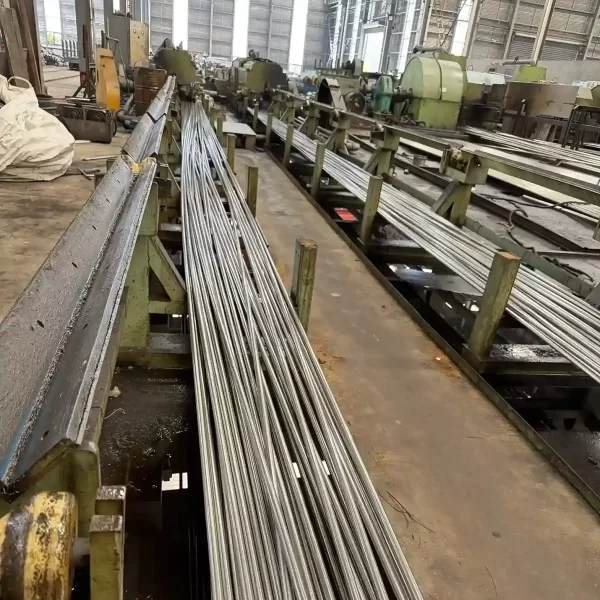
Our tube line shares one melt shop and one quench tank with the rest of the corrosion-resistant family. Therefore, a stocked size often ships without waiting for a furnace campaign.
Melting, tube drawing, and annealing sit under one roof.
Pilger mills, draw benches, and annealing furnaces serve the line.
Seamless and welded routes share one production campaign.
Tube-to-tubesheet and sour service questions reach a specialist.
Release rests on evidence rather than assumption. Chemistry runs against the N06059 window, and mechanical results follow the route you ordered.
Iron, silicon, and molybdenum are read against the ASTM limits on every heat.
Tensile, yield, and elongation values come from the tube you actually receive.
Welded product clears the flattening test, and seamless product clears the flare check.
Therefore, the pressure test report names the heat, the size, and the test level applied.
The making method decides which document governs, so tubular supply splits by route. Therefore, state the route ahead of the size.
Cold-drawn or hot-finished hollow to ASTM B622, capped at 219 mm outside diameter.
Request Availability →B619 product from Schedule 5S through XXS, with heavy wall agreed at order.
Request Availability →In addition, B626 tube runs from 3.2 to 88.9 mm outside diameter for exchanger bundles.
Request Availability →Therefore, we bend and stress relieve bundles to your drawing, agreeing the radius at quotation.
Request Availability →Fine-bore tube in the annealed condition serves sampling and impulse lines.
Request Availability →Acid plant that runs more than one process step carries the strongest case for this grade. Meanwhile, chloride-bearing cooling water benefits from the pitting margin.
Discuss Your Application →Exchanger bundles and shell-side piping in hot concentrated acid.
Slurry lines, spray headers, and quench sections in flue gas desulphurisation.
Process piping qualified to NACE MR0175 for oil and gas service.
Transfer lines and reactor piping in oxidising duty.
Condenser tube and brine lines in chlorinated cooling water.
Off-gas piping exposed to acid condensate.
Product-contact tubing that survives alternating acid and alkali cleaning.
Pulp mill lines that meet chlorine dioxide.
Detailed technical information including chemical composition, mechanical properties, standards and available dimensions.
The limits below come from ASTM B622, which also governs seamless tube. Iron and silicon are the deliberate restraints behind the grade, and aluminium is the small deliberate addition. The mill certificate governs final acceptance.
| Element | Content |
|---|---|
| Nickel (Ni) | Balance |
| Chromium (Cr) | 22.0–24.0% |
| Molybdenum (Mo) | 15.0–16.5% |
| Iron (Fe) | 1.5% max. |
| Aluminum (Al) | 0.10–0.40% |
| Copper (Cu) | 0.50% max. |
| Manganese (Mn) | 0.50% max. |
| Cobalt (Co) | 0.30% max. |
| Silicon (Si) | 0.10% max. |
| Phosphorus (P) | 0.015% max. |
| Sulfur (S) | 0.010% max. |
| Carbon (C) | 0.010% max. |
The three tubular documents set one annealed condition, so the table below repeats a single row set rather than splitting the routes. A separate European data sheet applies a higher yield floor, and that regime is not the same as the ASTM one.
| Product Form | Condition | Tensile Strength | Yield Strength, 0.2% Offset | Elongation | Hardness |
|---|---|---|---|---|---|
| Seamless tube, ASTM B622 | Solution annealed | ≥100 ksi (690 MPa) | ≥45 ksi (310 MPa) | 45% | 100 HRB max. |
| Welded pipe, ASTM B619 | Solution annealed | ≥100 ksi (690 MPa) | ≥45 ksi (310 MPa) | 45% | 100 HRB max. |
| Welded tube, ASTM B626 | Solution annealed | ≥100 ksi (690 MPa) | ≥45 ksi (310 MPa) | 45% | 100 HRB max. |
The hardness figures are informative only, and the standards bar their use as a basis for rejection. Because the grade resists aging, cold work is the only route above those floors. In addition, cold-worked classes of tube may be ordered, so state the temper on the enquiry.
Values below are typical figures for design work rather than acceptance criteria. Moreover, the alloy stays essentially non-magnetic, which suits instrument and seal assemblies.
| Property | Value |
|---|---|
| Density | Approx. 8.6 g/cm³ |
| Melting range | Approx. 1310–1360 °C |
| Modulus of elasticity | Approx. 210 GPa |
| Thermal conductivity at 20 °C | Approx. 10.4 W/m·K |
| Electrical resistivity at 20 °C | Approx. 1.26 µΩ·m |
| Specific heat at 20 °C | Approx. 414 J/kg·K |
| Thermal expansion, 20–100 °C | Approx. 11.9 µm/m·K |
| Relative magnetic permeability at 20 °C | 1.001 max. |
| Strengthening route | Cold work only |
Three ASTM documents divide the tubular forms, and the general-requirements documents carry the test regime behind each one. Specifically, no SAE aerospace specification reaches UNS N06059. The European and Chinese designations below serve cross-reference only.
| Standard | Product or Application |
|---|---|
| ASTM B622 / ASME SB622 | Seamless pipe and tube in the solution-annealed condition |
| ASTM B619 / ASME SB619 | Welded pipe, Schedule 5S and heavier |
| ASTM B626 / ASME SB626 | Welded tube and heat-exchanger tube |
| ASTM B829 | General requirements for seamless nickel alloy pipe and tube |
| ASTM B775 | General requirements for welded nickel alloy pipe |
| ASTM B751 | General requirements for welded nickel alloy tube |
| ASTM B366 / ASME SB366 | Factory-made wrought fittings in the same grade |
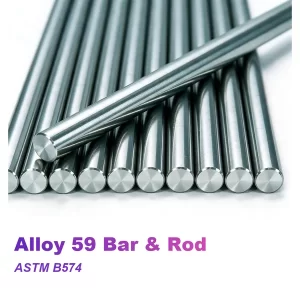
| ASTM B574 / ASME SB574 | Bar and rod in the same grade |
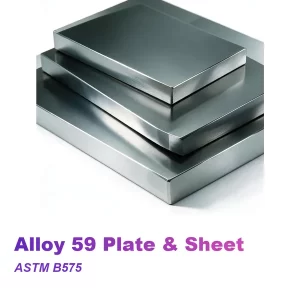
| ASTM B575 / ASME SB575 | Plate, sheet, and strip in the same grade |
| NACE MR0175 / ISO 15156-3 | Sour service qualification for oil and gas |
| DIN 17750 / 17751 | Flat product and tube in the European system |
| VdTÜV 505 | German pressure-equipment approval |
| UNS N06059 | Unified Numbering System designation |
| W.Nr. 2.4605 / NiCr23Mo16Al | European designation |
| GB/T 15007 NS3311 | Chinese designation |
| SAE AMS | No aerospace specification covers this grade |
Nicrofer 5923 hMo is a trademark of VDM Metals, and Inconel and Incoloy are trademarks of Special Metals Corporation. We list these names for cross-reference only, and our tube ships to the ASTM and ASME documents above.
The product documents come from ASTM International, and their text settles any acceptance question.
Each document sets its own size window, so a seamless ceiling and a welded size list tell different stories. Therefore, state the route and the dimensions together.
| Product Form | Outside Diameter | Wall Thickness |
|---|---|---|
| Seamless pipe and tube, ASTM B622 | 6–219 mm | 0.5–12.7 mm |
| Welded pipe, ASTM B619 | Schedule 5S through XXS | Per schedule |
| Welded tube, ASTM B626 | 3.2–88.9 mm | 0.41–3.7 mm |
| U-bend tube | As drawn, bent to drawing | 0.7–6 mm |
| Instrument tube | 3.2–25 mm | 0.5–3 mm |
Finish follows the next operation rather than a catalog default. In short, we agree it with the order so the bore suits the duty you have planned.
| Surface Condition | Typical Use |
|---|---|
| Solution annealed and pickled | Standard delivery for acid and chloride service |
| Bright annealed | Scale-free bore for instrument and clean circuits |
| Polished bore | Reduced roughness for product-contact tubing |
| Ground outside diameter | Tight tolerance for tube-to-tubesheet joints |
| Hot-finished | As-produced surface for lines that will be coated or lined |
| U-bent and stress relieved | Bundle form ready for exchanger assembly |
Get detailed information including specifications, standards, dimensions and material properties.
One coordinator follows your order from the first enquiry to the last shipping paper. Nothing moves until the route and the pressure class agree.
Give the medium, the pressure class, the diameter, and the wall.
Tell us whether you want seamless, welded pipe, or welded tube.
We settle hydrostatic, eddy current, or both against the specification.
Both routes reach you with price, lead time, and the certificate set.
Grade, size, test level, and delivery terms go on record first.
The mill melts, extrudes, draws, anneals, quenches, and tests the heat.
Where the drawing calls for it, we bend, stress relieve, and bundle the tube.
Finally, the desk follows the load and sends the paperwork before it docks.
Feedback from buyers and engineers who source nickel alloy materials from Southerly Alloy.
“The seamless and welded quotes arrived side by side, which let us drop the pressure class on half the circuit.”
“The quench log came stapled to the pressure report, so our third-party inspector signed off in one visit.”
“A single U-bend bundle settled the radius and the bore finish before we replaced the whole exchanger.”
Our production and inspection processes are certified to international standards, and every delivery ships with EN 10204 3.1 mill test certificates.
Quality Management System
Pressure Equipment Directive
Material Standards Compliance
Mill Test Certificates
B622 for seamless product, B619 for welded pipe, and B626 for welded tube.
Outside diameter from 6 to 219 mm, with wall from 0.5 to 12.7 mm.
Past that diameter the welded route costs less and B619 covers the sizes, so we quote welded pipe instead.
Iron holds at 1.5% maximum instead of 7%, which lifts the pitting resistance equivalent and protects the weld seam.
ERNiCrMo-13 wire to AWS A5.14, or ENiCrMo-13 covered electrodes to AWS A5.11.
Therefore, one length covers most stock sizes.
We quote mainly on FOB terms, and EXW or CIF follow on request.
Nickel, chromium, and molybdenum set the base, and the route, wall, and test scope set the rest.
Stock sizes ship in 7-15 days, and made-to-order material runs about 30 days.
Yes. Every heat ships with an EN 10204 3.1 certificate, and we arrange 3.2 endorsement on request.
Give the route, the diameter, the wall, and the duty on the enquiry. Our engineers come back with a quotation, a delivery date, and the certificate list. Because the test level changes the price, tell us whether the line runs under pressure code.
A trial quantity costs little, so one length proves the grade before a plant-wide order.