01
Hastelloy B-2 Bar and Rod
Specifically, rod to ASTM B335 runs from 7.94 to 88.9 mm diameter, with larger sections supplied as forged bar.
View Hastelloy B-2 Bar and Rod →Nickel-molybdenum grade for hydrochloric acid at every concentration, with a strict mid-temperature limit.
The page sets out the 26.0–30.0% molybdenum range and the 0.02% carbon ceiling that keep this grade weldable as delivered.
Consequently, oxidizing media, ferric contamination, and the 540–815 °C interval appear beside the capabilities, so a specification review sees both sides.
Bar, tube, and flat product trace to a single melt and ship under one EN 10204 3.1 document set.
Hastelloy B-2 is a nickel-molybdenum alloy carrying the UNS designation N10665. Molybdenum runs 26 to 30% while chromium stops at 1%, so reducing acids meet little attack. Above all, that same balance leaves the grade helpless against oxidizing media.
Buyers reach this grade from three directions, and the form pages carry the ordering detail. Round bar sits on the Hastelloy B-2 Bar and Rod page, tubular product on Hastelloy B-2 Pipe and Tube, and flat product on Hastelloy B-2 Plate and Sheet. One melt then covers all three, because the anneal and the paperwork stay the same across forms.
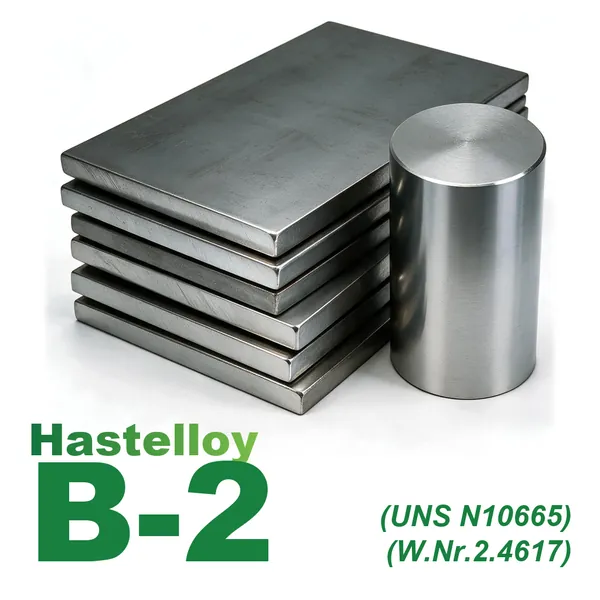
Hastelloy B-2 is a nickel-molybdenum alloy with chromium held near zero, and that chemistry makes it the benchmark for hydrochloric acid at every concentration up to boiling. UNS N10665 also resists sulfuric, phosphoric, and organic acids while oxidants stay absent. Ferric or cupric contamination destroys the passive film, and mid-temperature exposure between 540 and 815 °C precipitates Ni4Mo. Southerly Alloy works as a professional supplier and exporter of UNS N10665 bar, tube, and flat-rolled product under ASTM B335, B622, and B333.
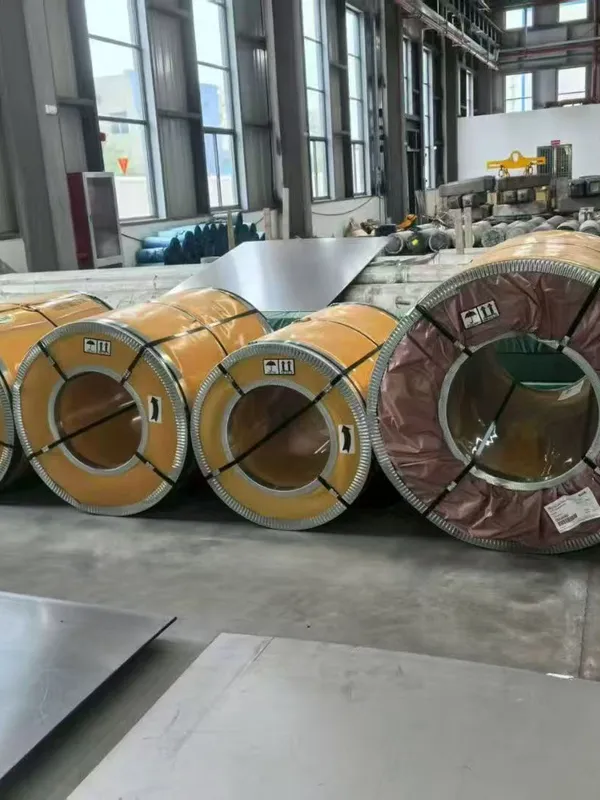
Dilute through concentrated, from ambient to boiling, the grade holds its surface while the stream stays reducing.
Moreover, non-oxidizing sulfuric acid, phosphoric acid, and several organic acids sit inside the working envelope.
As a result, chloride-bearing media cause no stress-corrosion cracking at any temperature.
Carbon at 0.02% maximum limits carbide precipitation, so welded fabrications often enter service as delivered.
The element that resists reducing acids sits at 26.0–30.0%, which is the highest in the wrought nickel family.
Nitric acid, wet chlorine, and hypochlorite attack the metal, so those duties need a chromium-bearing alloy.
Therefore, Ni4Mo forms between 540 and 815 °C, which makes quench control more important than insulation thickness.
Consequently, no aging treatment exists, so yield above the annealed minimum comes from drawing or rolling alone.
To begin with, the choice turns on whether the process stream oxidizes. Hydrochloric and sulfuric acid bring B-2 into play, while nitric acid or ferric contamination rules the grade out. From there, fabrication heat decides the rest.
Molybdenum at 26.0–30.0% carries the duty, so hydrochloric acid stays inside the window at every concentration up to boiling.
In addition, because Ni4Mo forms between 540 and 815 °C, the grade suits quench-controlled service rather than hot-wall equipment.
Welding runs in the annealed condition with ERNiMo-7 filler, yet severe acid duty still needs a post-weld solution anneal and quench.
ASTM B335 covers rod, B333 covers flat product, and B622 covers seamless tube, so one chemistry reaches three routes.
Standard practice splits the grade by product form, because the anneal and the finish change with the route. Consequently, a purchase order should name the form before the size.
Specifically, rod to ASTM B335 runs from 7.94 to 88.9 mm diameter, with larger sections supplied as forged bar.
View Hastelloy B-2 Bar and Rod →Seamless tube to B622 up to 88.9 mm outside diameter, plus welded pipe to B619 and welded tube to B626.
View Hastelloy B-2 Pipe and Tube →Flat product to ASTM B333, from 4.76 mm plate down through light sheet and strip.
View Hastelloy B-2 Plate and Sheet →Process streams decide where the grade serves, and the medium carries more weight than the temperature. Consequently, plants handling pure reducing acids form the core of the order book.
Discuss Your Application →Reactors, absorbers, and reboilers in HCl synthesis and acid recovery.
Heat exchangers and transfer lines handling non-oxidizing acid concentrations.
Evaporators, agitators, and transfer fittings in wet-process acid plants.
Reactor internals and distillation hardware for acetic and formic acid duty.
Catalyst systems where hydrolysis releases hot hydrochloric acid into the circuit.
Meanwhile, tanks, heating coils, and racks in steel pickling lines take the same grade.
Internals that run hot under vacuum or in reducing gas rather than air.
Finally, ducting and absorber hardware for acidic flue-gas treatment rounds out the list.
Detailed technical information including chemical composition, mechanical properties, standards and available dimensions.
The limits below come from ASTM B335 and B333, which share one composition table for UNS N10665. Carbon and silicon stay low because weld-zone precipitation follows them. The mill certificate governs final acceptance.
| Element | Content |
|---|---|
| Nickel (Ni) | Balance |
| Molybdenum (Mo) | 26.0–30.0% |
| Iron (Fe) | 2.0% max. |
| Chromium (Cr) | 1.0% max. |
| Cobalt (Co) | 1.00% max. |
| Manganese (Mn) | 1.0% max. |
| Carbon (C) | 0.02% max. |
| Silicon (Si) | 0.10% max. |
| Phosphorus (P) | 0.04% max. |
| Sulfur (S) | 0.03% max. |
Minimums differ between product documents, so the ordered form and section decide the acceptance table. As a result, we quote hardness and yield figures from the edition your purchase order names.
| Product Form | Condition | Tensile Strength | Yield Strength, 0.2% Offset | Elongation | Hardness |
|---|---|---|---|---|---|
| Rod, ASTM B335 | Solution annealed, 7.94–88.9 mm | ≥110 ksi (760 MPa) | ≥51 ksi (350 MPa) | 40% | 100 HRB max. |
| Plate, ASTM B333 | Solution annealed, 4.76–63.5 mm | ≥110 ksi (760 MPa) | ≥51 ksi (350 MPa) | 40% | 100 HRB max. |
| Sheet and strip, ASTM B333 | Solution annealed, under 4.76 mm | ≥110 ksi (760 MPa) | ≥51 ksi (350 MPa) | 40% | 100 HRB max. |
| Seamless tube, ASTM B622 | Solution annealed, to 88.9 mm | ≥110 ksi (760 MPa) | ≥45 ksi (310 MPa) | 40% | 100 HRB max. |
| Forgings, ASTM B564 | Solution annealed | ≥110 ksi (760 MPa) | ≥51 ksi (350 MPa) | 40% | 100 HRB max. |
Rod and plate share one set of minimums, while seamless tube carries a lower yield floor. Cold work raises those figures, and no aging treatment applies.
Values below are typical room-temperature figures for design work rather than acceptance criteria. In addition, the alloy stays non-magnetic in the annealed condition, which suits instrument assemblies.
| Property | Value |
|---|---|
| Alloy | Hastelloy B-2 |
| UNS | N10665 |
| Werkstoff | 2.4617 |
| Density | Approx. 9.22 g/cm³ |
| Melting range | Approx. 1330–1380 °C |
| Modulus of elasticity | Approx. 217 GPa |
| Thermal conductivity at 0 °C | Approx. 11.1 W/m·K |
| Thermal conductivity at 100 °C | Approx. 12.2 W/m·K |
| Specific heat at 100 °C | Approx. 389 J/kg·K |
| Electrical resistivity at 20 °C | Approx. 1.37 µΩ·m |
| Thermal expansion, 20–93 °C | Approx. 10.3 µm/m·K |
| Magnetic behaviour | Non-magnetic in the annealed condition |
| Strengthening route | Cold work only |
The forms divide between seven ASTM documents, and the ASME editions take over under pressure-code jurisdiction. Specifically, no SAE aerospace specification reaches UNS N10665. Meanwhile, the European and Chinese designations below serve cross-reference only.
| Standard | Product or Application |
|---|---|
| ASTM B335 / ASME SB335 | Nickel-molybdenum alloy rod, 7.94–88.9 mm |
| ASTM B333 / ASME SB333 | Plate, sheet, and strip in hot-rolled or cold-rolled condition |
| ASTM B622 / ASME SB622 | Seamless pipe and tube to 88.9 mm outside diameter |
| ASTM B619 / ASME SB619 | Welded pipe in Schedule 5S, 10S, 40S, and 80S and larger |
| ASTM B626 / ASME SB626 | Welded tube, 3.2–88.9 mm outside diameter |
| ASTM B564 / ASME SB564 | Nickel alloy forgings |
| ASTM B366 / ASME SB366 | Factory-made wrought fittings |
| ASTM B462 | Forged or rolled flanges and forged fittings |
| ASTM B472 | Forging billets and bars for reforging |
| DIN 17743 / 17750 / 17751 / 17752 / 17753 / 17754 | Wrought nickel alloys, flat product, tube, bar, wire, and forgings |
| ISO 6207 / 6208 / 9723 / 9724 / 9725 | Tube, flat product, bar, wire, and forgings |
| UNS N10665 | Unified Numbering System designation |
| W.Nr. 2.4617 / NiMo28 | European designation for Alloy B-2 |
| GB/T 15007 NS322 | Chinese designation |
| SAE AMS | No aerospace specification covers this grade |
The product documents come from ASTM International, and the full specification text settles any acceptance question.
Ranges below follow the scope each standard defines, and oversize bar moves to the forging document. For that reason, a quotation needs the product form, the ordered diameter, and the delivery condition.
| Product Form | Typical Supply Range |
|---|---|
| Rod | 7.94–88.9 mm diameter to ASTM B335 |
| Forged bar | Diameters above 88.9 mm, supplied to ASTM B564 |
| Seamless tube | Outside diameter to 88.9 mm |
| Welded pipe | Schedule 5S, 10S, 40S, and 80S to 8 in nominal and larger |
| Welded tube | Outside diameter 3.2–88.9 mm, wall 0.41–3.7 mm |
| Plate | 4.76–63.5 mm thick to ASTM B333 |
| Sheet | Under 4.76 mm thick, from 600 mm wide |
| Strip | Under 4.76 mm thick, under 600 mm wide |
Finish follows the next operation rather than a catalog default. In short, we agree it with the order so the surface reaches your shop ready for use.
| Surface Condition | Typical Characteristics or Applications |
|---|---|
| Solution annealed and pickled | The standard delivery condition for reducing-acid service |
| Hot-worked | As-rolled or as-forged surface for parts that will be machined |
| Cold drawn | Close diameter control with a brighter surface |
| Peeled | Uniform diameter with a machined skin for further turning |
| Centerless ground | Tight diameter and straightness for shafting |
| Polished | Reduced roughness for product-contact and visible parts |
| Bright annealed | Scale-free surface for instrument and clean circuits |
Get detailed information including specifications, standards, dimensions and material properties.
B335 governs rod, B333 plate, sheet, and strip, and B622 seamless tube.
No. The SAE aerospace series stops short of UNS N10665.
Avoid 540–815 °C. However, oxidizing atmospheres cap the grade near 540 °C, while vacuum and reducing gas allow more.
Yes, at every concentration up to boiling, provided the stream carries no oxidant.
Ferric and cupric ions. Even a few parts per million strip the passive film and start rapid attack.
ERNiMo-7 wire to AWS A5.14 and ENiMo-7 electrodes to AWS A5.11.
One piece covers most stock sizes.
We quote mainly on FOB terms, and EXW or CIF follow on request.
Stock sizes ship in 7-15 days. Meanwhile, made-to-order annealed rod runs about 25 days.
Yes. Every heat ships with an EN 10204 3.1 certificate, and we arrange 3.2 endorsement on request.
Send the product form, the ordered size, and the acid duty you need. Our engineers then answer with price, lead time, and the document set in one reply. Quotations stay valid for the nickel and molybdenum share fixed at the quotation date.
Trial quantities are welcome, so a single piece of stock rod or one plate is enough to prove the grade before a plant-wide order.