01
Monel 400 Plate
Hot-rolled plate from 4.76 mm to 100 mm for vessels, flanges, and tubesheets.
Request Availability →UNS N04400 flat product to B127 — hot-rolled plate, cold-rolled sheet, and strip cut to your blank list.
Above all, the page sets the thickness lines between plate, sheet, and strip, so a blank list meets the right product class.
In addition, cold-rolled coil runs from quarter-hard through spring temper when a part needs strength without heat treatment.
Moreover, sheet and strip draw, spin, and weld with ERNiCu-7 filler, so a fabrication shop keeps to one route.
Monel 400 Plate and Sheet supplies UNS N04400 flat product for vessel shells, linings, and gaskets. The grade holds up in flowing seawater, hydrofluoric acid, and caustic service. Flat gauges follow ASTM B127, and we cut each order to your blank list.
The grade hub at Monel 400 holds chemistry, standards, and process limits. Ordering detail for the other two routes sits on the Monel 400 Bar and Rod and Monel 400 Pipe and Tube pages.
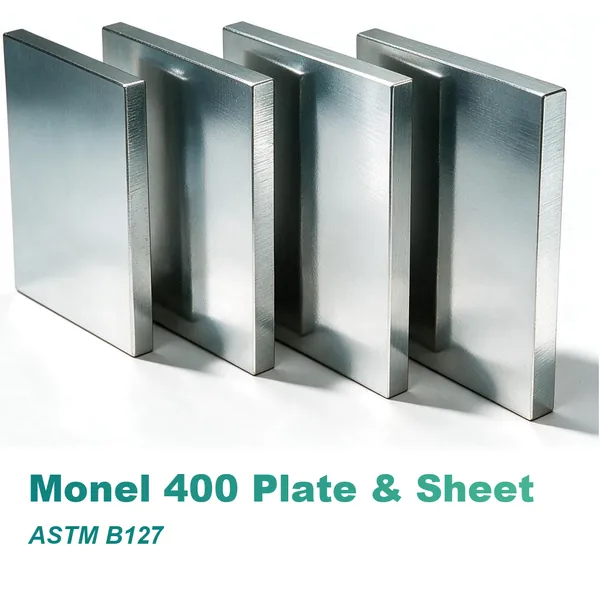
Monel 400 plate and sheet cover UNS N04400 flat product to ASTM B127, from 4.76 mm hot-rolled plate up to 100 mm and down to 0.13 mm coil. The grade resists flowing seawater, hydrofluoric acid, and caustic solutions, so flat product suits vessel shells, linings, tubesheets, and gaskets. Cold-rolled tempers run from annealed through quarter-hard to spring, which lets parts take strength without a heat treatment. Each order ships cut to a blank list with EN 10204 3.1 certificates.

Above all, B127 sets plate at 4.76 mm and above, sheet between 0.46 mm and 6.4 mm, and coil from 0.13 mm.
Meanwhile, cold-rolled product runs from annealed through quarter-hard, half-hard, hard, and spring temper.
Consequently, hard-rolled sheet reaches a 90 ksi yield minimum, which parts use as-rolled.
Still, no yield requirement applies under 0.51 mm thickness, so foil-thin gauges rely on tensile and hardness.
Therefore, chloride-bearing cooling water and spray leave the surface stable, so tank linings last.
In short, HF service takes plate and sheet where the alloy resists every concentration to boiling.
Moreover, caustic soda causes little attack, which suits tanks, evaporator shells, and ducting.
Cold forming, spinning, and welding with ERNiCu-7 filler all work on standard shop equipment.
Every flat-product enquiry reaches the team that rolls, anneals, and cuts nickel-copper sheet on one site. To begin with, we match the ordered thickness and temper to the route that makes it. Therefore, the blank list you approve is the blank list we cut.
We check grade, thickness, temper, and width against B127 before the plate enters the shear.
Heat numbers, EN 10204 3.1 certificates, and flatness or hardness records travel with each consignment.
One blank, one plate, or a full container load runs through the same qualified rolling route.
Every reply names thickness tolerance, temper, and the certificates that come with the load.
Monel 400 plate and sheet start as a nickel-copper heat melted to the UNS N04400 balance. Above all, each slab or coil then follows one route to the ordered temper. The plant logs composition and test results under the heat number that follows the metal.
Refined nickel and cathode copper enter the melt at the UNS N04400 balance, with impurity limits taken from B127.
Induction melting feeds slab ingots for plate, and continuous casting feeds the coil route.
Reheating and rolling reduce the slab to plate thickness while the wrought structure refines.
Further reduction to sheet and strip gauge sets thickness tolerance and surface finish.
An anneal follows each cold pass, restoring ductility before the next reduction.
Controlled final passes set quarter-hard, half-hard, or hard temper to the ordered strength.
Shear, plasma, or waterjet cutting brings plate and blanks to length, width, and edge condition.
Chemistry, tensile, hardness, and dimensional checks run before the plate or coil leaves the works.
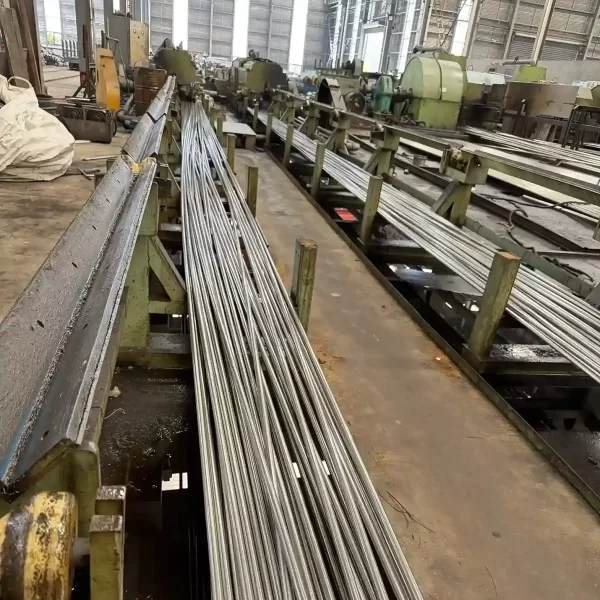
Monel 400 plate and sheet ship in standard and custom sizes, with thickness, temper, and cut plan settled before rolling starts. Meanwhile, the numbers below set out the capacity that stands behind that schedule.
Rolling, annealing, and cutting bays on one site.
Hot-rolling mills, cold mills, shears, and inspection equipment.
Nickel-copper and nickel alloy flat-product output.
Metallurgists who confirm thickness tolerance and temper at quotation.
Annealed, quarter-hard, half-hard, hard, and spring-temper flat product.
Flat product leaves the works only after the ordered B127 requirements show on the heat. Moreover, thickness, hardness, and tensile results stay with the material for incoming verification.
Spectrometer analysis confirms the UNS N04400 balance before the slab enters rolling.
Micrometer checks on gauge, plus flatness verified against the ordered tolerance class.
Tensile and hardness results from the delivered temper, with bend or grain-size testing where the order calls for it.
EN 10204 3.1 documents link every plate and coil to its heat number.
Above all, the flat-product family splits by thickness first and temper second, so the gauge you name decides the route.
Hot-rolled plate from 4.76 mm to 100 mm for vessels, flanges, and tubesheets.
Request Availability →Cold-rolled or hot-rolled sheet between 0.46 mm and 6.4 mm for shells and linings.
Request Availability →Coil from 0.13 mm to 6.4 mm, slit to width for press and roll-forming work.
Request Availability →Annealed or tempered sheet with controlled thickness for fabrication.
Request Availability →As-rolled or annealed plate with mill edge or sheared edge.
Request Availability →Plate and sheet cut to a blank list, including burner-cut circles for exchanger parts.
Request Availability →Drilled or perforated sheet shaped to your drawing.
Request Availability →Consequently, flat product serves vessels and linings where chlorides, hydrofluoric acid, or caustic dominate. The duties below pair each service with the flat-product form that carries it.
Discuss Your Application →Plate and sheet linings for ballast tanks, condenser water boxes, and intake structures.
Plate shells and heads for alkylation reactors and acid storage.
Plate and sheet for caustic service at ambient and elevated temperature.
Tubesheets, baffles, and shell plate cut from heavier gauge.
Blanks cut from plate, including gasket sheet for chloride and HF joints.
Sheet for brine circuits where spray and condensate reach the metal.
Plate for brackets, deck hardware bases, and hull fittings.
Plate released inside the NACE hardness envelope for H2S-bearing duty.
Shells, trays, and internals for reducing and alkaline media.
Detailed technical information including chemical composition, mechanical properties, standards and available dimensions.
The limits below apply to UNS N04400 across the plate, sheet, and strip documents, so one chemistry governs every gauge. Nickel runs at 63.0% minimum with cobalt inside that figure. In addition, copper sits between 28.0% and 34.0%.
| Element | Content |
|---|---|
| Nickel (Ni) plus Cobalt (Co) | 63.0% min. |
| Copper (Cu) | 28.0–34.0% |
| Iron (Fe) | 2.5% max. |
| Manganese (Mn) | 2.0% max. |
| Carbon (C) | 0.30% max. |
| Silicon (Si) | 0.50% max. |
| Sulfur (S) | 0.024% max. |
Values below come from B127 for flat product, and the table separates hot-rolled plate from cold-rolled sheet and strip. Therefore, the temper on your drawing decides which row applies.
| Product Form | Condition | Tensile Strength | Yield Strength, 0.2% Offset | Elongation |
|---|---|---|---|---|
| Hot-rolled plate | Annealed | ≥70 ksi (485 MPa) | ≥28 ksi (195 MPa) | 35% |
| Hot-rolled plate | As-rolled | ≥75 ksi (515 MPa) | ≥40 ksi (275 MPa) | 25% |
| Hot-rolled sheet | Annealed | ≥70 ksi (485 MPa) | ≥28 ksi (195 MPa) | 35% |
| Cold-rolled sheet | Annealed | 70–85 ksi (485–585 MPa) | ≥28 ksi (195 MPa) | 35% |
| Cold-rolled strip | Quarter-hard | 78–85 ksi (538–586 MPa) | ≥45 ksi (310 MPa) | 20% |
| Cold-rolled sheet | Hard | ≥100 ksi (690 MPa) | ≥90 ksi (620 MPa) | 2% |
Below 0.51 mm thickness no yield requirement applies, and temper hardness runs from skin-hard near 68 HRB up to spring temper at 98 HRB and above. Therefore, quote gauge and temper together so acceptance stays unambiguous.
Values below are typical figures for design calculations rather than acceptance tests. Meanwhile, magnetic permeability stays low, so the alloy suits parts that sit near instruments.
| Property | Value |
|---|---|
| Alloy | Monel 400 |
| UNS | N04400 |
| Werkstoff | 2.4360 |
| Density | Approx. 8.80 g/cm³ |
| Melting range | Approx. 1300–1350 °C |
| Modulus of elasticity | Approx. 179 GPa |
| Thermal conductivity at 20 °C | Approx. 21.8 W/m·K |
| Specific heat at 20 °C | Approx. 427 J/kg·K |
| Electrical resistivity at 20 °C | Approx. 0.51 µΩ·m |
| Thermal expansion, 20–100 °C | Approx. 13.9 µm/m·K |
| Curie temperature | Approx. 21–49 °C |
| Strengthening route | Cold work only |
B127 governs flat product, and the ASME SB edition applies once the equipment falls under code jurisdiction. Moreover, the designations below identify the same melt rather than widening the acceptance window.
| Standard | Product / Application |
|---|---|
| ASTM B127 | Plate, sheet, and strip in hot-rolled and cold-rolled tempers |
| ASTM B906 | General requirements for flat-rolled nickel alloy product |
| ASME SB127 | Counterpart under pressure-code jurisdiction |
| SAE AMS 4544 | Plate, sheet, and strip, 67Ni - 30Cu, annealed |
| DIN 17750 | Flat product, W.Nr. 2.4360 |
| ISO 6208 | Nickel alloy flat product |
| ASTM B164 / B165 | Bar and rod, and seamless tube, in the same grade |
| NACE MR0175 / ISO 15156 | Sour service in oil and gas production |
| UNS N04400 · W.Nr. 2.4360 · NiCu30Fe | Designations |
The documents come from ASTM International. Meanwhile, aerospace flat product references AMS 4544, which covers annealed plate, sheet, and strip in 67Ni - 30Cu.
| Product Form | Typical Supply Range | Length / Width |
|---|---|---|
| Plate | 4.76–100 mm thick, up to 2000 mm wide | Up to 6000 mm |
| Sheet | 0.46–6.4 mm thick, up to 2000 mm wide | Up to 6000 mm |
| Strip and coil | 0.13–6.4 mm thick, slit to width | Coil or fixed length |
| Plate blank | Cut to your blank list | Up to 6000 mm |
| Circles | Burner-cut or machined to diameter | Per drawing |
| Perforated sheet | 0.5–6 mm thick | Per drawing |
Ranges above reflect normally produced sizes, and heavy plate depends on slab supply. Therefore, state thickness, width, length, temper, and edge condition when you order Monel 400 plate.
| Surface Condition | Typical Characteristics / Applications |
|---|---|
| Hot-rolled, annealed and pickled | Standard plate delivery for vessels and linings |
| Hot-rolled, as-rolled | Oxide surface for parts machined or blasted later |
| Cold-rolled, annealed | Smooth sheet for forming and visible parts |
| Cold-rolled, bright | Bright finish to the ordered roughness for clean service |
| Brushed or No. 4 | Cosmetic sheet for enclosure and panel work |
| Shot-blasted | Uniform matte plate ready for coating or lining |
Get detailed information including specifications, standards, dimensions and material properties.
Most flat-product orders leave the works two to four weeks after release, and heavy plate runs longer. Above all, the steps below fix thickness, temper, and test scope before the shear moves.
Give thickness, width, length, quantity, temper, and the medium the part will face.
Flat product runs to B127, with the ASME SB edition when a pressure code applies.
Annealed sheet suits forming, while quarter-hard or hard temper covers strength without a heat treatment.
Then we set the blank list, edge condition, and nesting so offcuts stay low.
The reply carries price, rolling route, test scope, documents, and an Incoterm.
Afterwards the mill rolls, anneals, and cuts each plate or coil to the agreed plan.
The papers travel with the load, and we settle Incoterm and packing before dispatch.
Feedback from buyers and engineers who source nickel alloy materials from Southerly Alloy.
“The 6 mm sheet formed and welded into our tank sections, and every blank matched the nesting plan.”
“Flatness on the 20 mm plate held inside tolerance, so our flanges needed no extra machining.”
“Hard-temper strip arrived with hardness results that matched the certificate, so our press ran first time.”
Our production and inspection processes are certified to international standards, and every delivery ships with EN 10204 3.1 mill test certificates.
Quality Management System
Pressure Equipment Directive
Material Standards Compliance
Mill Test Certificates
ASTM B127 covers all three, and the ASME SB127 edition applies once a pressure code governs the equipment. Both share one chemistry window for UNS N04400.
Plate starts at 4.76 mm (3/16 in.) and runs to 100 mm thick. Sheet and strip sit between 0.46 mm and 6.4 mm, and coil reaches down to 0.13 mm.
Annealed, quarter-hard, half-hard, hard, and spring temper. Hard temper reaches a 90 ksi yield minimum, so parts use it as-rolled.
Yes. Annealed sheet forms well, and we report grain size where a drawing operation needs it. Tell us the forming route at enquiry.
ERNiCu-7 wire to AWS A5.14 and ENiCu-7 electrodes to A5.11 suit the joints. As a result, welded plate and sheet need no post-weld heat treatment.
One plate or one blank covers most stock gauges, and trial quantities carry no minimum premium.
We quote FOB by default, and EXW or CIF terms follow once the destination and packing are clear.
Weight drives the quotation, with the copper share set on the order date. Cutting and edge preparation appear as separate lines.
Stock gauges leave in 7-15 days, and rolled-to-order plate gets a schedule date with the offer.
Yes. Every flat-product consignment carries an EN 10204 3.1 certificate, and we book 3.2 third-party endorsement on request.
Send thickness, width, length, quantity, temper, and the medium the part will face. Therefore, the reply carries price, rolling route, test scope, documents, and an Incoterm.