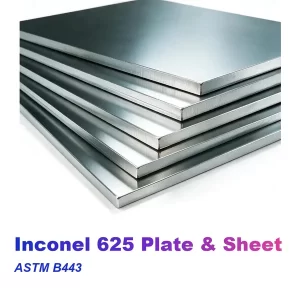
01
Hastelloy C-276 Hot-Rolled Plate
Plate from 4.8 mm thick in solution-annealed condition for vessel shells, scrubber liners, and ducting.
Request Availability →Hot-rolled and cold-rolled UNS N10276 plate, sheet, and strip to B575 for vessels, scrubbers, and acid plant duty.
Plate, sheet, and strip from 0.5 mm to 100 mm travel a single UNS N10276 purchase route.
Flat product resists oxidizing and reducing attack in the same vessel, so one lining serves the whole shell.
Our cutting lines also profile, shear, or saw plate to the geometry your fabricators need.
Hastelloy C-276 Plate and Sheet supplies UNS N10276 flat product for vessels, scrubbers, and acid plant equipment. Molybdenum and tungsten resist reducing media while chromium handles oxidizing ones. Gauges follow ASTM B575 under B906 general requirements.
Besides, the Hastelloy C-276 hub collects composition, standards, and mechanical minimums for the grade. Meanwhile, bar and tubular product live on the Hastelloy C-276 Bar and Rod and Hastelloy C-276 Pipe and Tube pages.
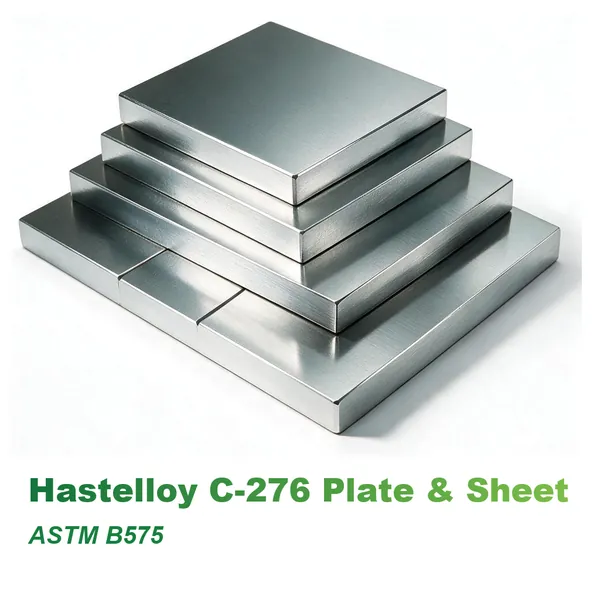
Hastelloy C-276 plate, sheet, and strip covers UNS N10276 to ASTM B575 in the solution-annealed condition, cut to your blank list. Gauges span 0.5 mm coil through 100 mm plate. Molybdenum at 15.0-17.0% and tungsten at 3.0-4.5% make flat product the default lining material for scrubber shells, reaction vessels, and acid evaporator bodies. EN 10204 3.1 certificates and heat-level traceability accompany every delivery.
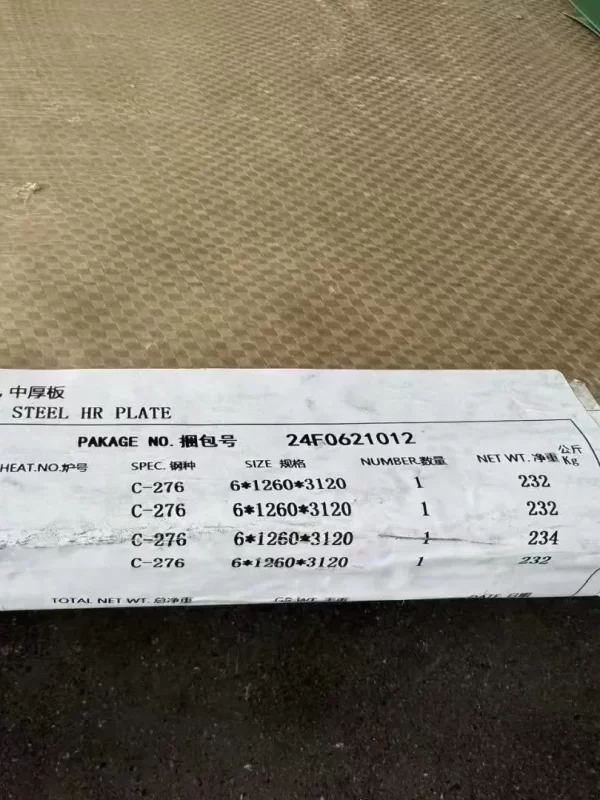
One plate grade copes with hydrochloric, sulphuric, phosphoric, and blended acid streams inside the same vessel.
Molybdenum keeps pitting and crevice attack away from wetted plate faces in brine and seawater duty.
Hypochlorite and chlorine dioxide service leaves few lining options, and flat C-276 product is one of them.
Hot-rolled plate, cold-rolled sheet, and strip all leave the mill in the water-quenched condition.
Cold forming, rolling, and welding proceed with no aging or stress-relief step.
You source coil from 0.5 mm and plate to 100 mm through the same enquiry.
Each certificate names the heat number with its chemistry and mechanical results.
Our commercial desk handles flat-product enquiries while audited partner plants melt and roll the plate. Your requirement reaches the mill that will run it, and one exchange settles gauge, cutting, and documentation.
We pick thickness and width from the rolling or pressing step your shop runs next.
For example, plasma, waterjet, and shear cutting brings plate to the blank geometry you draw.
Above all, ultrasonic testing, PMI, and third-party witness join the job as the service requires.
The same desk arranges packing, Incoterm, and destination documents.
Flat C-276 product passes through melt, slab rolling, cold rolling, and a water-quenched anneal before it is cut to size. In addition, the sequence changes with the ordered gauge, standard, and acceptance level.
Nickel, chromium, molybdenum, and tungsten charge melts to the N10276 window with carbon at 0.010% max.
AOD or vacuum treatment lowers carbon, silicon, and gas content, and ESR refines heats bound for critical service.
The mill reduces slabs to plate gauge on a schedule set for the ordered thickness.
Cold mills bring sheet and strip to final gauge, which tightens tolerance and surface finish.
The line heats material to 1120–1160 °C and quenches it in water to dissolve precipitates.
Leveling and cutting to size follow, then the batch clears inspection against the ordered acceptance level.
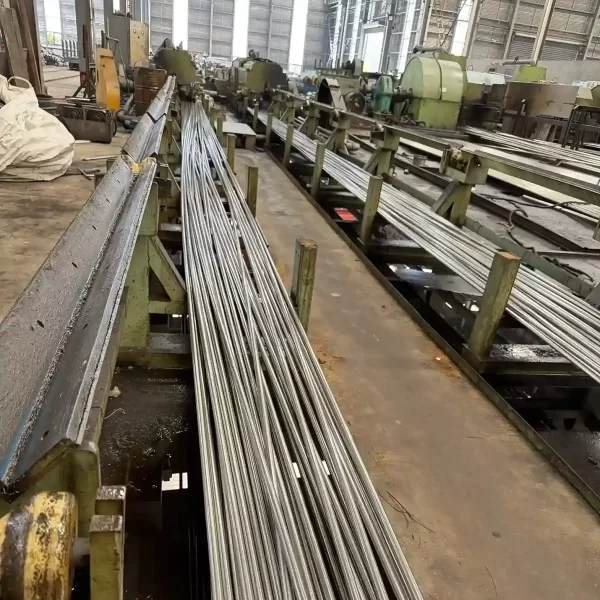
Hot-rolled plate and cold-rolled sheet in UNS N10276 come from 0.5 mm through 100 mm. We agree thickness, width, length, and edge condition before rolling starts. As a result, the rolling plan you approve at quotation carries through to dispatch.
Rolling, annealing, and leveling halls work on one site.
Cold and hot mills, shears, and levelers run under one quality system.
Monthly plate and sheet tonnage, covering standard and made-to-order gauges.
Our metallurgists settle gauge, condition, and cutting questions before the order starts.
Our inspectors clear chemistry, mechanics, gauge, and surface before any plate leaves. That work runs inside the ISO 9001 system. Above all, each delivery carries a mill certificate, and third-party inspection joins the order when required.
Spectrographic analysis confirms the N10276 window and records carbon and silicon on the mill certificate.
We measure mechanical values on the delivered gauge and condition.
Thickness, flatness, and edge quality go on file, with ultrasonic testing where specified.
Consequently, the certificate heat number links every plate back to its melt.
Overall, four flat-product forms cover the UNS N10276 range, and each follows its own finishing route under ASTM B575.
Plate from 4.8 mm thick in solution-annealed condition for vessel shells, scrubber liners, and ducting.
Request Availability →Sheet from 0.5 to 6.35 mm with a smoother finish for fabricated equipment and linings.
Request Availability →Similarly, strip and coil from 0.5 to 6.35 mm come slit to width for roll forming and stamping.
Request Availability →Circles, rings, and profiled plate cut to your drawings from any stocked gauge.
Request Availability →This flat product suits vessels and gas-cleaning equipment where the wetted surface meets both acid and chloride attack. Thickness and blank size therefore follow the structure being built rather than a pressure rating.
Discuss Your Application →Absorber walls, ducting, and stack liners that carry chloride-laden flue gas.
Shell plate for reactors handling mixed mineral acids.
Pressure-retaining plate for exchangers in acid and chloride service.
Lining stock for hypochlorite, brine, and acid storage.
Hood plate and washer components in chlorine dioxide circuits.
Vessel plate for wet-process acid concentration trains.
Likewise, pressure plate for generator vessels and associated piping spools.
Polished sheet for reactor shells where metal pickup must stay minimal.
Stack liners, dampers, and duct plate for acidic combustion products.
Detailed technical information including chemical composition, mechanical properties, standards and available dimensions.
The UNS N10276 window below applies across the B575 flat-rolled family. Molybdenum and tungsten set the reducing-acid and localised-corrosion performance, and carbon stays ultra-low so welded seams keep their resistance. In addition, the purchase specification in force sets acceptance.
| Element | Content |
|---|---|
| Nickel (Ni) | 57.0% min. (balance) |
| Molybdenum (Mo) | 15.0–17.0% |
| Chromium (Cr) | 14.5–16.5% |
| Tungsten (W) | 3.0–4.5% |
| Iron (Fe) | 4.0–7.0% |
| Cobalt (Co) | 2.50% max. |
| Manganese (Mn) | 1.00% max. |
| Vanadium (V) | 0.35% max. |
| Silicon (Si) | 0.08% max. |
| Carbon (C) | 0.010% max. |
| Phosphorus (P) | 0.040% max. |
| Sulphur (S) | 0.030% max. |
Minimum values below follow ASTM B575 for the solution-annealed condition, which is the condition the standard lists for this grade. Therefore, confirm the ordered gauge and condition before acceptance.
| Product Form | Standard | Condition | Tensile Strength | Yield Strength, 0.2% Offset | Elongation |
|---|---|---|---|---|---|
| Hot-rolled plate | ASTM B575 | Solution annealed | ≥690 MPa (100 ksi) | ≥283 MPa (41 ksi) | ≥40% |
| Cold-rolled sheet and strip | ASTM B575 | Solution annealed | ≥690 MPa (100 ksi) | ≥283 MPa (41 ksi) | ≥40% |
| Cut blanks and profiled plate | ASTM B575 | Solution annealed | ≥690 MPa (100 ksi) | ≥283 MPa (41 ksi) | ≥40% |
Hardness on annealed flat product normally falls at or below 100 HRB. Aerospace flat product runs to AMS 5530, which adds melting practice, surface, and examination controls. Confirm the ordered condition at enquiry so the right document is quoted.
| Property | Value |
|---|---|
| Alloy | Hastelloy C-276 |
| UNS | N10276 |
| Werkstoff | 2.4819 |
| Density | Approx. 8.89 g/cm³ |
| Melting Range | Approx. 1325–1370 °C |
| Elastic Modulus | Approx. 205 GPa |
| Thermal Conductivity | Approx. 10.2 W/m·°C at 20 °C |
| Specific Heat | Approx. 427 J/kg·°C |
| Expansion Coefficient | Approx. 11.2 µm/m·°C (20–100 °C) |
| Electrical Resistivity | Approx. 1.30 µΩ·m at 20 °C |
| Alloy Type | Nickel-molybdenum-chromium with tungsten |
| Standard | Product / Application |
|---|---|
| ASTM B575 / ASME SB575 | Plate, sheet, and strip |
| ASTM B906 | General requirements for nickel alloy flat-rolled product |
| SAE AMS 5530 | Plate, sheet, and strip for aerospace work |
| ASTM B564 / B366 | Forgings, flanges, and wrought fittings in the same grade |
| NACE MR0175 / ISO 15156 | Sour service in oil and gas production |
| DIN 17750 | Nickel alloy plate, sheet, and strip, W.Nr. 2.4819 |
| ISO 6208 | Nickel and nickel alloy plate, sheet, and strip |
| UNS N10276 · W.Nr. 2.4819 · NiMo16Cr15W · NS334 | Designations |
ASTM International issues the flat-rolled documents. Besides, the ASME SB575 edition governs wherever a vessel falls under pressure-code jurisdiction.
Exposure between roughly 650 and 1090 °C during fabrication can precipitate intermetallic phases, so hot forming needs a follow-up solution anneal. Our engineers review that step with your shop before the plate leaves.
| Product Form | Typical Supply Range | Length |
|---|---|---|
| Hot-rolled plate | 4.8–100 mm thick, widths to 2000 mm | Cut to length and width |
| Cold-rolled sheet | 0.5–6.35 mm thick, widths to 1500 mm | Cut to length and width |
| Strip and coil | 0.5–6.35 mm thick, slit to width | Coil or custom lengths |
| Cut blanks | Any stocked gauge | To customer drawing |
Gauges beyond the listed windows depend on slab and coil supply. Therefore, confirm gauge, width, edge finish, and condition at enquiry so the route can be priced accurately.
| Surface Condition | Typical Characteristics / Applications |
|---|---|
| Solution Annealed & Pickled | Standard delivery for lining, vessel, and duct fabrication |
| Bright Annealed | Scale-free surface for clean or visible service |
| Pickled Only | Acid-descaled finish for general industrial work |
| Polished | Reduced roughness for product-contact and hygienic duty |
| Mill Finish | Hot-rolled surface for parts machined after delivery |
Get detailed information including specifications, standards, dimensions and material properties.
Most flat-product orders ship two to four weeks after release, and heavy plate takes longer. Price firms up once thickness, condition, and cutting scope line up with your fabrication plan.
List thickness, width, length, quantity, and condition, plus the vessel or duct the plate will serve.
B575 covers industrial flat product, while AMS 5530 applies to aerospace gauges.
Solution-annealed stock suits forming, and we agree blank geometry before rolling. Then the cutting plan locks in.
Your offer states the rolling route, cutting, testing, document scope, and Incoterm.
The mill rolls and anneals the plate, then tests it to the level agreed at order placement.
Each consignment ships with 3.1 certificates, packing list, and export papers.
Feedback from buyers and engineers who source nickel alloy materials from Southerly Alloy.
“Scrubber shell plate arrived flat and cut to our blank list, and the molybdenum figure on the certificate matched our incoming check.”
“Reactor shell sheet held its thickness across the whole order, so our rolling sequence never needed adjustment.”
“The ultrasonic records travelled with the plate, which turned incoming inspection into a document check instead of a re-test.”
Our production and inspection processes are certified to international standards, and every delivery ships with EN 10204 3.1 mill test certificates.
Quality Management System
Pressure Equipment Directive
Material Standards Compliance
Mill Test Certificates
You order flat-rolled C-276 product to ASTM B575, which sits alongside B906 general requirements. Additionally, ASME SB575 applies under code jurisdiction.
Gauges run from 0.5 mm coil through 100 mm hot-rolled plate, cut to your length and width. Still, thicker sections depend on slab supply.
Yes. Carbon at 0.010% max keeps grain-boundary carbides out of the weld zone, so post-weld heat treatment usually stays unnecessary. For that reason, shops save a furnace step on vessel fabrication.
Hot work above roughly 650 °C can precipitate intermetallic phases, so a follow-up solution anneal restores corrosion resistance. In that case, tell us the forming route and we quote the re-anneal with the order.
Yes. Plasma, waterjet, and shear cutting produce blanks, rings, and circles from any stocked gauge.
A single plate or sheet covers most stocked gauges. Consequently, trial lots carry no premium hurdle.
FOB is the default Incoterm. Alternatively, EXW, CIF, and DAP quotes follow confirmed destinations.
We quote plate by weight in kilograms against the ordered gauge, width, and condition. The applicable Incoterm appears on every offer.
Standard gauges ship in 7-15 days. Meanwhile, we quote cut-to-size or heavy plate against the confirmed schedule.
Yes. Each delivery carries an EN 10204 3.1 certificate. Likewise, we can arrange third-party 3.2 endorsement on request.
Send thickness, width, length, standard, and quantity, and we return price plus Incoterm. Cutting and condition questions can ride along in the same message.