01
Incoloy 800 / 800H / 800HT Bar and Rod
Round, hex, square, and forged sections for reformer hardware, furnace fixtures, and machined high-temperature parts.
View Incoloy 800 / 800H / 800HT Bar and Rod →Iron-nickel-chromium alloys split by carbon, Al+Ti, and grain size, with a 593 °C design divide.
Alloy 800, 800H and 800HT share a single iron-nickel-chromium composition range, and the carbon plus Al+Ti fields decide which designation the duty needs.
Our laboratory checks every 800H and 800HT heat to ASTM E112, so the ASTM 5 or coarser requirement arrives as a number rather than a promise.
The quotation names the ASME code cases that tabulate creep allowables for 800H and 800HT, so the design basis arrives with the price.
Incoloy 800 / 800H / 800HT is an iron-nickel-chromium alloy family built on one composition base. Carbon, the Al+Ti total, and annealed grain size separate the three designations. Accordingly, ASTM B407, B409 and B163 print them on a single composition table.
The family divides at about 593 °C, and that divide is the whole point of the series. Below it, the three grades behave alike. Above it, 800H and 800HT hold their strength far longer under load, because a controlled carbon window and a coarse grain structure slow the damage that ends a part's life. Southerly Alloy works as a professional supplier and exporter across bar, tube, and flat product, so a project can draw all three forms from one documentation set. Incoloy 800 / 800H / 800HT Bar and Rod covers the forged and machined side of the same family.
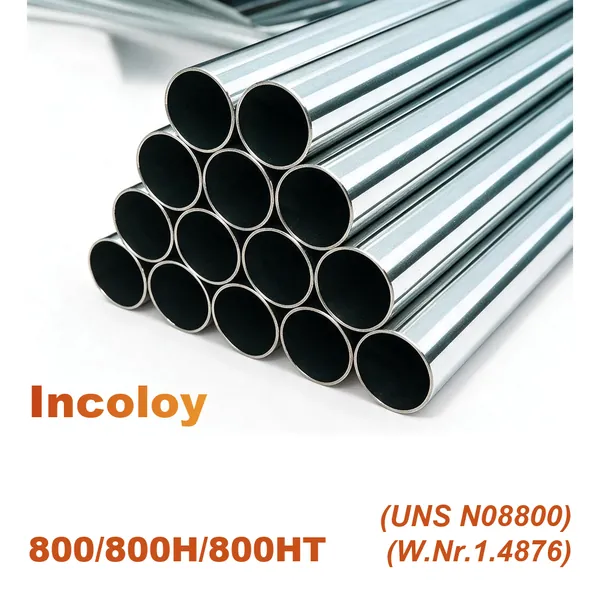
Incoloy 800, 800H and 800HT share one iron-nickel-chromium composition base, and only carbon, the Al+Ti total, and annealed grain size separate them. UNS N08800 suits general high-temperature service to about 593 °C, while UNS N08810 and N08811 carry design values for long-term creep above that line. Moreover, all three resist oxidation, carburization, and chloride stress-corrosion cracking, and all three remain weldable by standard practice. Southerly Alloy works as a professional supplier and exporter of bar, tube, and flat-rolled product in the series, with EN 10204 3.1 documentation on every heat.
A chromium-rich oxide scale stays adherent in air and combustion gas, so the surface keeps regenerating instead of spalling away.
The nickel-rich austenitic matrix and 19–23% chromium slow carbon ingress in carburizing furnace gas, where plain stainless steels fail early.
A controlled carbon window, the Al+Ti total, and a coarse grain structure combine to extend the hours a loaded part survives at temperature.
30–35% nickel keeps the structure austenitic and resists chloride cracking in aqueous service and wet-process streams.
The higher Al+Ti total of 800HT improves behaviour in sulfur-bearing reducing atmospheres where grade 800 would spall.
800H and 800HT receive a solution anneal at 1121 °C or 1149 °C minimum, with E112 grain size verified per lot.
Standard arc processes with a matching nickel filler produce sound joints, and consequently most fabrications release without a furnace cycle.
The lower anneal of grade 800 leaves a finer grain, which means its room-temperature tensile and yield minimums sit above those of 800H and 800HT.
Grade selection here turns on duty temperature, furnace atmosphere, and the design code. Moreover, the three designations carry different allowable stresses above 593 °C. Therefore, the choice changes wall thickness and expected life, not only price.
Oxidation, carburization, and sulfidation set the working envelope, and the chromium scale serves as the first line of defence on every one of them.
Grade 800 loses usable creep strength above that line, whereas 800H and 800HT keep theirs, which is why the code separates them.
The family forms and machines like an austenitic alloy, but the 425–815 °C sensitization band deserves attention on thick welded sections.
Each form carries its own ASTM specification, and the aerospace AMS documents reach only grade 800 chemistry rather than the whole family.
The series ships in three product families, and each one carries its own ASTM specification. Furthermore, the ordered grade fixes the anneal and the grain size, so form and duty travel together through the order.
Round, hex, square, and forged sections for reformer hardware, furnace fixtures, and machined high-temperature parts.
View Incoloy 800 / 800H / 800HT Bar and Rod →Seamless pipe to B407, heat-exchanger tube to B163, and welded pipe and tube for cracking and reforming service.
View Incoloy 800 / 800H / 800HT Pipe and Tube →Hot-rolled plate, cold-rolled sheet, and strip for muffle liners, retorts, and formed furnace internals.
View Incoloy 800 / 800H / 800HT Plate and Sheet →The series is the default choice wherever a part sits under load in hot, carburizing, or oxidizing atmospheres. Consequently, petrochemical furnaces, heat-treatment shops, and power plants account for most of the demand.
Discuss Your Application →Radiant coil and transfer-line exchanger tubing that runs carburizing process gas at 750–900 °C.
Pigtails, outlet manifolds, and collector headers on hydrogen, ammonia, and methanol reforming units.
Muffles, retorts, inner covers, trays, and baskets that cycle through carburizing and annealing furnaces.
Heat-transfer tube for pressurized water reactors, where design life runs into decades in high-purity water.
Superheater and reheater tubing, header end caps, and desuperheater liners in conventional and combined-cycle plants.
Heat exchangers and piping for nitric acid service, where the alloy combines aqueous corrosion resistance with chloride cracking resistance.
Sheathing and terminal parts for heating elements, the application that first brought the alloy to market.
Protective sheaths that must hold their shape through repeated thermal cycles in furnace atmospheres.
Detailed technical information including chemical composition, mechanical properties, standards and available dimensions.
The limits below follow the same composition table in ASTM B407, B409 and B163, with iron as the balance of the melt. Carbon, the Al+Ti total, and the annealed grain size are the three fields that separate the designations. In addition, the mill test certificate governs final acceptance.
| Element | Alloy 800 (UNS N08800) | Alloy 800H (UNS N08810) | Alloy 800HT (UNS N08811) |
|---|---|---|---|
| Nickel (Ni) | 30.0–35.0% | 30.0–35.0% | 30.0–35.0% |
| Chromium (Cr) | 19.0–23.0% | 19.0–23.0% | 19.0–23.0% |
| Iron (Fe) | 39.5% min. | 39.5% min. | 39.5% min. |
| Carbon (C) | 0.10% max. | 0.05–0.10% | 0.06–0.10% |
| Aluminium (Al) | 0.15–0.60% | 0.15–0.60% | 0.25–0.60% |
| Titanium (Ti) | 0.15–0.60% | 0.15–0.60% | 0.25–0.60% |
| Aluminium + Titanium | 0.30–1.20% | 0.30–1.20% | 0.85–1.20% |
| Copper (Cu) | 0.75% max. | 0.75% max. | 0.75% max. |
| Manganese (Mn) | 1.50% max. | 1.50% max. | 1.50% max. |
| Silicon (Si) | 1.00% max. | 1.00% max. | 1.00% max. |
| Sulfur (S) | 0.015% max. | 0.015% max. | 0.015% max. |
| Annealed Grain Size | Not specified | ASTM 5 or coarser | ASTM 5 or coarser |
We draw the minimums below from the tables of each product-form specification, and they change with grade, form, and delivery condition. Therefore, the same UNS number can show two different yield values depending on the standard that governs the form. Confirm the ordered grade and condition at quotation.
| Form and Standard | Grade / Condition | Tensile Strength, min. | Yield Strength (0.2%), min. | Elongation, min. |
|---|---|---|---|---|
| B408 rod and bar | N08800 — hot-worked, as-hot-worked | 80 ksi (550 MPa) | 35 ksi (240 MPa) | 25% |
| B408 rod and bar | N08800 — cold-worked and hot-worked, annealed | 75 ksi (515 MPa) | 30 ksi (205 MPa) | 30% |
| B408 rod and bar | N08810 / N08811 — annealed | 65 ksi (450 MPa) | 25 ksi (170 MPa) | 30% |
| B409 plate, sheet, and strip | N08800 — hot-rolled, annealed | 75 ksi (520 MPa) | 30 ksi (205 MPa) | 30% |
| B409 plate, sheet, and strip | N08800 — as-rolled | 80 ksi (550 MPa) | 35 ksi (240 MPa) | 25% |
| B409 plate, sheet, and strip | N08810 / N08811 — annealed | 65 ksi (450 MPa) | 25 ksi (170 MPa) | 30% |
| B407 seamless pipe and tube | N08800 — cold-drawn, annealed | 75 ksi (520 MPa) | 30 ksi (205 MPa) | 30% |
| B407 seamless pipe and tube | N08800 — hot-worked, annealed or as-hot-worked | 65 ksi (450 MPa) | 25 ksi (170 MPa) | 30% |
| B407 seamless pipe and tube | N08810 / N08811 — annealed | 65 ksi (450 MPa) | 25 ksi (170 MPa) | 30% |
| B163 heat-exchanger tube | N08800 — annealed | 75 ksi (517 MPa) | 30 ksi (207 MPa) | 30% |
| B163 heat-exchanger tube | N08800 — cold-worked | 83 ksi (572 MPa) | 47 ksi (324 MPa) | 30% |
| B163 heat-exchanger tube | N08810 / N08811 — annealed | 65 ksi (448 MPa) | 25 ksi (172 MPa) | 30% |
Five footnotes travel with the table above. First, the yield strength requirement does not apply to material thinner than 0.020 in. (0.51 mm). Second, N08810 and N08811 cold-rolled sheet ships only at 0.115 in. (2.92 mm) and heavier. Third, the strip elongation requirement does not apply below 0.010 in. (0.25 mm). Fourth, forging-quality bar ships to chemical and surface requirements only, with no mandatory tensile values. Finally, hot-worked rectangular bar at 5/16 in. (7.94 mm) and under carries an elongation minimum of 20%.
Typical values below describe all three grades, because the physical base does not change with the carbon window. Nevertheless, they support design work rather than acceptance testing.
| Property | Value |
|---|---|
| Density | Approx. 7.94 g/cm³ |
| Melting range | Approx. 1357–1385 °C |
| Specific heat, 0–100 °C | Approx. 460 J/kg·°C |
| Modulus of elasticity at 20 °C | Approx. 196.5 GPa |
| Thermal conductivity at 20 °C | Approx. 11.5 W/m·K |
| Thermal expansion, 20–100 °C | Approx. 14.4 µm/m·°C |
| Electrical resistivity at 20 °C | Approx. 0.989 µΩ·m |
| Curie temperature | Approx. −115 °C |
| Magnetic behaviour | Non-magnetic at ambient temperature |
| Hardness, annealed | Approx. 138 HB |
Each form of the series carries its own ASTM specification, and the AMS documents reach only the grade 800 chemistry. Consequently, the table below separates form standards from grade designations and design codes. Reference ASTM International for the current text of any specification named here.
| Standard / Designation | Scope |
|---|---|
| ASTM B408 / ASME SB408 | Rod and bar — UNS N08800, N08810, N08811 |
| ASTM B409 / ASME SB409 (with B906) | Plate, sheet, and strip — UNS N08800, N08810, N08811 |
| ASTM B407 / ASME SB407 (with B829) | Seamless pipe and tube — UNS N08800, N08810, N08811 |
| ASTM B163 / ASME SB163 | Seamless condenser and heat-exchanger tube |
| ASTM B514 / B515 (with B775 / B751) | Welded pipe and welded tube |
| ASTM B564 / B366 | Forgings, and wrought pipe fittings |
| SAE AMS 5766 | Alloy 800 bars, forgings, and forging stock, solution heat treated — UNS N08800 bars and forgings 4.0 in. (102 mm) and under |
| SAE AMS 5871 | Alloy 800 sheet, strip, and plate, solution heat treated — UNS N08800 in 0.25–50.8 mm thickness |
| ASME Code Case 1325 | Elevated-temperature design allowables for 800H, Sections I and VIII Divisions 1 and 2 |
| ASME Code Case 1983 | 800H design allowables to 1800 °F (982 °C), Section VIII Division 1 |
| ASME Code Case 1987 | Maximum allowable stresses for 800HT |
| ASME Code Cases N-201 / N-253 / N-254 | Nuclear construction under Section III |
| UNS N08800 / N08810 / N08811 | Material designations for Alloy 800, 800H and 800HT |
| W.Nr. 1.4876 / 1.4958 / 1.4959 | European designations, EN X10NiCrAlTi32-20 / X5NiCrAlTi31-20 / X8NiCrAlTi32-21 |
| EN 10095 / DIN 17459 / DIN 17460 | European heat-resisting materials standards, by product form |
| BS 3072–3076 (NA 15 series) | British designations NA 15, NA 15(H), and NA 15(HT) across flat, tubular, and bar products |
| JIS NCF 800 / NCF 800H / NCF 800HT | Japanese designations, with plate, sheet, and strip under JIS G 4902 |
| ISO FeNi32Cr21AlTi (NW8800 / NW8810 / NW8811) | ISO designations, the HC and HT suffixes marking the 800H and 800HT compositions |
| ISO 9723 / 9724 / 9725 | Bar, wire, and forgings in nickel and nickel alloys |
| ISO 6207 / ISO 6208 | Seamless tube, and plate, sheet, and strip in nickel and nickel alloys |
Ranges below reflect normally produced sizes for the series, and availability depends on grade, condition, and quantity. Above all, state the form, grade, section, and length in the inquiry, so we can confirm the route before quotation.
| Product Form | Typical Supply | Length |
|---|---|---|
| Round bar | 6–500 mm dia. | Cut to length or random |
| Round rod | 3–50 mm dia. | Cut to length |
| Hex and square bar | 10–150 mm | Cut to length or random |
| Flat bar | 3–100 mm thick × 10–300 mm wide | Cut to length |
| Forged bar and blanks | 100–500 mm dia. or forged section | Cut to length |
| Seamless pipe | 6–219 mm OD | Random or cut to length |
| Seamless heat-exchanger tube | 6–76 mm OD | Cut to length |
| Welded pipe and tube | 12–2032 mm OD | Random or cut to length |
| Hot-rolled plate | 3–100 mm thick | Up to 6000 mm |
| Cold-rolled sheet and strip | 0.25–3.5 mm thick | Coil or cut to length |
We match the finish to your next operation rather than to a catalogue default. Meanwhile, note that 800H and 800HT normally ship solution annealed so the coarse-grain structure survives to the end of the route.
| Surface Condition | Typical Use |
|---|---|
| Solution annealed | Standard delivery condition for 800H and 800HT, setting the ASTM 5 or coarser grain |
| Hot-worked | Supplied as-worked for parts that will be machined to final size |
| Annealed and pickled | Standard flat and tubular finish that removes scale ahead of forming or welding |
| Cold-rolled and bright annealed | Smooth sheet and strip for visible surfaces and formed components |
| Cold drawn | Close diameter control with a brighter surface for tubular and bar products |
| Peeled or rough turned | Machined skin on bar and heavy sections, with allowance for further turning |
| Centreless ground | Tight diameter and straightness for precision shafting and pins |
| Polished or brushed | Reduced roughness for visible or product-contact surfaces |
Choice inside this family follows the duty temperature and the governing design code, and the table below shows how the three grades land on an order. Specifically, the differing fields are the carbon window, the Al+Ti total, and the annealed grain size.
| Selection Factor | Alloy 800 | Alloy 800H | Alloy 800HT |
|---|---|---|---|
| UNS | N08800 | N08810 | N08811 |
| Carbon window | 0.10% max. | 0.05–0.10% | 0.06–0.10% |
| Al + Ti combined | 0.30–1.20% | 0.30–1.20% | 0.85–1.20% |
| Annealed grain size | Not specified | ASTM 5 or coarser | ASTM 5 or coarser |
| Minimum solution anneal | Not specified | 1121 °C (2050 °F) | 1149 °C (2100 °F) |
| Typical duty | General high-temperature service to about 593 °C | Creep-controlled service above 593 °C | Highest creep-rupture duty above 593 °C |
| Room-temperature strength | Highest of the three, from the finer annealed grain | Lower than grade 800 at room temperature | Lower than grade 800 at room temperature |
| Design code reference | ASTM B407, B408, B409 scope | ASME Code Cases 1325 and 1983 | ASME Code Case 1987 |
Get detailed information including specifications, standards, dimensions and material properties.
They share one composition base and one set of form standards. Grade 800 sets carbon at 0.10% max., 800H narrows that window and adds a coarse-grain anneal, and 800HT raises Al+Ti to 0.85–1.20%.
ASTM B408 names 1100 °F (593 °C) as the ceiling for normal service of UNS N08800. Beyond that line, creep rather than yield governs the part, and the controlled-carbon grades take over.
At high temperature the grain boundaries are the weak path, and damage starts there. Fewer boundaries mean fewer places for cavities to open. Consequently, 800H and 800HT specify ASTM 5 or coarser and reject fine grain.
ASTM B408 for rod and bar, B409 for plate, sheet, and strip, B407 for seamless pipe and tube, and B163 for heat-exchanger tube. B514 and B515 cover welded product, and each has an ASME SB edition.
No. AMS 5766 covers bars, forgings, and forging stock of the grade 800 composition, and AMS 5871 covers sheet, strip, and plate of the same chemistry. Neither reaches the 800H or 800HT window.
ERNiCr-3, the AWS A5.14 classification also known as Inconel 82 type, is the usual match. However, keep interpass temperature controlled, and avoid dwelling in the 425–815 °C band where sensitization can start on heavy sections.
One bar, one tube length, or one sheet for most stock sizes.
Our standard basis is FOB, and we add EXW or CIF terms to the offer on request.
Stock sizes leave in 7-15 days, and grain-controlled 800H and 800HT heats need about 25 days.
Yes. A 3.1 mill test certificate accompanies every heat, and we arrange the 3.2 third-party endorsement on request.
Send the grade, UNS number, form, size, and duty temperature to receive price, lead time, and documents in one reply. Consequently, we fix the annealing condition and the grain size requirement before production starts.
Incoloy 800, 800H and 800HT material is stocked in common sizes or produced to your drawing, and single-unit trials are accepted on many stock items.