01
Inconel 601 Bar and Rod
Round, hex, square, and forged bar to ASTM B166, delivered annealed or hot-finished.
View Inconel 601 Bar and Rod →Alumina-forming grade data for UNS N06601 / W.Nr. 2.4851 — composition, standards, and three supply forms.
Aluminium at 1.0–1.7% builds the sub-scale that keeps the oxide attached in cyclic furnace duty.
Bar, pipe, and plate enquiries are quoted and coordinated through the same commercial desk.
EN 10204 3.1 documents link each shipment back to its melting heat for incoming checks.
Inconel 601 is supplied in UNS N06601 / Werkstoff 2.4851, a nickel-chromium-aluminium grade with 1.0–1.7% aluminium. That addition builds an alumina sub-scale under the chromia layer, so the oxide resists spalling through thermal cycling. No age-hardening step applies, so welding and cold forming stay practical.
Below, the grade data is arranged for specification review — composition, standards, and mechanical minimums by form. Detailed sizes and supply conditions sit on the Inconel 601 Bar and Rod, Inconel 601 Pipe and Tube, and Inconel 601 Sheet and Plate pages.
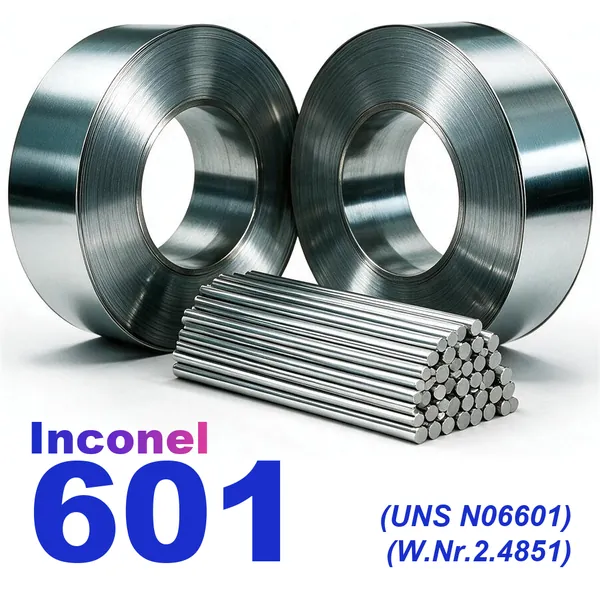
Inconel 601 is an alumina-forming nickel-chromium grade covering bar and rod, pipe and tube, and plate under the B166, B167, B163, B516, and B168 family. Aluminium at 1.0-1.7% builds a sub-scale beneath the chromia layer, so the protective oxide resists spalling through repeated furnace cycles. Chromium at 21-25% also carries carburizing and nitriding atmospheres to about 1250 °C. This page collects composition, standards, and mechanical minimums for UNS N06601.
Aluminium forms an Al₂O₃ layer beneath the chromia scale, which slows oxidation at peak temperature.
The oxide stays attached through repeated heating and cooling, so fixtures survive more campaigns.
Carbon pickup is slowed in carburizing and carbonitriding furnaces that embrittle stainless fixtures.
The grade resists nitrogen pickup where leaner heat-resistant steels harden and crack.
Continuous service in air is documented to roughly 1250 °C, with atmosphere and load setting the real limit.
Short-time load capacity stays useful near 1000 °C, above the austenitic stainless working range.
Chromium plus aluminium handles oxidizing sulphur atmospheres common to oil- and gas-fired furnaces.
Matching filler metal and no precipitation step keep shop and field repair straightforward.
Inconel 601 suits hot furnace atmospheres, where service life depends on an oxide scale that keeps rebuilding. Aluminium forms a sub-scale beneath the chromia layer, which survives repeated cycling. Consequently, the grade answers oxidation, carburizing, and nitriding duty from one specification.
Selection turns on how the scale behaves, not on base strength, when peak furnace temperature drives the design.
Carbon-rich atmospheres attack chromia-only scales, and the aluminium addition is what holds them back.
Fixtures and retorts take weld repair in the shop or in the field without an ageing step afterwards.
Short-time load capacity stays useful near 1000 °C, so supports and trays keep their shape through a campaign.
Three forms carry this grade, and each has a page with its own sizes, standards, and supply conditions.
Round, hex, square, and forged bar to ASTM B166, delivered annealed or hot-finished.
View Inconel 601 Bar and Rod →Seamless product to B167 and B163, with welded tube to B516 for furnace and exchanger duty.
View Inconel 601 Pipe and Tube →Hot-rolled plate and cold-rolled sheet to ASTM B168 in the annealed condition.
View Inconel 601 Sheet and Plate →This grade is chosen where hot gas and furnace atmosphere, not liquid corrosion, decide material life. Cycling rate and atmosphere therefore matter as much as the peak temperature.
Discuss Your Application →Heated tubes and covers running hot in air without shedding scale onto the load.
Fixtures carrying parts through carburizing and carbonitriding campaigns.
Closed vessels and shielding panels kept at temperature through long production runs.
Sensor sheaths that stay readable inside aggressive hot gas streams.
Parts that sit in the flame path of industrial process burners.
Catalyst grids, heater tubes, and support hardware in petrochemical plants.
Insulation cans, catalyst support grids, and high-temperature internals.
Grates and support fittings for waste incinerators and ceramic kilns.
Combustor liners and exhaust components in hot oxidizing gas flow.
Detailed technical information including chemical composition, mechanical properties, standards and available dimensions.
The window below follows the ASTM product family for UNS N06601. Aluminium sits inside a narrow 1.0–1.7% band because it drives the oxide behaviour. Acceptance follows the governing purchase specification.
| Element | Content |
|---|---|
| Nickel (Ni) | 58.0–63.0% |
| Chromium (Cr) | 21.0–25.0% |
| Aluminium (Al) | 1.0–1.7% |
| Iron (Fe) | Balance |
| Carbon (C) | 0.10% max. |
| Manganese (Mn) | 1.00% max. |
| Silicon (Si) | 0.50% max. |
| Copper (Cu) | 1.00% max. |
| Sulphur (S) | 0.015% max. |
Minimum room-temperature values below come from the governing standard and condition. Because these differ by product form, the ordered condition and size band decide final acceptance.
| Product Form | Standard | Condition | Tensile Strength | Yield Strength, 0.2% Offset | Elongation |
|---|---|---|---|---|---|
| Bar and rod | ASTM B166 | Annealed, cold-worked or hot-worked | ≥655 MPa (95 ksi) | ≥240 MPa (35 ksi) | ≥30% |
| Bar and rod | ASTM B166 | Hot-finished, as-worked | ≥585 MPa (85 ksi) | ≥240 MPa (35 ksi) | ≥15% |
| Seamless pipe and tube | ASTM B167 | Cold-worked or hot-worked annealed, all sizes | ≥550 MPa (80 ksi) | ≥205 MPa (30 ksi) | ≥30% |
| Heat-exchanger tube | ASTM B163 | Annealed | ≥552 MPa (80 ksi) | ≥207 MPa (30 ksi) | ≥30% |
| Welded tube | ASTM B516 | Cold-worked and annealed | ≥550 MPa (80 ksi) | ≥205 MPa (30 ksi) | ≥30% |
| Plate, sheet, and strip | ASTM B168 | Annealed | ≥550 MPa (80 ksi) | ≥205 MPa (30 ksi) | ≥30% |
Aerospace deliveries to AMS 5715 for bar and AMS 5870 for flat product add process controls and condition-specific minimums. State the required condition at enquiry so the right standard is applied.
| Property | Value |
|---|---|
| Alloy | Inconel 601 |
| UNS | N06601 |
| Werkstoff | 2.4851 |
| Density | Approx. 8.11 g/cm³ |
| Melting Range | Approx. 1360–1411 °C |
| Elastic Modulus | Approx. 206 GPa |
| Thermal Conductivity | Approx. 11.2 W/m·°C at 20 °C |
| Specific Heat | Approx. 450 J/kg·°C |
| Expansion Coefficient | Approx. 13.8 µm/m·°C (20–100 °C) |
| Electrical Resistivity | Approx. 1.19 µΩ·m at 20 °C |
| Alloy Type | Nickel-chromium-aluminium |
| Strengthening | Solid solution and cold work |
| Magnetic Behaviour | Non-magnetic at ambient temperature |
| Standard | Product / Application |
|---|---|
| ASTM B166 | Rod, bar, and wire in annealed and as-worked conditions |
| ASTM B167 | Seamless pipe and tube, hot-worked and cold-worked |
| ASTM B163 | Seamless tube for condensers and heat exchangers |
| ASTM B516 | Welded tube, cold-worked and annealed |
| ASTM B829 / B775 / B751 | General requirements for seamless and welded product |
| ASTM B168 | Plate, sheet, and strip |
| ASTM B906 | General requirements for nickel alloy flat-rolled product |
| ASME SB166 / SB167 / SB163 / SB516 / SB168 | Counterparts for pressure-code jurisdiction |
| SAE AMS 5715 | Bars, forgings, and rings |
| SAE AMS 5870 | Sheet, strip, and plate |
| DIN 17742 / 17751 / 17750 | Wrought nickel alloy, tube, and flat product |
| ISO 6207 / 6208 / 9723 | Nickel alloy tube, flat product, and bar |
| EN 10095 | Heat-resisting steels and nickel alloys |
| UNS N06601 · W.Nr. 2.4851 · NiCr23Fe · JIS NCF 601 · BS NA 49 | Designations |
Standards are issued by ASTM International. Once equipment comes under pressure-code jurisdiction, the ASME SB edition governs instead.
| Product Form | Typical Supply Range |
|---|---|
| Bar and rod | 3–500 mm dia. by section and condition |
| Seamless pipe | NPS 1/8 to NPS 24, SCH 10 to SCH 160 and custom wall |
| Seamless tube | OD 6–101.6 mm, wall 0.5–10 mm |
| Welded tube | OD 3.18–127 mm, wall 0.38–12.7 mm |
| EP / BA tube | OD 6–50.8 mm, wall 0.5–3 mm |
| Plate and sheet | 0.5–100 mm thick, cut to length and width |
Size windows move with standard and condition, and heavier sections depend on billet or slab supply. Therefore, quote the diameter, wall or thickness, and length at enquiry so the route is accurate.
| Surface Condition | Typical Characteristics / Applications |
|---|---|
| Annealed & Pickled | Standard condition for welding, forming, and furnace service |
| Bright Annealed | Scale-free surface for clean and visible applications |
| Solution Annealed | Condition set for high-temperature duty and forming |
| Hot-Worked | As-rolled or as-forged surface for parts machined to size |
| Cold Drawn | Close diameter control with a bright finish |
Get detailed information including specifications, standards, dimensions and material properties.
Seamless tubular product is ordered to B167 and B163, welded tube to B516, flat product to B168, and bar and rod to B166. Under pressure-code jurisdiction the ASME SB editions apply instead.
Oxidation resistance in air is documented to roughly 1250 °C (2282 °F). However, the practical ceiling depends on atmosphere, load, and cycling rate, so it is fixed case by case.
Solution annealing between 1100 and 1200 °C, followed by rapid cooling, sets the oxide-forming structure. Because the grade hardens only by cold work, no aging step applies.
ERNiCr-3 wire to AWS A5.14 pairs with ENiCrFe-3 electrodes for most joints. In addition, preheat is rarely required in shop or field work.
UNS N06601, W.Nr. 2.4851, and EN NiCr23Fe all designate the grade. Alloy 601 and Nickelvac 601 are common trade names for the same chemistry.
A single piece covers most stock sizes, so trials and repair quantities carry no premium hurdle.
FOB serves as the default Incoterm, while EXW, CIF, and DAP quotes follow confirmed destinations.
Quotations follow the ordered form, size, and condition, and are normally calculated by weight (kg). The applicable Incoterm is stated on every offer.
Stock sizes run 7-15 days, and made-to-order sections are quoted against the confirmed production schedule.
Yes. Every delivery ships with an EN 10204 3.1 certificate, and 3.2 endorsement through a third party is available on request.
Give the grade, form, standard, size, and quantity, and the reply returns price, Incoterm, lead time, and document list. Condition and tolerance questions can travel with the same message.