01
Incoloy 825 Bar and Rod
Round, hex, flat, and forged sections to ASTM B425, used for pump shafts, valve trim, and machined acid-plant parts.
View Incoloy 825 Bar and Rod →Titanium-stabilised nickel-iron-chromium alloy covering reducing and oxidising acids up to 540 °C.
Molybdenum and copper carry reducing-acid duty while chromium handles oxidising media, and as a result one grade covers both without a lining change.
For NACE MR0175 orders, the quotation fixes a 35 HRC ceiling and the release record then carries the measured values.
Titanium ties up carbon during melting, and consequently a welded fabrication keeps its intergranular resistance without a post-weld anneal.
Incoloy 825 is a titanium-stabilised nickel-iron-chromium alloy offered in UNS N08825 / W.Nr. 2.4858. Molybdenum and copper additions therefore extend its corrosion range into reducing acids, while chromium maintains the oxidising side.
Consequently, one material serves sulfuric, phosphoric, and nitric acid circuits inside a single plant, and it does so without a lining change. Above all, this alloy is not a high-temperature grade. Phase formation above about 540 °C costs ductility and impact strength, and for that reason designers avoid 825 wherever creep-rupture governs the wall. Moreover, NACE MR0175 / ISO 15156 covers sour oil and gas duty at a 35 HRC hardness ceiling. Southerly Alloy works as a professional supplier and exporter of Incoloy 825 Bar and Rod, Incoloy 825 Pipe and Tube, and Incoloy 825 Plate and Sheet, so all three forms arrive under one documentation set.
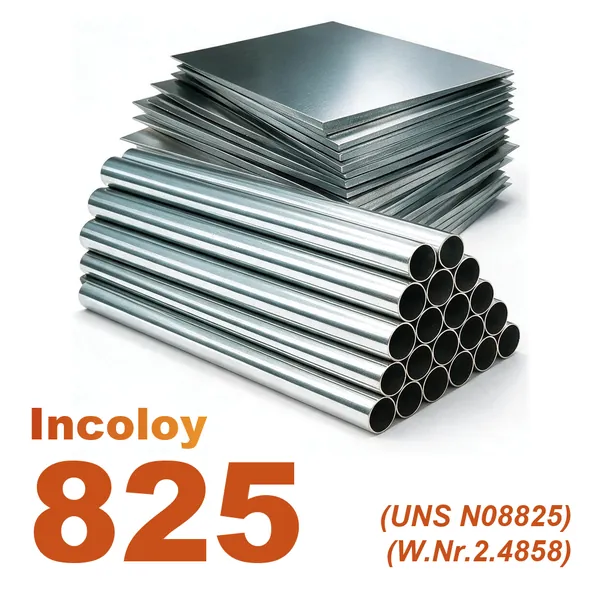
Alloy 825 is a titanium-stabilised nickel-iron-chromium grade, and copper plus molybdenum give it a corrosion range that spans reducing and oxidising acids. UNS N08825 keeps useful toughness from cryogenic service up to roughly 540 °C, and NACE MR0175 covers sour oil and gas duty at a 35 HRC ceiling. Because the grade is solid-solution strengthened rather than age hardened, strength above the annealed minimum comes from cold work. Southerly Alloy works as a professional supplier and exporter of 825 bar, tube, and flat-rolled product, and every heat ships with EN 10204 3.1 paperwork.
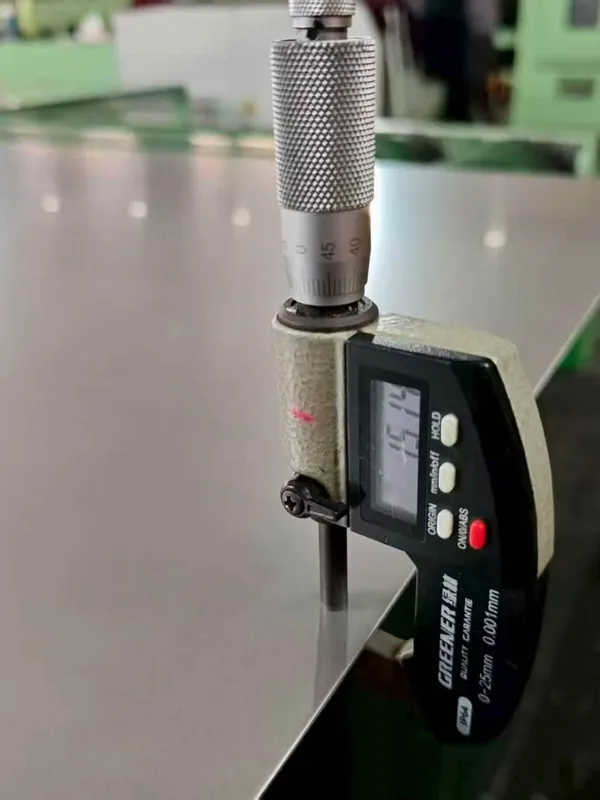
Copper and molybdenum work together in sulfuric and phosphoric acid, where chromium alone would leave the surface unprotected.
The 19.5–23.5% chromium range maintains a passive film in nitric acid and other oxidising media, therefore one vessel can run both duty types.
A nickel content of 38–46% keeps the matrix austenitic, and consequently chloride stress-corrosion cracking does not start the way it does on 300-series grades.
Because titanium ties up carbon as carbide, welded joints resist intergranular attack without a post-weld stabilising anneal.
Charpy values stay near 91–97 J at −196 °C, therefore the grade suits cold boxes and LNG-side hardware as well as ambient duty.
NACE MR0175 / ISO 15156 accepts the grade in the solution-annealed condition at 35 HRC maximum, although cold-straightened product needs re-verification.
Molybdenum lifts the pitting resistance equivalent to roughly 31, which covers chloride-bearing process streams below the warm-seawater limit.
As 825 is not age hardenable, extra strength comes purely from cold work, which keeps the corrosion response predictable.
Selection here turns on the process medium rather than on temperature alone. Moreover, 825 earns its place where one vessel handles reducing and oxidising acids together. Consequently, four questions decide whether the duty belongs to this grade.
Sulfuric, phosphoric, and mixed acid streams justify 825 long before any temperature argument does.
Above roughly 540 °C, phase formation erodes ductility and impact strength, therefore creep-limited designs belong to a different family.
Where chloride cracking rules out 316L, the 38–46% nickel in 825 removes that failure mode.
NACE MR0175 accepts the grade at 35 HRC maximum, although H2S partial pressure and chloride limits still apply table by table.
The grade reaches the market as bar, tube, and flat-rolled product, and each route carries its own ASTM specification. In addition, the anneal and the finish change with the form, so the order should state both.
Round, hex, flat, and forged sections to ASTM B425, used for pump shafts, valve trim, and machined acid-plant parts.
View Incoloy 825 Bar and Rod →Seamless pipe and exchanger tube to B423 and B163, plus welded pipe and tube to B705 and B704.
View Incoloy 825 Pipe and Tube →Hot-rolled plate, cold-rolled sheet, and strip to B424 for vessels, ducting, and formed liners.
View Incoloy 825 Plate and Sheet →Acid plants, effluent systems, and sour-service wells account for most of the demand. Furthermore, the grade suits any duty where one vessel meets both a reducing and an oxidising stream.
Discuss Your Application →Heating coils, baskets, hooks, and chain that stay in service through repeated acid dips.
Heat-exchanger tube, tube sheets, and agitator hardware in wet-process acid that carries fluoride and chloride.
Absorber internals, spray headers, and damper parts that see chloride-laden slurry.
Tube and tube-sheet stock for coastal plants, where chlorinated seawater is the cooling medium.
Valve bodies, stems, and tree components for H2S-bearing production covered by NACE MR0175.
Dissolver and solvent-extraction equipment that handles nitric acid and radioactive waste streams.
Piping, vessels, and pump parts in spent-acid recovery and waste-treatment circuits.
Reactor internals and transfer-line hardware where mixed acids rule out stainless grades.
Detailed technical information including chemical composition, mechanical properties, standards and available dimensions.
The limits below follow ASTM B424, B425, and B423 for UNS N08825, and iron balances the melt. Because copper and molybdenum set the acid performance while titanium stabilises the structure, the heat certificate governs acceptance.
| Element | Content |
|---|---|
| Nickel (Ni) | 38.0–46.0% |
| Chromium (Cr) | 19.5–23.5% |
| Iron (Fe) | 22.0% min. |
| Molybdenum (Mo) | 2.5–3.5% |
| Copper (Cu) | 1.5–3.0% |
| Titanium (Ti) | 0.6–1.2% |
| Carbon (C) | 0.05% max. |
| Manganese (Mn) | 1.00% max. |
| Silicon (Si) | 0.50% max. |
| Aluminium (Al) | 0.20% max. |
| Sulfur (S) | 0.03% max. |
The minimum values below come from the product specification that governs each form. In addition, the seamless pipe and tube standard sets two strength levels.
| Product Form | Standard | Condition | Tensile Strength | Yield Strength (0.2%) | Elongation |
|---|---|---|---|---|---|
| Seamless pipe and tube | ASTM B423 | Hot-finished, annealed | 75 ksi (517 MPa) | 25 ksi (172 MPa) | 30% |
| Seamless pipe and tube | ASTM B423 | Cold-worked, annealed | 85 ksi (586 MPa) | 35 ksi (241 MPa) | 30% |
| Condenser and exchanger tube | ASTM B163 | Annealed | 85 ksi (586 MPa) | 35 ksi (241 MPa) | 30% |
| Welded pipe and tube | ASTM B704 / B705 | Annealed | 85 ksi (586 MPa) | 35 ksi (240 MPa) | 30% |
| Plate, sheet, and strip | ASTM B424 | Annealed | 85 ksi (586 MPa) | 35 ksi (241 MPa) | 30% |
| Rod and bar | ASTM B425 | Annealed | 85 ksi (586 MPa) | 35 ksi (241 MPa) | 30% |
| Forgings | ASTM B564 | Solution annealed | 85 ksi (586 MPa) | 35 ksi (241 MPa) | 30% |
| Small-diameter tube | ASTM B423, Table X1.1 | Annealed | 85–115 ksi (586–793 MPa) | 35 ksi (241 MPa) | 30% |
| Small-diameter tube | ASTM B423, Table X1.1 | Half-hard | 105 ksi (724 MPa) min. | 75 ksi (517 MPa) | 15% |
| Small-diameter tube | ASTM B423, Table X1.1 | Full-hard | 125 ksi (862 MPa) min. | 100 ksi (689 MPa) | 5% |
The yield requirement does not apply below 0.51 mm thickness in flat product, and the B425 yield minimum likewise excludes diameters under 2.4 mm. Converter sizes carry their own table, and hot-forming quality ships to chemistry and surface inspection alone.
Typical room-temperature values appear below, and they support design work rather than acceptance testing. Above all, the grade stays non-magnetic in service, because its Curie point sits below room temperature.
| Property | Value |
|---|---|
| Density | Approx. 8.14 g/cm³ |
| Melting range | Approx. 1370–1400 °C |
| Specific heat at 20 °C | Approx. 440 J/kg·K |
| Modulus of elasticity at 20 °C | Approx. 196 GPa |
| Shear modulus at 20 °C | Approx. 76 GPa |
| Poisson's ratio | Approx. 0.29 |
| Thermal conductivity at 25 °C | Approx. 11.1 W/m·K |
| Thermal expansion, 20–100 °C | Approx. 14.1 µm/m·K |
| Electrical resistivity at 25 °C | Approx. 1.13 µΩ·m |
| Curie temperature | Below −196 °C |
| Relative permeability at 200 oersted | 1.005 |
| Magnetic behaviour | Non-magnetic at ambient temperature |
Form decides which ASTM document governs, and the numbered documents below serve as cross-reference labels rather than separate approvals. Moreover, sour-service orders also reference NACE MR0175. ASTM International publishes the current text of each specification.
| Standard / Designation | Scope |
|---|---|
| ASTM B425 / ASME SB425 | Rod and bar — UNS N08825 |
| ASTM B564 / ASME SB564 | Forgings, including flanges and tube sheets |
| ASTM B424 / ASME SB424 | Plate, sheet, and strip |
| ASTM B906 / ASME SB906 | General requirements for flat-rolled nickel-alloy product |
| ASTM B423 / ASME SB423 | Seamless pipe and tube for general corrosive service |
| ASTM B163 / ASME SB163 | Seamless condenser and heat-exchanger tube up to 3 in. (76.2 mm) OD |
| ASTM B704 / ASME SB704 | Welded tube in UNS N06625 and UNS N08825 |
| ASTM B705 / ASME SB705 | Welded pipe in UNS N06625, N06219, and UNS N08825 |
| ASTM B751 / ASME SB751 | General requirements for welded nickel and nickel-alloy tube |
| ASTM B775 / ASME SB775 | General requirements for welded nickel and nickel-alloy pipe |
| ASTM B829 / ASME SB829 | General requirements for seamless nickel and nickel-alloy pipe and tube |
| ASTM B366 / ASME SB366 | Wrought nickel-alloy pipe fittings |
| ASME Code Case N-572 | Nuclear construction — rod, bar, wire, and forging stock |
| ASME Code Case 1936 | Nuclear construction — pipe and tube |
| NACE MR0175 / ISO 15156 | Sour service, 35 HRC maximum in the annealed condition |
| BS 3072 NA16 / BS 3073 NA16 | British plate, sheet, and strip standards |
| BS 3074 NA16 / BS 3076 NA16 | British tube, and British bar standards |
| DIN 17744 / 17750 / 17751 / 17752 | German wrought nickel-alloy standards by form |
| DIN 17753 / 17754 | German wire, and German forging stock standards |
| ISO 6207 / 6208 / 9723 / 9724 / 9725 | ISO tube, flat product, bar, wire, and forging stock |
| VdTÜV 432 | German pressure-vessel material data sheet |
| UNS N08825 / W.Nr. 2.4858 / NiCr21Mo | Material designations |
| JIS NCF 825 | Japanese designation |
The ranges below reflect sections we normally produce, and availability still depends on condition, finish, and quantity. Therefore, please state diameter or thickness, width, length, and quantity in the enquiry.
| Product Form | Typical Supply | Length |
|---|---|---|
| Hot-rolled plate | 4.76–100 mm thick × up to 2000 mm wide | Up to 6000 mm, or cut to size |
| Cold-rolled sheet | 0.5–4.76 mm thick × up to 1500 mm wide | Up to 6000 mm, or cut to size |
| Cold-rolled strip | 0.1–4.76 mm thick × 10–600 mm wide | Coil, or cut to length |
| Seamless pipe | 6–219 mm OD | Random, or cut to length |
| Seamless exchanger tube | 6–76 mm OD × 0.5–3.76 mm wall | Random, U-bent, or cut to length |
| Welded pipe | 10.3–762 mm OD | Random, or cut to length |
| Welded tube | 1.6–101.6 mm OD | Random, coil, or cut to length |
| Round bar | 6–500 mm dia. | Cut to length, or random |
| Hex and square bar | 10–150 mm | Cut to length, or random |
| Forged bar and rings | 100–500 mm dia. | Cut to length, or to drawing |
Pick the finish for the next operation, whether that is welding, forming, or a painted assembly. Furthermore, we agree each finish with the order instead of assuming it from stock.
| Surface Condition | Typical Use |
|---|---|
| Hot-rolled, annealed, and pickled | Standard plate delivery for vessels and ducting |
| Cold-rolled and annealed | Sheet and strip for forming and deep drawing |
| Bright annealed | Strip and light sheet where an oxide-free surface matters |
| 2B cold-rolled | General sheet work with a smooth, dull finish |
| No. 4 polished | Visible panels and product-contact surfaces |
| Descaled and pickled tube | Exchanger tube and process pipe for acid duty |
| Machined or turned bar | Forged and hot-worked bar with a machining allowance |
| Centreless ground bar | Tight diameter and straightness for shafting |
Get detailed information including specifications, standards, dimensions and material properties.
B424 for plate, sheet, and strip; B425 for rod and bar; B423 for seamless pipe and tube; B163 for exchanger tube; B704 and B705 for welded product; B564 for forgings.
No. The SAE aerospace specifications do not reach UNS N08825, so every form ships against its ASTM product standard instead.
About 540 °C. Phase formation above that point lowers ductility and impact strength, so designers avoid the grade where creep-rupture governs.
Yes. Copper and molybdenum give it reducing-acid performance that austenitic stainless grades cannot match at a comparable cost.
Yes. NACE MR0175 / ISO 15156 lists the grade in the solution-annealed condition at 35 HRC maximum.
INCONEL Welding Electrode 112 for shielded metal-arc work, and INCONEL Filler Metal 625 for gas-shielded processes.
One piece or one length for most stock sizes.
Mainly FOB. We also quote EXW and CIF when you ask.
7-15 days for stock items, and about 25 days for made-to-order annealed product.
Yes. Every heat ships with 3.1, and we arrange 3.2 with third-party witness on request.
Send the form, the medium, the concentration, and the temperature, and our reply carries price, lead time, and the document set. Since we lock the ordered condition and the inspection level before production, the material you approve is the material that ships.
Moreover, we carry Incoloy 825 bar, tube, and flat-rolled stock and machine or cut to your drawing. Trial quantities are available for most sizes.