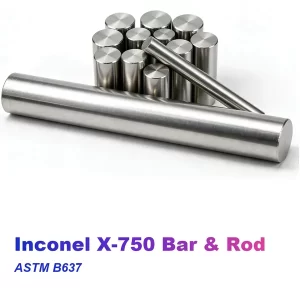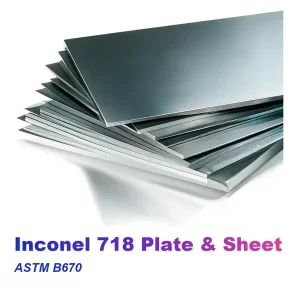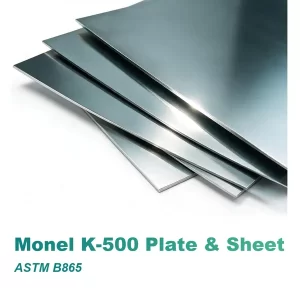
01
Plate
Hot rolled and annealed to AMS 5542, from 4.76 mm through 101.6 mm thick.
Request Availability →Gamma-prime hardened flat product to AMS 5542 and AMS 5598, annealed for forming or aged for service to 704 °C.
The annealed route follows AMS 5542 and the remelted route follows AMS 5598.
Therefore, thickness and width together decide whether the order is plate, sheet, or strip.
Moreover, the certificate states where the elongation requirement stops applying.
Inconel X-750 plate and sheet serves fabrication in two supply conditions. The annealed route forms and machines easily, and the aged route arrives at full strength for service. Sheet reaches 1138 MPa minimum tensile after the age, and plate reaches 1069 MPa.
Flat product covers the panels and liners that a bar or a tube cannot. The bar and tubular routes sit on the Inconel X-750 Bar and Rod and Inconel X-750 Pipe and Tube pages. Meanwhile, the Inconel X-750 hub holds the data for every form.
However, drawings often carry ASTM B168 for nickel alloy flat product, and that document does not list UNS N07750 at all.
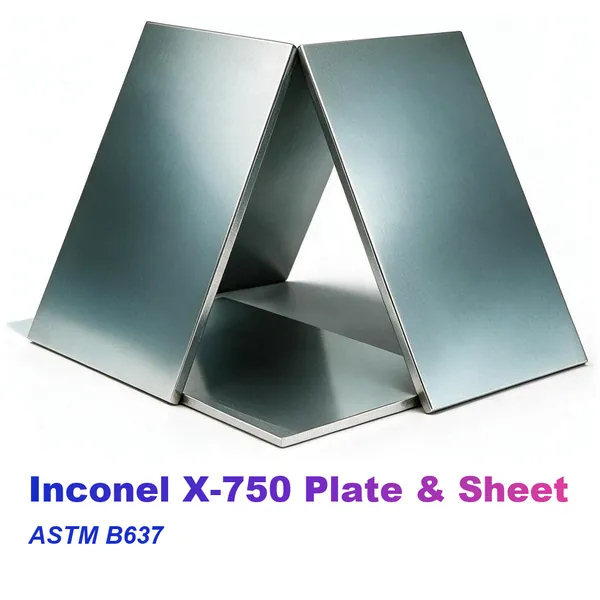
Inconel X-750 plate and sheet carries the UNS N07750 grade, a precipitation-hardening nickel-chromium-iron alloy strengthened by gamma prime. Two AMS documents cover flat product, the annealed route through AMS 5542 and the remelted route through AMS 5598, and no ASTM flat document lists this grade at all. Aging at 704 °C lifts sheet to 1138 MPa and plate to 1069 MPa minimum tensile. Southerly Alloy supplies and exports UNS N07750 plate, sheet, and strip to AMS 5542 and AMS 5598.
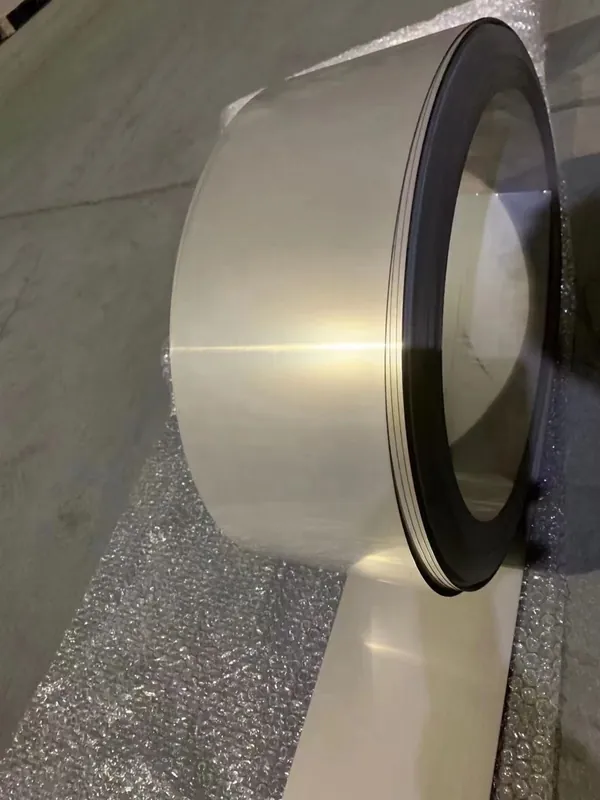
AMS 5542 covers annealed stock and AMS 5598 covers remelted or vacuum melted stock.
Specifically, sheet reaches 1138 MPa minimum tensile after the 704 °C age.
Plate reaches 1069 MPa minimum tensile with 20% elongation after the same age.
Therefore, thickness and width together fix the product form under ASTM B906.
The elongation requirement stops applying to strip below 0.51 mm thick.
Sheet forms in the annealed condition and hardens in the final furnace cycle.
Moreover, the flat documents are AMS because ASTM B168 does not reach this grade.
In fact, the precipitation treatment contracts the metal, so rough machining comes first.
Start with the temperature and the forming step together. Sheet that must hold shape at 600 °C earns its cost in gamma prime. Where the part runs cool, a solid-solution flat product costs less.
Consequently, a formed panel hardens in the final furnace cycle rather than before it.
The annealed route machines and forms easily, and the aged route ships ready for service.
Because ASTM B906 draws the lines, thickness and width together decide the acceptance document.
Rockwell readings come off the aged flat product, and the certificate names the scale used.
Flat product follows one route from slab to finished gauge, and the ordered condition sets where that route ends. Because the age contracts the metal slightly, the sequence of forming and heat treatment matters.
The slabbing bay cuts an approved heat to match the rolling schedule.
The furnace brings the slab to rolling temperature under a recorded curve.
Roughing and finishing stands reduce the slab to the ordered plate gauge.
The plate holds at 982 °C or above, then cools in air.
The pickling line removes oxide scale and leaves a surface ready for forming.
Consequently, the charge ages near 704 °C for twenty hours when the order requires it.
A rotary shear cuts to length, and a leveller then flattens each plate.
Finally, the laboratory clears chemistry, tensile results, and dimensions.
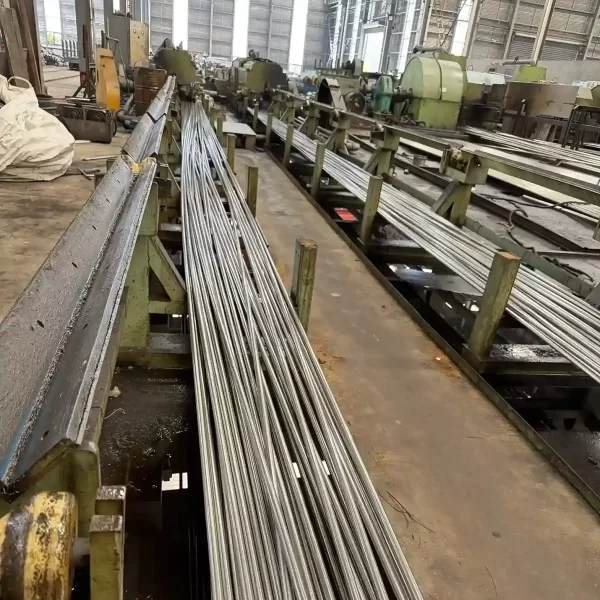
Our manufacturing facility provides reliable production capacity for seamless pipes, tubes, fittings, plates and bars with strict quality management systems.
Melting, rolling, heat treatment, and finishing share one boundary.
Levellers, shears, and plasma cutters span the ordered thicknesses.
Custom heats and stocked gauges run on one calendar.
A metallurgist reviews every flat-product enquiry before the offer leaves.
Flat product carries two checks that bar does not, because thickness and flatness drive the forming result. Therefore, the certificate reports the gauge and the heat treatment together.
The laboratory logs titanium, aluminium, and niobium readings against the heat number.
Mechanical values come from the aged plate rather than from the annealed stock.
A layout check covers thickness, width, length, and flatness before release.
Consequently, the certificate names the annealing and aging cycles applied to that heat.
Flat product arrives in the forms a fabricator cuts, rolls, and welds. Therefore, each route names its own acceptance document.
Hot rolled and annealed to AMS 5542, from 4.76 mm through 101.6 mm thick.
Request Availability →Below 4.76 mm thick, 600 mm wide or wider, annealed and pickled.
Request Availability →Cold rolled under 4.76 mm thick and under 600 mm wide, in coil or cut length.
Request Availability →Heavy plate cut to the exchanger drawing and drilled where the order asks.
Request Availability →Rolled shells, dished heads, and bent sections worked to the fabrication drawing.
Request Availability →Panels that meet hot gas are where this grade has served longest. Meanwhile, the cryogenic side of its envelope keeps it in cold-wall and shielding work.
Discuss Your Application →Liners and shields that face hot gas directly.
Duct sections and thrust reverser panels.
Flexible elements that must hold shape under heat.
Disc and leaf springs in high-temperature assemblies.
Panels and covers inside the reactor building.
Trays and fixtures that survive repeated furnace cycles.
Panels for duty well below −100 °C.
Muffles and baffles exposed to a hot atmosphere.
Detailed technical information including chemical composition, mechanical properties, standards and available dimensions.
The limits below come from ASTM B637, which shares one composition table with the AMS documents for UNS N07750. Titanium and aluminium set the gamma prime volume, and niobium slows its coarsening in service. Iron balances the matrix, and the nickel plus cobalt floor keeps the alloy austenitic. The mill certificate governs final acceptance.
| Element | Content |
|---|---|
| Nickel plus Cobalt (Ni + Co) | 70.00% min. |
| Chromium (Cr) | 14.00–17.00% |
| Iron (Fe) | 5.00–9.00% |
| Titanium (Ti) | 2.25–2.75% |
| Aluminum (Al) | 0.40–1.00% |
| Niobium + Tantalum (Nb + Ta) | 0.70–1.20% |
| Manganese (Mn) | 1.00% max. |
| Silicon (Si) | 0.50% max. |
| Copper (Cu) | 0.50% max. |
| Cobalt (Co) | 1.00% max. |
| Carbon (C) | 0.08% max. |
| Tantalum (Ta) | 0.05% max. |
| Sulfur (S) | 0.010% max. |
The annealed rows give ceiling values, because the delivered sheet must stay formable. The aged rows give floor values, and they differ between the standard and the remelted route. Every value is a minimum unless the row states a limit.
| Product Form | Condition | Tensile Strength | Yield Strength (0.2%) | Elongation, min. | Hardness |
|---|---|---|---|---|---|
| Strip, AMS 5542 | Annealed, 0.25–0.64 mm | ≤130 ksi (896 MPa) | — | 20% | — |
| Sheet, AMS 5542 | Annealed, 0.61–3.18 mm | ≤130 ksi (896 MPa) | ≤60 ksi (414 MPa) | 30% | — |
| Sheet, AMS 5542 | Annealed, 3.18–4.76 mm | ≤130 ksi (896 MPa) | ≤65 ksi (448 MPa) | 30% | — |
| Sheet, AMS 5542 | Aged at 704 °C for 20 h | ≥165 ksi (1138 MPa) | ≥105 ksi (724 MPa) | 20% | Rc 32 min. |
| Plate, AMS 5542 | Aged at 704 °C for 20 h | ≥155 ksi (1069 MPa) | ≥100 ksi (689 MPa) | 20% | Rc 30 min. |
| Strip, AMS 5542 | Aged at 704 °C for 20 h | ≥155 ksi (1069 MPa) | — | 15% | Rc 30 min. |
| Sheet, AMS 5598 | Remelted, aged at 704 °C | ≥170 ksi (1172 MPa) | ≥115 ksi (793 MPa) | 18% | Rc 32 min. |
| Plate, AMS 5598 | Remelted, aged at 704 °C | ≥160 ksi (1103 MPa) | ≥105 ksi (724 MPa) | 18% | Rc 30 min. |
Annealed stock carries ceiling values rather than floors, which keeps the sheet workable before the age. The elongation requirement stops applying to strip below 0.51 mm thick. ASTM B906 draws the lines between plate, sheet, and strip, so thickness and width together decide the form.
The figures below come from the published data for the grade and serve design work rather than acceptance testing. Moreover, the magnetic behaviour changes with heat treatment, so the Curie temperature depends on the cycle applied.
| Property | Value |
|---|---|
| Density | Approx. 8.28 g/cm³ |
| Melting range | Approx. 1393–1427 °C |
| Curie temperature, hot rolled | Approx. −143 °C |
| Curie temperature, fully heat treated | Approx. −125 °C |
| Modulus of elasticity at 20 °C | Approx. 214 GPa |
| Modulus of rigidity at 20 °C | Approx. 76 GPa |
| Poisson's ratio | 0.29 |
| Thermal conductivity at 20 °C | Approx. 12.0 W/m·K |
| Specific heat at 20 °C | Approx. 431 J/kg·K |
| Electrical resistivity at 20 °C | Approx. 1.22 µΩ·m |
| Thermal expansion, 20–100 °C | Approx. 12.6 µm/m·K |
| Contraction during precipitation treatment | Approx. 0.00026 to 0.00052 |
| Strengthening route | Precipitation hardening only |
Two AMS documents carry the flat forms, and each one names its own melting route. The ASTM documents below sit behind them for general requirements and for test methods. The designations serve cross-reference only.
| Standard | Product or Application |
|---|---|
| AMS 5542 | Sheet, strip, and plate, annealed |
| AMS 5598 | Sheet, strip, and plate, consumable electrode remelted or vacuum induction melted |
| ASTM B906 | General requirements for flat-rolled nickel alloys, and the form definitions |
| ASTM E112 | Average grain size determination |
| ASTM B637 / ASME SB637 | Bars, forgings, and forging stock in the same grade |
| NACE MR0175 / ISO 15156-3 | Sour service qualification where the order requires it |
| UNS N07750 · W.Nr. 2.4669 · NiCr15Fe7TiAl | Material designations |
| GB/T 14992 GH4145 · JIS NCF 750 | Chinese and Japanese designations |
| ASTM B168 | This document does not list UNS N07750 in its scope |
Pyromet X750, Nickelvac X750, Nicrofer 7016 TiNb, and Inconel are trademarks of their respective owners. We quote those names for reference only, and our deliveries follow the ASTM and AMS documents listed above.
The standard text from ASTM International settles any acceptance question.
Because ASTM B906 draws the lines, the ranges below follow those definitions rather than one house rule. For that reason, state the form and the ordered size on the enquiry.
| Product Form | Thickness | Width |
|---|---|---|
| Plate | 4.76–101.6 mm | Over 250 mm |
| Sheet | Under 4.76 mm | 600 mm and over |
| Strip and coil | Under 4.76 mm | Under 600 mm |
| Cut blank or circle | To drawing | To drawing |
| Formed plate | To drawing | To drawing |
Plate runs to 101.6 mm thick, because AMS 5542 sets that as its ceiling. Therefore, anything heavier needs the forged route instead and should be raised on the enquiry.
Finish follows the operation that comes next rather than a catalogue default. In short, we agree the surface with your order.
| Surface Condition | Typical Use |
|---|---|
| Annealed and pickled | Standard delivery for high-temperature service |
| Bright annealed | Scale-free face for clean and instrument duty |
| Hot rolled, descaled | Plate for parts that will be machined or rolled |
| Cold rolled | Smoother sheet for lining and forming |
| Polished | Reduced roughness for product-contact panels |
Get detailed information including specifications, standards, dimensions and material properties.
Eight steps carry a flat-product enquiry from the first message to the delivered bundle. Therefore, give the thickness and the width first, and the rest follows.
Give the service temperature, the medium, and the pressure class.
State whether the order is plate, sheet, or strip, with thickness and width.
Put thickness, width, and length on the enquiry in one schedule.
We agree tensile, hardness, and dimensional checks against the documents.
The quotation carries the price per kilogram, the lead time, and the certificate set.
Grade, form, test level, and delivery terms enter the order acknowledgement.
The mill takes the lot through rolling, solution treatment, aging, and release testing.
Finally, the desk tracks the consignment and mails the papers before arrival.
Feedback from buyers and engineers who source nickel alloy materials from Southerly Alloy.
“The liners formed without cracking in the annealed condition and hardened in one furnace cycle.”
“The certificate named the aging curve and the Rockwell scale, so incoming inspection cleared the bundle.”
“Flatness held across the plate, so the rolling plan needed no second pass.”
Our production and inspection processes are certified to international standards, and every delivery ships with EN 10204 3.1 mill test certificates.
Quality Management System
Pressure Equipment Directive
Material Standards Compliance
Mill Test Certificates
AMS 5542 covers annealed flat product and AMS 5598 covers the remelted route. ASTM B906 supplies the definitions that separate plate, sheet, and strip.
No. ASTM B168 lists a long set of nickel-chromium alloys, and UNS N07750 is not among them. Flat-product acceptance therefore rests on the AMS documents.
Plate starts at 4.76 mm thick and runs wider than 250 mm. Sheet sits under 4.76 mm thick at 600 mm wide or more, and strip is narrower than 600 mm.
Plate runs from 4.76 to 101.6 mm thick, which is the AMS 5542 ceiling. Sheet and strip run under 4.76 mm down to light gauge.
Order annealed stock when the part needs forming, welding, or heavy machining first. Order the aged condition when the panel goes to service without further heat treatment.
The gamma prime that forms during the age is denser than the matrix it grows from, so the part contracts slightly. Rough machining therefore precedes the age.
One plate covers most stock sizes, and a cut piece is enough for a trial.
We quote mainly on FOB terms, and EXW or CIF follow on request.
Stock gauges ship in 7-15 days, and made-to-order plate runs about 25 days.
Yes. Every heat ships with an EN 10204 3.1 certificate, and we arrange 3.2 endorsement on request.
Send the thickness, the width, and the service temperature. Our quotation sets out the price, the lead time, and the certificate package. Because the supply condition decides whether we age the plate, tell us whether it forms first in your shop.
One trial piece costs very little, so a single plate settles the question before a plant-wide release.