01
Nickel Hot-Rolled Plate
Above all, plate from 4.76 mm up for vessels, linings, and heavy fabricated parts.
Request Availability →Flat-rolled nickel in plate, sheet, and strip, ordered to ASTM B162 in both grades.
Hot-rolled plate, cold-rolled sheet, and strip quote on one enquiry, so a fabricated vessel draws on one standard.
In addition, we agree flatness, edge condition, and temper in writing before rolling, which keeps the cutting line predictable.
Strip arrives in quarter-hard through spring temper for parts that need strength without heat treatment.
Nickel 200 / 201 plate and sheet come in two commercially pure nickel grades. Grade 200 permits up to 0.15% carbon, and grade 201 caps that element at 0.02%.
Flat-rolled product follows B162 alone among the standards for these grades. The Nickel 200 / 201 material page holds the full grade data, while Nickel 200 / 201 Bar and Rod and Nickel 200 / 201 Pipe and Tube cover the other two forms.
Service temperature decides between the grades, not corrosion behaviour. Above 315 °C, a caustic vessel or a hot process panel needs grade 201, because carbon leaves solution as graphite in grade 200 over time. Therefore, we confirm the duty before quoting a thickness.
Southerly Alloy works as a professional supplier and exporter for both grades in flat-rolled form. A single contact stays with the order, from the technical question to the shipping papers.
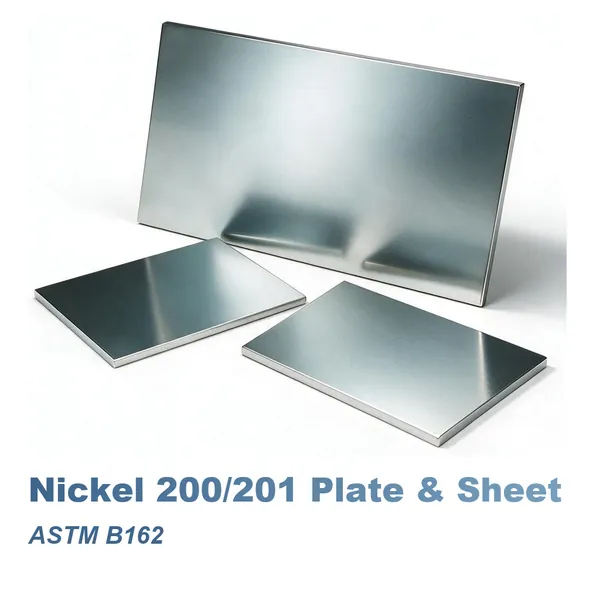
Nickel 200 and Nickel 201 plate and sheet carry caustic and reducing media in vessels, linings, and fabricated panels. The low-carbon grade takes over above 315 °C, because the standard grade releases graphite along its grain boundaries at higher temperatures. Southerly Alloy works as a professional supplier and exporter for both grades in flat-rolled form, covering plate, sheet, and strip to ASTM B162 with EN 10204 3.1 documentation.
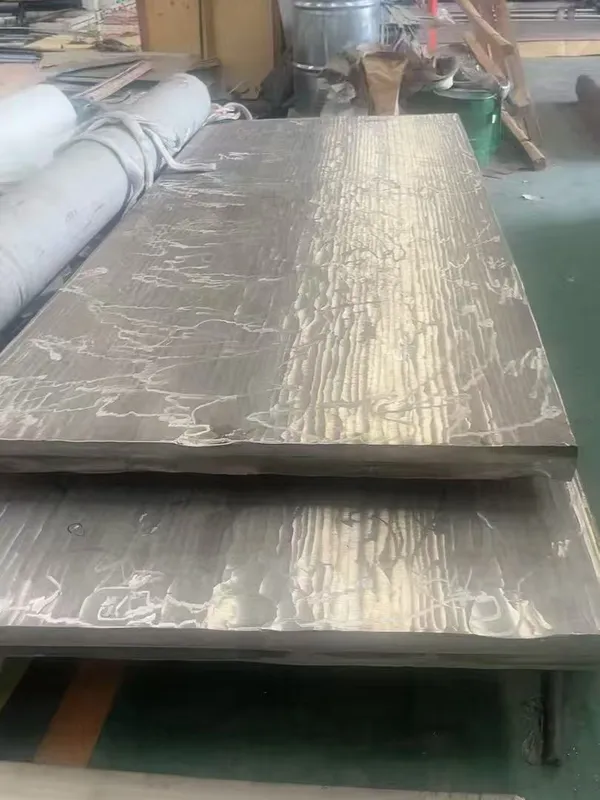
Sodium hydroxide and potassium hydroxide at every concentration sit inside the envelope, and molten alkali salt does too.
Also, neutral and alkaline salt solutions bring no stress-corrosion cracking, so brine and cooling water duties stay safe.
Plate and sheet arrive to an agreed flatness so laser and plasma cutting runs without re-levelling.
Similarly, annealed sheet draws and spins without intermediate annealing, which suits formed linings and shells.
In fact, heat passes through the wall at roughly 70 W/m·K, so the grade serves thermal panels and heat shields.
Strip comes in quarter-hard through spring temper, which gives strength without a heat treatment step.
Moreover, both grades stay magnetic below a Curie point near 360 °C, which serves shielding and electromagnetic parts.
In addition, hydrofluoric acid in wet form and oxidizing acids sit outside the envelope, and sulfide attack limits grade 201 above 315 °C.
A flat-rolled order turns on four points. They cover the size range we quote, flatness and temper control, the documents that follow the material, and export handling.
First, hot-rolled plate, cold-rolled sheet, and strip share one quotation, so a vessel project needs one supplier contact.
We record the flatness and edge requirement in the order, and the consignment is checked against it.
Also, quarter-hard through spring temper covers formed parts, and the certificate states the temper that shipped.
Coil travels on saddles and plate in wooden cases, with marking that matches the packing list.
Flat-rolled production runs a fixed route from heat to packed bundle. Meanwhile, the ordered temper and thickness decide how many rolling and annealing passes apply.
Nickel cathode and controlled additions go to the N02200 or N02201 chemistry, with carbon inside the ordered limit.
A controlled atmosphere limits gas pickup as the heat casts into slabs or strip bars.
Slabs roll down to plate or coil at temperature, and the reduction refines the cast structure.
Cold reduction sets thickness and finish, and annealing between passes restores ductility.
Acid pickling or mechanical descaling removes oxide and leaves a clean surface.
The line slits coil to width and shears plate to the ordered length.
Straightness, flatness, and surface pass inspection against the ordered finish.
We mark, interleave, and case every bundle for shipment against the packing list.
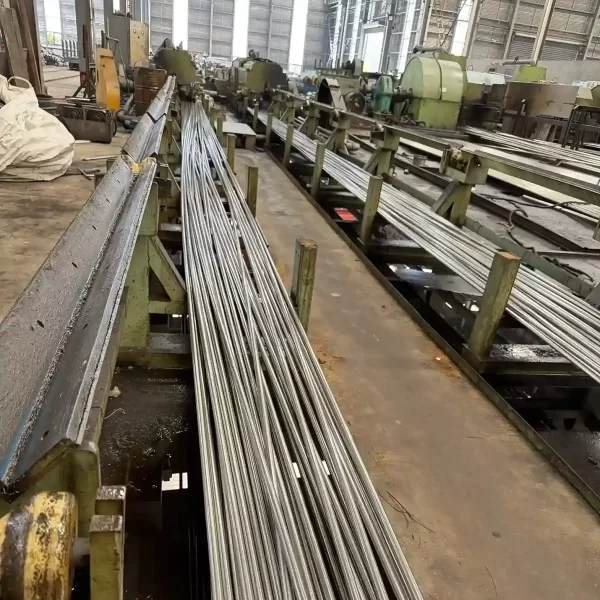
Standard thicknesses and made-to-order sizes both leave against one schedule. Temper and thickness, meanwhile, decide how many rolling and annealing passes apply. Therefore, we settle flatness and temper before rolling starts.
Melting, rolling, annealing, and inspection halls sit on one site.
Rolling mills, annealing furnaces, and finishing lines serve the flat-rolled route.
Nickel and nickel alloy plate, sheet, and strip leave in stock and custom sizes.
Metallurgists match temper and flatness to the forming operation.
Plate, sheet, and strip share one composition table.
Custom rolling runs about that long after confirmation.
Inspection closes on the heat before any bundle leaves the yard. Consequently, our checks cover chemistry, mechanical properties, thickness, and flatness against the purchase specification.
We check every heat for the N02200 or N02201 balance before rolling starts.
Micrometers, width tapes, and straightedges prove thickness, width, and flatness against the ordered tolerance.
Tensile, yield, and elongation come from the ordered temper, with hardness on request.
Finally, certificates, heat numbers, and PMI results follow the plate and sheet through dispatch.
Southerly Alloy supplies Nickel 200 / Nickel 201in multiple product forms according to application, dimensions and applicable international standards.
Above all, plate from 4.76 mm up for vessels, linings, and heavy fabricated parts.
Request Availability →Sheet with a controlled finish for formed panels and drawn components.
Request Availability →Narrow strip in coil for press work and continuous forming lines.
Request Availability →Quarter-hard through spring temper for parts that need strength as rolled.
Request Availability →Low-roughness sheet for product-contact surfaces and appearance parts.
Request Availability →Discs cut to your diameter for spun shells and drawn cups.
Request Availability →Coil for continuous lines and cut lengths for job-shop work.
Request Availability →Flat-rolled product lands where caustic or reducing media touch a vessel wall or a fabricated part. In addition, conductivity and magnetic response open electrical and shielding duties.
Discuss Your Application →Shells, heads, and internals for sodium hydroxide service.
Panel and lining stock for chlor-alkali cells.
Fabricated conductive parts for plating lines.
Strip and sheet for terminals, tabs, and housings.
Plate that carries heat away from a hot face.
Sheet linings for stearic and oleic acid service.
Product-contact sheet for food and pharmaceutical equipment.
Plate and sheet for parts that rely on magnetic response.
Detailed technical information including chemical composition, mechanical properties, standards and available dimensions.
B162 carries the same composition table as the other forms for these grades. Moreover, nickel comes by difference and includes cobalt, so carbon alone separates the two grades. An ordered specification and its certificate decide acceptance.
| Element | Nickel 200 (UNS N02200) | Nickel 201 (UNS N02201) |
|---|---|---|
| Nickel (Ni), min. | 99.0% | 99.0% |
| Copper (Cu), max. | 0.25% | 0.25% |
| Iron (Fe), max. | 0.40% | 0.40% |
| Manganese (Mn), max. | 0.35% | 0.35% |
| Carbon (C), max. | 0.15% | 0.02% |
| Silicon (Si), max. | 0.35% | 0.35% |
| Sulfur (S), max. | 0.01% | 0.01% |
B162 acceptance minimums appear below in both unit systems. However, conditions run from annealed through the hard tempers, and thin strip carries separate elongation bands.
| Grade / Product / Condition | Tensile Strength, min. | Yield Strength (0.2%), min. | Elongation, min. |
|---|---|---|---|
| Nickel 200, hot-rolled plate, annealed | ≥55 ksi (380 MPa) | ≥15 ksi (100 MPa) | 40% |
| Nickel 200, hot-rolled plate, as rolled | ≥55 ksi (380 MPa) | ≥20 ksi (135 MPa) | 30% |
| Nickel 200, hot-rolled sheet, annealed | ≥55 ksi (380 MPa) | ≥15 ksi (100 MPa) | 40% |
| Nickel 200, cold-rolled sheet, annealed | ≥55 ksi (380 MPa) | ≥15 ksi (100 MPa) | 40% |
| Nickel 200, cold-rolled strip, annealed | ≥55 ksi (380 MPa) | ≥15 ksi (100 MPa) | 40% |
| Nickel 200, sheet and strip, hard temper | ≥90 ksi (620 MPa) | ≥70 ksi (480 MPa) | 2% |
| Nickel 201, hot-rolled plate, annealed | ≥50 ksi (345 MPa) | ≥12 ksi (80 MPa) | 40% |
| Nickel 201, hot-rolled plate, as rolled | ≥50 ksi (345 MPa) | ≥12 ksi (80 MPa) | 30% |
| Nickel 201, hot-rolled sheet, annealed | ≥50 ksi (345 MPa) | ≥12 ksi (80 MPa) | 40% |
| Nickel 201, cold-rolled strip, annealed | ≥50 ksi (345 MPa) | ≥12 ksi (80 MPa) | 40% |
Three footnotes travel with this table. Notably, the yield requirement does not apply below 0.51 mm (0.020 in.) thickness, sheet and strip between 0.25 mm and 1.2 mm carry 30% minimum, and material between 1.3 mm and 2.7 mm carries 35%. Strip under 0.25 mm has no tensile requirement at all.
Values below describe annealed material at room temperature and serve design work rather than acceptance. In addition, the two grades part company on thermal conductivity and electrical resistivity.
| Property | Nickel 200 (N02200) | Nickel 201 (N02201) |
|---|---|---|
| Density | Approx. 8.89 g/cm³ | Approx. 8.89 g/cm³ |
| Melting range | Approx. 1435–1446 °C | Approx. 1435–1446 °C |
| Specific heat at 20 °C | Approx. 456 J/kg·K | Approx. 456 J/kg·K |
| Curie temperature | Approx. 360 °C (680 °F) | Approx. 360 °C (680 °F) |
| Modulus of elasticity | Approx. 205 GPa | Approx. 207 GPa |
| Thermal conductivity at 20 °C | Approx. 70.3 W/m·K | Approx. 79.3 W/m·K |
| Electrical resistivity at 20 °C | Approx. 0.096 µΩ·m | Approx. 0.085 µΩ·m |
| Thermal expansion, 20–100 °C | Approx. 13.3 µm/m·K | Approx. 13.2 µm/m·K |
| Poisson's ratio | Approx. 0.29 | Approx. 0.29 |
| Magnetic behaviour | Ferromagnetic at room temperature | Ferromagnetic at room temperature |
B162 governs flat-rolled product in both grades, and the designations below serve cross-reference alone. For acceptance, an ASTM International standard named on the order decides.
| Standard / Designation | Scope |
|---|---|
| ASTM B162 / ASME SB162 | Plate, sheet, and strip — UNS N02200 and UNS N02201 |
| SAE AMS 5553 | Low-carbon nickel sheet and strip 0.03–0.65 mm — grade 201 only, plate excluded |
| DIN 17750 / ISO 6208 | Flat-rolled nickel product — plate, sheet, and strip |
| DIN 17740 | Wrought nickel — chemical composition |
| BS 3072 / BS 3073 (NA12) | Flat-rolled nickel product |
| VdTÜV 345 | Wrought nickel — technical delivery conditions |
| JIS G 4901 | Nickel and nickel alloy plate, sheet, and strip |
| W.Nr. 2.4066 / 2.4068 | European designations for Nickel 200 and Nickel 201 |
| UNS N02200 / N02201 | Material designations for the two grades |
AMS 5553 needs one note. Its scope covers low-carbon nickel sheet and strip between 0.03 mm and 0.65 mm, so it matches grade 201 alone among these two grades, and it excludes plate. Nickel 200 carries no aerospace material specification of its own.
Thickness, width, and length below cover the ranges normally rolled to B162. Nevertheless, temper and finish shift what we can quote, so we confirm each size at quotation.
| Product Form | Thickness | Width | Length |
|---|---|---|---|
| Plate | 4.76–50 mm | Up to 2500 mm | Up to 6000 mm |
| Sheet | 0.5–4.76 mm | Up to 1250 mm | Up to 2500 mm |
| Strip | 0.13–3.2 mm | Up to 600 mm | Coil |
Surface condition follows the operation that comes next, from deep drawing through to a finished panel. In short, the ordered temper and finish decide what the line prepares.
| Surface Condition | Typical Use |
|---|---|
| Hot-rolled and descaled | Plate for vessels, linings, and heavy fabrication |
| Annealed and pickled | Plate and sheet for forming and welding |
| Cold-rolled and bright | Sheet and strip for press work and visible parts |
| Bright annealed | Oxide-free strip for electronic and instrument parts |
| Polished | Product-contact panels where roughness matters |
| Interleaved and cased | Stock plate held before fabrication |
Get detailed information including specifications, standards, dimensions and material properties.
One contact carries a flat-rolled enquiry from the first question to loading. A quotation states the temper, flatness, and test requirements in writing, so nothing rests on a verbal understanding.
Give the grade, standard, thickness, width, length, temper, and quantity.
Then we check the ordered temper, tolerance, and finish against the rolling schedule.
We record the forming operation, flatness requirement, and any third-party witness point.
Price, delivery date, and the document list come back with the quotation.
We fix the agreed thickness, temper, flatness, and delivery terms before rolling.
The plate or sheet takes its rolling, annealing, and final test against the ordered standard.
Export papers, the packing list, and the certificates travel with every consignment.
Feedback from buyers and engineers who source nickel alloy materials from Southerly Alloy.
“The 6 mm plate arrived flat inside the tolerance we asked for, so our laser cutting needed no re-levelling.”
“Sheet and strip came from one heat, which kept our press settings stable through the whole run.”
“The hard-temper strip met the spring limit, and the certificate listed every heat we ordered.”
Our production and inspection processes are certified to international standards, and every delivery ships with EN 10204 3.1 mill test certificates.
Quality Management System
Pressure Equipment Directive
Material Standards Compliance
Mill Test Certificates
ASTM B162 covers plate, sheet, and strip in both grades, and B162 is the only form standard among the four for these grades. Bar and tube fall under other standards.
Above about 315 °C in continuous service. Therefore, vessels, linings, and hot panels that run past that point need grade 201 rather than grade 200.
Plate runs from 4.76 mm to 50 mm thick, with sheet below that down to 0.5 mm and strip to 0.13 mm. Then wider or thicker sizes quote case by case.
Choose annealed stock for forming and welding, and a hard temper where the part needs strength as rolled. Also, quarter-hard through spring temper covers most strip duties.
No. AMS 5553 covers low-carbon nickel sheet and strip between 0.03 mm and 0.65 mm, so it matches grade 201 alone and excludes plate entirely.
One plate, one sheet, or one coil for many stock sizes. Also, we accept trial quantities on the same terms as full orders.
FOB suits most flat-rolled orders, and we quote EXW or CIF on request. We fix the port and the term at quotation.
Stock plate and sheet leave within 7–15 days of confirmation. Made-to-order rolling takes about 25 days, and we state the date in writing.
Every heat travels with an EN 10204 3.1 mill certificate. Additionally, we add a 3.2 endorsement through a third party when your project requires it.
Yes. We shear plate and slit coil to your dimensions. Also, circular blanks come cut to the diameter your spinning or drawing operation needs.
Send the grade, ASTM standard, thickness, width, length, temper, and finish. We reply with the price, the delivery date, and the document list.
Also, stock sizes cover many common thicknesses, and made-to-order rolling handles the rest. Therefore, a trial plate is a practical way to check flatness and finish before a full order.