01
Seamless Pipe and Tube
Cold-drawn or extruded to ASTM B622, capped at 88.9 mm outside diameter.
Request Availability →Seamless and welded tubular product for reducing-acid lines, built so the joint keeps its properties after welding.
The stability window lets most welded runs enter service as welded, which removes a furnace cycle from the schedule.
Each tubular route carries its own specification, so one enquiry covers the whole run.
Every welded lot travels with the data that keeps the joint ductile.
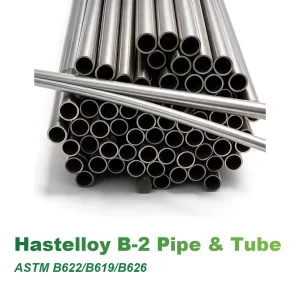
Hastelloy B-3 Pipe and Tube carries the UNS N10675 grade in seamless and welded tubular form. Chromium between 1 and 3% slows the ordered phases, which matters most at a welded joint. Reducing acids stay inside the envelope, and oxidants do not.
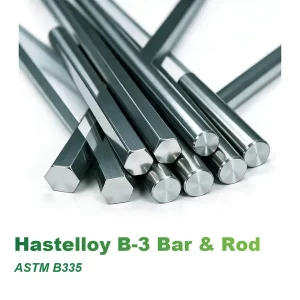
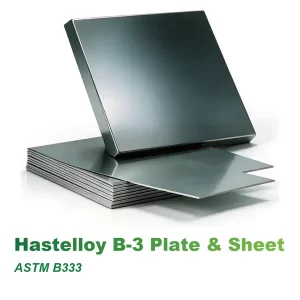
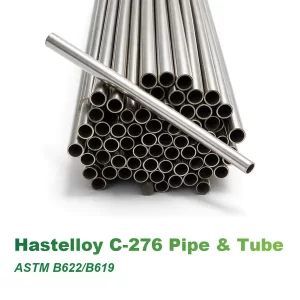
Tubular product reaches plants as seamless tube, welded pipe, and welded exchanger tube. Above all, the welded routes are where this grade separates itself. The Hastelloy B-3 hub carries the alloy data, and the Hastelloy B-3 Bar and Rod and Hastelloy B-3 Plate and Sheet pages cover the other two routes.
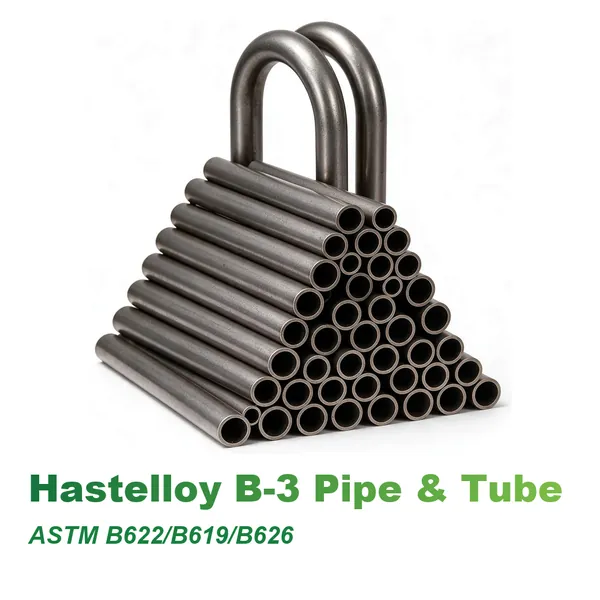
Hastelloy B-3 pipe and tube carries the UNS N10675 grade in seamless, welded, and exchanger-tube form. Chromium between 1 and 3 percent slows Ni4Mo ordering, which is what a welded joint needs most. The nickel-molybdenum chemistry resists hydrochloric and sulfuric acid while the stream reduces, and it refuses oxidants outright. Southerly Alloy works as a professional supplier and exporter of tubular product to ASTM B622, B619, and B626.
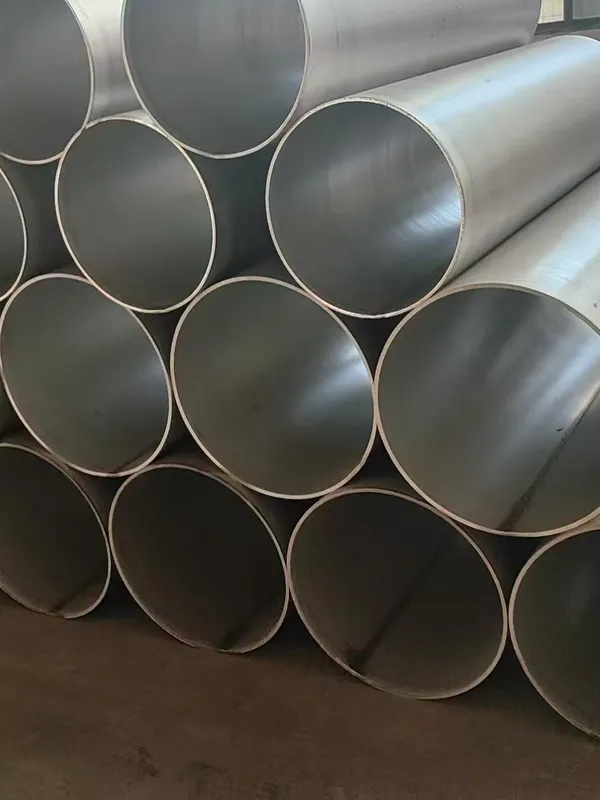
Chromium in the 1 to 3% range slows ordering, so a joint keeps more ductility than an earlier B-type weld would.
Moreover, carbon at 0.01% maximum lets most welded pipe leave the works without a post-weld anneal.
Moreover, the bore resists HCl from dilute streams to boiling while the circuit stays reducing.
In addition, non-oxidizing sulfuric, formic, and acetic duty sits inside the envelope.
The nickel-rich matrix holds up wherever chlorides concentrate.
Consequently, seamless tube stops where ASTM B622 stops, at 88.9 mm outside diameter.
Meanwhile, B619 pipe runs from Schedule 5S through 80S at 8 in nominal and larger.
B626 welded tube spans 3.2 to 88.9 mm outside diameter.
A welded tubular run asks a different question than a machined part does. Can the joint keep its properties without a furnace cycle afterwards? For most B-3 fabrications the answer is yes, and that frees a schedule slot.
We look at the joint design and the heat input before quoting, because both decide the acceptance route.
Every report names the melt, with the pressure-test record filed beside the tensile results.
In addition, pickled, bright annealed, or polished bores are fixed before drawing starts.
Ends are capped and lengths crated, then we quote FOB, CIF, or DAP against your port.
Welding heat is the point of risk in tubular work, so a B-3 run stays close to the anneal window. Therefore, the mill quenches every lot quickly after the furnace pass.
We cut and inspect the shell stock before the forming line takes it.
Roll forming closes the shell, and an automatic pass joins it without filler.
The joint is sized and dressed so the bore stays continuous.
A furnace pass near 1066 °C returns the whole tube, weld included, to one phase.
A fast water quench preserves that structure as the tube cools.
Drawing brings welded tube to its final diameter and wall where the order calls for it.
An acid bath removes scale from both the bore and the outside surface.
Hydrostatic or eddy-current testing clears the tube before dispatch.
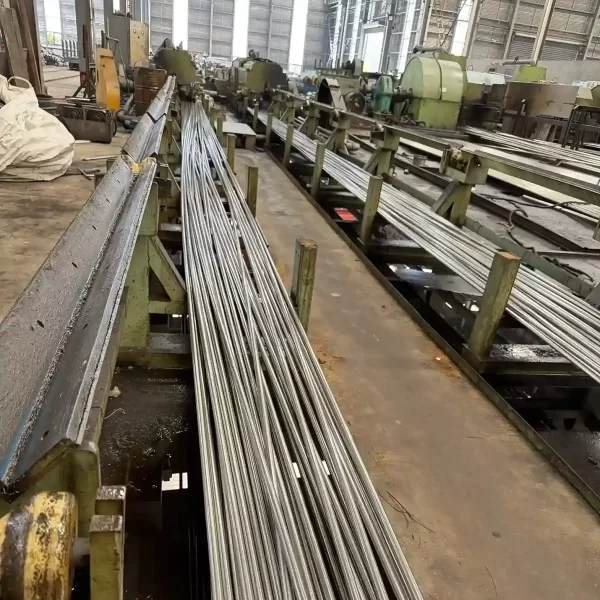
Tubular output runs on the same melt shop and annealing line as our bar and flat product. As a result, a mixed project order leaves under one certificate set.
The melt shop, forming line, and quench station sit together.
Forming, welding, drawing, and testing machines make up the line.
Seamless and welded routes share one melting campaign.
Weld procedure and heat-treatment questions reach a metallurgist.
Evidence follows the tubular document named on your order. The lab reads chemistry against the N10675 window, and pressure testing follows the standard you specified.
The lab compares molybdenum, chromium, and carbon with the ASTM limits.
Hydrostatic or eddy-current results file beside the joint documentation.
The inspection bay checks wall thickness, inside diameter, and straightness.
Each certificate figure traces back to a single heat.
Tubular supply splits by how the tube is made, and the method decides which document governs. Consequently, name the route before the size.
Cold-drawn or extruded to ASTM B622, capped at 88.9 mm outside diameter.
Request Availability →B619 product in Schedule 5S through 80S, at 8 in nominal and larger.
Request Availability →In addition, B626 tube runs from 3.2 to 88.9 mm outside diameter.
Request Availability →Therefore, bundles bend to drawing for exchanger assembly, with the radius agreed at quotation.
Request Availability →Welded acid lines are where this grade pays for itself, because the joint keeps its properties without a further furnace pass. Meanwhile, hydrochloric service takes most of the tonnage.
Discuss Your Application →Transfer and circulation piping for HCl up to boiling.
Spools and nozzles on vessels that cannot be re-annealed.
Tube bundles in reducing sulfuric acid circuits.
Column and reboiler tubing in reducing organic acid service.
Heater tubes and circulation lines in steel pickling.
Evaporator tubing in wet-process acid service.
Finally, spray and drain piping for acidic flue-gas treatment rounds out the list.
Tubing for acid-bearing solvent recovery.
Detailed technical information including chemical composition, mechanical properties, standards and available dimensions.
The tubular documents share one composition table for UNS N10675. Chromium in the 1 to 3% range is the deliberate addition behind the grade, and nickel plus molybdenum resists the acid. The mill certificate governs final acceptance.
| Element | Content |
|---|---|
| Nickel (Ni) | 65.0% min. |
| Molybdenum (Mo) | 27.0–32.0% |
| Chromium (Cr) | 1.0–3.0% |
| Iron (Fe) | 1.0–3.0% |
| Tungsten (W) | 3.0% max. |
| Cobalt (Co) | 3.0% max. |
| Manganese (Mn) | 3.0% max. |
| Carbon (C) | 0.01% max. |
| Silicon (Si) | 0.10% max. |
| Phosphorus (P) | 0.030% max. |
| Sulfur (S) | 0.010% max. |
| Vanadium (V) | 0.20% max. |
| Aluminum (Al) | 0.50% max. |
| Titanium (Ti) | 0.20% max. |
| Copper (Cu) | 0.20% max. |
| Columbium (Nb) | 0.20% max. |
| Tantalum (Ta) | 0.20% max. |
| Zirconium (Zr) | 0.10% max. |
| Nickel plus Molybdenum | 94.0–98.0% |
ASTM B622 sets a lower yield floor than the rod document does. Therefore, the table below reflects seamless product, and the welded routes follow their own documents.
| Product Form | Condition | Tensile Strength | Yield Strength, 0.2% Offset | Elongation |
|---|---|---|---|---|
| Seamless pipe and tube, ASTM B622 | Solution annealed and descaled | ≥110 ksi (760 MPa) | ≥45 ksi (310 MPa) | 40% |
B619 welded pipe and B626 welded tube carry their own acceptance minima. Consequently, we quote those figures from the edition your purchase order names.
Values below are typical room-temperature figures for design work rather than acceptance criteria. In addition, the alloy stays essentially non-magnetic in the annealed condition.
| Property | Value |
|---|---|
| Density | Approx. 9.22 g/cm³ |
| Melting range | Approx. 1370–1418 °C |
| Modulus of elasticity | Approx. 216 GPa |
| Modulus of rigidity | Approx. 83 GPa |
| Thermal conductivity at 20 °C | Approx. 11.2 W/m·K |
| Electrical resistivity at 20 °C | Approx. 1.37 µΩ·m |
| Thermal expansion, 25–100 °C | Approx. 10.6 µm/m·K |
| Magnetic behaviour | Essentially non-magnetic in the annealed condition |
Seamless product answers to ASTM B622, and that document stops at 88.9 mm outside diameter. Beyond it, welded work follows B619 for pipe and B626 for exchanger tube. Meanwhile, the designations below identify the same melt.
| Standard | Product or Application |
|---|---|
| ASTM B622 / ASME SB622 | Seamless pipe and tube to 88.9 mm outside diameter |
| ASTM B619 / ASME SB619 | Welded pipe in Schedule 5S, 10S, 40S, and 80S and larger |
| ASTM B626 / ASME SB626 | Welded tube, 3.2–88.9 mm outside diameter |
| ASTM B829 | General requirements for seamless pipe and tube |
| ASTM B775 / B751 | General requirements for welded pipe and welded tube |
| ASTM B335 / ASME SB335 | Rod in the same grade |
| ASTM B333 / ASME SB333 | Plate, sheet, and strip in the same grade |
| ASTM B564 / ASME SB564 | Forgings |
| ASTM B366 / ASME SB366 | Factory-made wrought fittings |
| DIN 17751 | Seamless tube in wrought nickel alloys |
| ISO 6207 | Nickel alloy seamless tube |
| UNS N10675 | Unified Numbering System designation |
| W.Nr. 2.4600 / NiMo29 | European designation for Alloy B-3 |
| GB/T 15007 NS3203 | Chinese designation |
| SAE AMS | No aerospace specification covers this grade |
The tubular documents come from ASTM International, and their text settles any acceptance question.
Each document sets its own size window, so a seamless ceiling and a welded size list tell different stories. Therefore, state the route and the dimensions together.
| Product Form | Outside Diameter | Wall Thickness |
|---|---|---|
| Seamless pipe and tube, ASTM B622 | Up to 88.9 mm | 0.5–12.7 mm |
| Welded pipe, ASTM B619 | Schedule 5S through 80S, 8 in nominal and larger | Per schedule |
| Welded tube, ASTM B626 | 3.2–88.9 mm | 0.41–3.7 mm |
| U-bend tube | As drawn, bent to drawing | 0.7–6 mm |
The bore finish decides how well the tube cleans and how long the line lasts. In short, we fix it with the order rather than assume one.
| Surface Condition | Typical Use |
|---|---|
| Solution annealed and pickled | Standard delivery for hydrochloric and sulfuric acid service |
| Bright annealed | Scale-free bore for instrument and clean circuits |
| Polished bore | Reduced roughness for product-contact lines |
| Mechanically descaled | Welded product cleaned without acid pickling |
Get detailed information including specifications, standards, dimensions and material properties.
One coordinator follows your B-3 tube order from the first enquiry to the last document. We settle the weld route and the bore finish before forming starts.
Give the acid, its strength, the outside diameter, and the wall.
Tell us whether you need seamless, welded, or exchanger tube.
Tell us the joint design and the heat input your shop will use.
Price, lead time, and the test set reach you together.
Grade, size, inspection level, and delivery terms go on record first.
The line forms, welds, anneals, quenches, and pressure tests the tube to order.
Export papers and certificates follow the tube under the agreed terms.
Finally, a status report follows the consignment until it reaches your port.
Feedback from buyers and engineers who source nickel alloy materials from Southerly Alloy.
“The welded spools for our acid line held their ductility, so we skipped a post-weld furnace cycle.”
“Pressure records arrived with the certificate, which cleared our receipt check in one pass.”
“Capped ends and crated lengths meant the tubes went straight into the rack.”
Our production and inspection processes are certified to international standards, and every delivery ships with EN 10204 3.1 mill test certificates.
Quality Management System
Pressure Equipment Directive
Material Standards Compliance
Mill Test Certificates
Seamless product follows B622, welded pipe follows B619, and welded exchanger tube follows B626.
88.9 mm outside diameter is the ceiling in ASTM B622.
Usually not, because the chromium window slows ordering. However, severe acid duty still calls for one.
Yes, at every concentration up to boiling, provided no oxidant enters the circuit.
ERNiMo-7 wire to AWS A5.14, or ENiMo-7 electrodes to AWS A5.11.
One length covers the common stocked sizes.
FOB terms are our default, and EXW or CIF follows on request.
The quotation follows weight, with the alloy share frozen at the order date.
Stocked sizes leave in 7-15 days, and made-to-order drawing takes about 25 days.
Yes. A 3.1 certificate travels with each lot, and 3.2 endorsement is available.
Give us the medium, the outside diameter, and the wall you need. Tell us how the joint will be welded, because that decides the test set. Price, lead time, and the paperwork come back as one reply.
A trial length is enough to prove the bore finish, so start with one piece before a plant-wide release.