01
Hastelloy C-22 Bar and Rod
Round, hex, square, and forged bar to ASTM B574 in the solution-annealed or hot-finished condition.
View Hastelloy C-22 Bar and Rod →Grade data for UNS N06022 / W.Nr. 2.4602 — chromium-rich composition, standards, and three supply routes.
The grade holds the highest chromium level of the C-family, so nitric acid and wet chlorine meet a more stable passive film.
Composition, standards, and mechanical minimums for every supply form sit together, so a specification review needs a single page.
Bar, tubular, and flat-product questions reach the same coordinator rather than three separate order desks.
Hastelloy C-22 is a nickel-chromium-molybdenum-tungsten alloy carrying more than 20% chromium in solid solution. That chromium level covers oxidizing acids, wet chlorine, and oxidizing chloride salts. Molybdenum and tungsten hold the reducing-acid and pitting side of the envelope.
Specification review starts with the tables below, which set out composition, standards, and mechanical minimums for each form. Ordering detail lives on the Hastelloy C-22 Bar and Rod, Hastelloy C-22 Pipe and Tube, and Hastelloy C-22 Plate and Sheet pages.
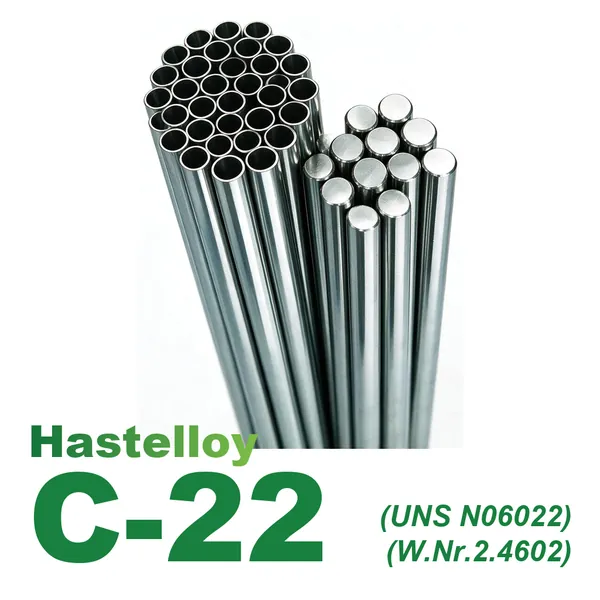
Hastelloy C-22 is a nickel-chromium-molybdenum-tungsten grade supplied as bar and rod, tubular product, and flat-rolled plate, sheet, and strip. Chromium at 20.0-22.5% carries oxidizing media such as nitric acid, wet chlorine, and ferric chloride, while molybdenum and tungsten hold reducing acids and chloride pitting in check. Because carbon stays at 0.015% max, welded joints keep their resistance without a post-weld anneal. This page collects composition, standards, and mechanical minimums for UNS N06022.
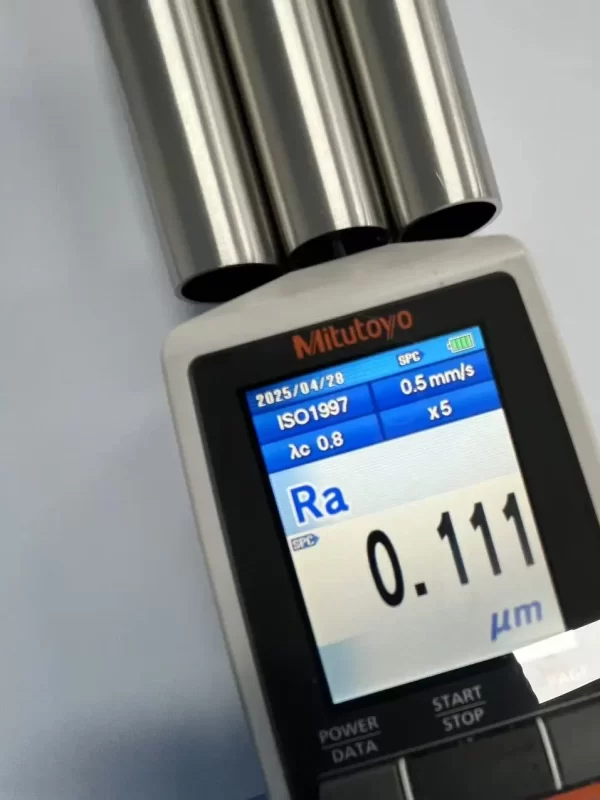
Chromium above 20% holds nitric acid, ferric chloride, and cupric chloride away from the passive film.
In addition, hypochlorite bleach, chlorine dioxide, and moist chlorine gas leave few lining options open.
Still, molybdenum at 12.5–14.5% and tungsten at 2.5–3.5% carry hydrochloric, sulphuric, and phosphoric duty.
Moreover, a molybdenum level near 13% keeps crevice and pitting attack off wetted surfaces in seawater and brine.
Carbon at 0.015% max and silicon at 0.08% max leave the grain boundaries clear of carbides.
Therefore, annealed product meets a 310 MPa yield minimum with 45% elongation for expansion and forming work.
A water-quenched anneal at 1121 °C dissolves intermetallic phases before the mill releases the lot.
Consequently, continuous service stays below 1250 °F, where harmful phases would otherwise precipitate.
Selection turns on the oxidizing load in the stream. C-22 lifts chromium above C-276 to cover nitric acid and wet chlorine, then keeps molybdenum for reducing duty. Upsets between the two no longer force a material change.
Chromium sets the ceiling, so nitric acid, wet chlorine, and ferric chloride duty belongs here rather than on a lower-chromium grade.
Above 1250 °F the alloy precipitates harmful phases, so continuous service stays under that line unless the design accepts a shorter life.
A conventional 650 °C stress-relief cycle destroys corrosion resistance, so residual-stress work needs a full solution anneal instead.
The grade costs more than C-276, so it earns its place where oxidizing or mixed media justify the premium, not on plain reducing acid.
Above all, three supply routes share this grade, and each links to a page listing its own sizes, standards, and delivery conditions.
Round, hex, square, and forged bar to ASTM B574 in the solution-annealed or hot-finished condition.
View Hastelloy C-22 Bar and Rod →Seamless product to B622, welded pipe to B619, and welded tube to B626.
View Hastelloy C-22 Pipe and Tube →Plate, sheet, and strip to ASTM B575 with B906 general requirements.
View Hastelloy C-22 Plate and Sheet →Consequently, this grade serves streams that oxidize as well as reduce, and the medium and its temperature drive material life. The duties below pair each environment with the form that carries it.
Discuss Your Application →Scrubber shells, damper hardware, and stack liners that meet sulfurous condensate.
Transfer piping and vessel plate for bleach plants and disinfection circuits.
Reactor internals and agitator shafts for nitric duty and oxidizer-bearing blends.
Pickling lines, etching baths, and leach circuits where oxidising salts dominate.
Vessels and internals where metal pickup must stay minimal across clean-in-place cycles.
Digester fittings and chlorine dioxide hardware for bleach plant service.
Exchanger tube, tubesheets, and pump parts for chloride-rich cooling water.
Ducting and quench hardware that face acidic combustion products.
Wellhead and valve parts released inside the NACE hardness envelope.
Detailed technical information including chemical composition, mechanical properties, standards and available dimensions.
Chemical limits for UNS N06022 sit in one window across the B574, B575, and B622 documents. Chromium above 20% carries oxidizing media, molybdenum and tungsten cover reducing acids and pitting, and carbon stays at 0.015% max to protect weld zones. The purchase specification in force still governs acceptance.
| Element | Content |
|---|---|
| Nickel (Ni) | Balance |
| Chromium (Cr) | 20.0–22.5% |
| Molybdenum (Mo) | 12.5–14.5% |
| Tungsten (W) | 2.5–3.5% |
| Iron (Fe) | 2.0–6.0% |
| Cobalt (Co) | 2.50% max. |
| Manganese (Mn) | 0.50% max. |
| Vanadium (V) | 0.35% max. |
| Silicon (Si) | 0.08% max. |
| Carbon (C) | 0.015% max. |
| Phosphorus (P) | 0.020% max. |
| Sulfur (S) | 0.020% max. |
Every form of this grade shares one set of minimum values, so the same tensile floor applies to plate, seamless tube, and bar alike. Still, name the ordered document and condition at enquiry so acceptance stays unambiguous.
| Product Form | Standard | Condition | Tensile Strength | Yield Strength, 0.2% Offset | Elongation | Hardness |
|---|---|---|---|---|---|---|
| Bar and rod | ASTM B574 | Solution annealed | ≥690 MPa (100 ksi) | ≥310 MPa (45 ksi) | ≥45% | ≤241 HB |
| Seamless pipe and tube | ASTM B622 | Solution annealed | ≥690 MPa (100 ksi) | ≥310 MPa (45 ksi) | ≥45% | Not specified |
| Welded pipe | ASTM B619 | Solution annealed after welding | ≥690 MPa (100 ksi) | ≥310 MPa (45 ksi) | ≥45% | Not specified |
| Welded tube | ASTM B626 | Solution annealed after welding | ≥690 MPa (100 ksi) | ≥310 MPa (45 ksi) | ≥45% | Not specified |
| Plate, sheet, and strip | ASTM B575 | Solution annealed | ≥690 MPa (100 ksi) | ≥310 MPa (45 ksi) | ≥45% | 100 HRB max. |
| Forgings and flanges | ASTM B564 | Solution annealed | ≥690 MPa (100 ksi) | ≥310 MPa (45 ksi) | ≥45% | Not specified |
Annealed product normally runs at or below 100 HRB on the B-scale, and B575 lists that figure for guidance rather than acceptance. C-22 holds no aerospace AMS document, so aerospace work follows the project specification or the ASTM document named on the order.
| Property | Value |
|---|---|
| Alloy | Hastelloy C-22 |
| UNS | N06022 |
| Werkstoff | 2.4602 |
| Density | Approx. 8.69 g/cm³ |
| Melting Range | Approx. 1357–1399 °C |
| Elastic Modulus | Approx. 206 GPa |
| Thermal Conductivity | Approx. 10.1 W/m·°C at 20 °C |
| Specific Heat | Approx. 414 J/kg·°C |
| Expansion Coefficient | Approx. 12.4 µm/m·°C (20–100 °C) |
| Electrical Resistivity | Approx. 1.14 µΩ·m at 20 °C |
| Alloy Type | Nickel-chromium-molybdenum with tungsten |
| Strengthening | Solid solution and cold work |
| Magnetic Behaviour | Practically non-magnetic at ambient temperature |
| Standard | Product / Application |
|---|---|
| ASTM B575 | Plate, sheet, and strip, solution annealed and descaled |
| ASTM B574 | Rod and bar in the solution-annealed condition |
| ASTM B622 | Seamless pipe and tube, outside diameter to 88.9 mm |
| ASTM B619 | Welded pipe, solution annealed after welding |
| ASTM B626 | Welded tube for heat exchangers, condensers, and evaporators |
| ASTM B564 | Forgings and flanges |
| ASTM B366 | Wrought fittings in the same grade |
| ASTM B829 / B775 / B751 | General requirements for seamless and welded tubular product |
| ASTM B906 | General requirements for flat-rolled nickel alloy product |
| ASME SB575 / SB574 / SB622 / SB619 / SB626 | Counterparts under pressure-code jurisdiction |
| DIN 17744 | Wrought nickel alloy, W.Nr. 2.4602 / NiCr21Mo14W |
| DIN 17750 / 17751 / 17752 | Flat product, tube, and bar under the German series |
| ISO 6207 / 6208 / 9723 | Nickel alloy tube, flat product, and bar |
| NACE MR0175 / ISO 15156 | Sour service in oil and gas production |
| UNS N06022 · W.Nr. 2.4602 · NiCr21Mo14W · NS334 | Designations |
These documents come from ASTM International, and the ASME SB edition takes over once equipment falls under pressure-code jurisdiction. Sour-service projects, on the other hand, reference NACE MR0175 / ISO 15156 beside the product standard.
| Product Form | Typical Supply Range |
|---|---|
| Bar and rod | 6–340 mm dia. by section and condition |
| Seamless pipe | NPS 1/8 to NPS 3, outside diameter to 88.9 mm |
| Seamless tube | OD 6–88.9 mm, wall 0.5–10 mm |
| Welded pipe and tube | OD 21.3–610 mm, wall 0.5–12.7 mm |
| Plate and sheet | 0.5–100 mm thick, cut to length and width |
| Strip and coil | 0.5–6.35 mm thick, slit to width |
Size windows move with the standard and the ordered condition, and heavy sections depend on billet or slab supply. Therefore, quote the diameter, wall or thickness, and length at enquiry so the plant route stays accurate.
| Surface Condition | Typical Characteristics / Applications |
|---|---|
| Solution Annealed & Pickled | Standard delivery for acid, chloride, and seawater service |
| Bright Annealed | Scale-free surface for clean and visible applications |
| Pickled Only | Acid-descaled finish for general industrial work |
| Hot-Worked | As-rolled or as-forged surface for parts machined to size |
| Cold Drawn | Close diameter control with a bright finish |
Get detailed information including specifications, standards, dimensions and material properties.
Flat-rolled product runs to B575, bar and rod to B574, seamless tube to B622, welded pipe to B619, and welded tube to B626. Under code jurisdiction the ASME SB editions apply instead.
Chromium sits at 20.0–22.5% to cover oxidizing media, while molybdenum and tungsten handle the reducing side of the same stream. Therefore, one alloy serves a plant whose process chemistry shifts.
ASME limits the grade to 1250 °F (677 °C) in continuous service. Above that line, harmful phases precipitate and corrosion resistance falls away.
ERNiCrMo-10 wire to AWS A5.14 and ENiCrMo-10 electrodes to A5.11 cover most joints. As a result, most weldments enter service without a post-weld heat treatment.
Yes. We supply it to NACE MR0175 / ISO 15156 with per-heat hardness records inside the 35 HRC envelope.
One piece serves most stock sizes, and we quote trial quantities without a minimum premium.
We quote FOB as standard, and EXW, CIF, or DAP terms follow once the destination is fixed.
Weight in kilograms drives most quotations, and the ordered form and condition set the final figure.
Expect 7-15 days on stocked sizes, and we confirm a schedule date for made-to-order items.
Yes. We issue an EN 10204 3.1 certificate with every consignment and arrange third-party 3.2 endorsement on request.
Tell us the form, standard, size, and quantity, and the reply carries price, Incoterm, lead time, and documents. Add the medium and its temperature if the duty needs a corrosion review.