01
Seamless Pipe
Hot-worked and cold-drawn pipe to ASTM B407 for pressure piping, manifolds, and furnace connections.
Request Availability →Seamless pipe, heat-exchanger tube, and welded product for cracking, reforming, and high-temperature steam duty.
Seamless pipe, heat-exchanger tube, and welded product are each quoted against the grade and the ASTM specification that governs it, rather than against a single generic route.
Hydrostatic or eddy-current records follow the piece count, so you can see which lengths passed and against which clause.
We check every 800H and 800HT tube order to ASTM E112 before release, because creep duty rests on that number.
Incoloy 800 / 800H / 800HT pipe and tube comes in UNS N08800, N08810 and N08811 for hot, carburizing service. Three tubular routes carry this iron-nickel-chromium family, and each one answers to its own ASTM specification.
Cracking furnace coils, reformer pigtails, and superheater tubing are the usual destinations for this material. Southerly Alloy works as a professional supplier and exporter across all three routes, and the Incoloy 800 / 800H / 800HT material page carries the grade data behind the tube choice. Above all, the grade follows the duty temperature rather than the tube diameter.
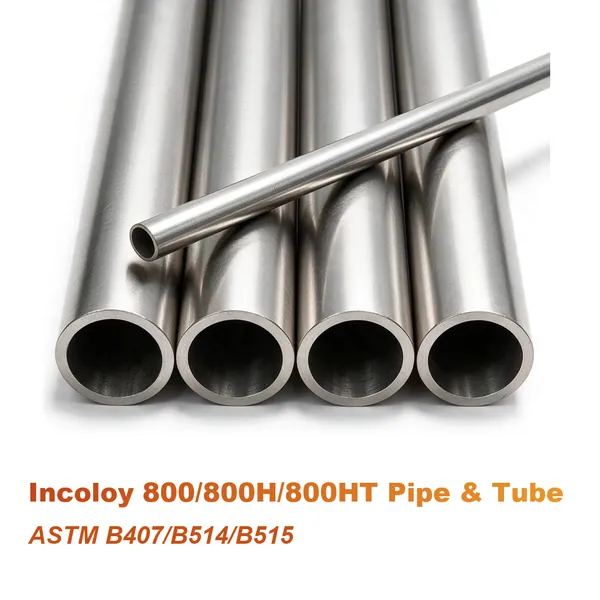
Incoloy 800 / 800H / 800HT pipe and tube covers three tubular routes on one iron-nickel-chromium family. ASTM B407 governs seamless pipe and tube, B163 covers heat-exchanger tube, and B514 with B515 covers welded product, with the same design divide at about 593 °C. Cracking furnace coils, reformer pigtails, and superheater tubing are the usual destinations. Southerly Alloy works as a professional supplier and exporter in all three routes, and every length ships with EN 10204 3.1 documentation.
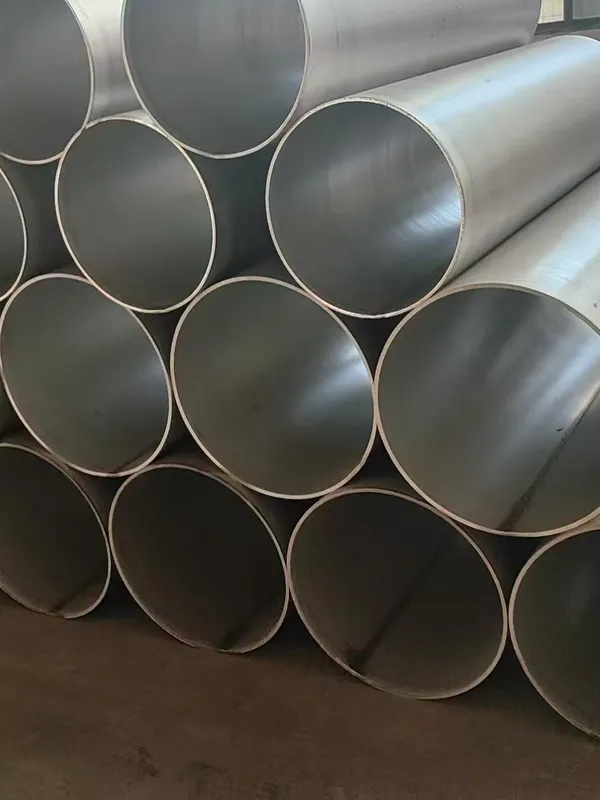
Cold-drawn and hot-worked routes cover the pressure range, and we write the hydrostatic test into the order before cutting the lengths.
We draw condenser and heat-exchanger tube to close wall tolerance, then run eddy-current testing when your specification asks for it.
Large-diameter welded product extends the size range well beyond the seamless ceiling, with the weld seam tested as a matter of course.
The controlled-carbon 800H and 800HT routes keep their load-carrying capacity where grade 800 would begin to sag under long exposure.
A chromium oxide scale and a nickel-rich matrix together slow both surface scaling and carbon ingress in furnace gas.
We produce U-bent lengths and coiled tube for exchanger bundles and for field installation where long straight runs are impractical.
We report E112 results for 800H and 800HT, so the coarse-grain requirement rests on a measured number rather than an assumption.
Tube orders fail on documentation as often as material, so we settle the test and paperwork before the first cut. Moreover, one coordinator stays on the file from inquiry to bill of lading. In addition, we quote the lead time we can hold.
We agree grade, standard, temper, and test level in writing, which keeps the delivered tube aligned with what your inspector expects.
We build the certificate set around your incoming inspection, not around a fixed template that may omit a clause you need.
We book third-party inspection and EN 10204 3.2 endorsement through the order when your project requires a second signature.
Straight lengths travel in wooden cases and coils in steel-strapped bundles, with end caps and desiccant where the route warrants them.
Tubular production adds forming and pressure steps that bar and plate never see, so each leaves a control point. Therefore, the sequence below runs from melt chemistry to the packed length. Moreover, the route records every result against the heat and the piece count.
The melt shop weighs nickel, chromium, and iron to the ordered UNS window, and targets carbon for grade 800, 800H, or 800HT.
The melt shop forges or rolls down the cast ingot, then bores or pierces it into a hollow ready for forming.
The press extrudes or rolls the hollow over a mandrel to build the tube wall and set the initial dimensions.
Successive draw passes reduce wall and diameter, with an anneal between passes to restore ductility.
The furnace anneals 800H at 1121 °C minimum and 800HT at 1149 °C minimum, which sets the coarse-grain structure the creep duty needs.
The laboratory etches and rates a specimen per lot to ASTM E112, and a fine grain becomes a rejection rather than a concession.
The laboratory applies hydrostatic, eddy-current, or ultrasonic examination according to the ordered specification and the intended service.
The packing crew marks heat number, grade, size, and standard on each length, then cases or bundles the order for shipment.
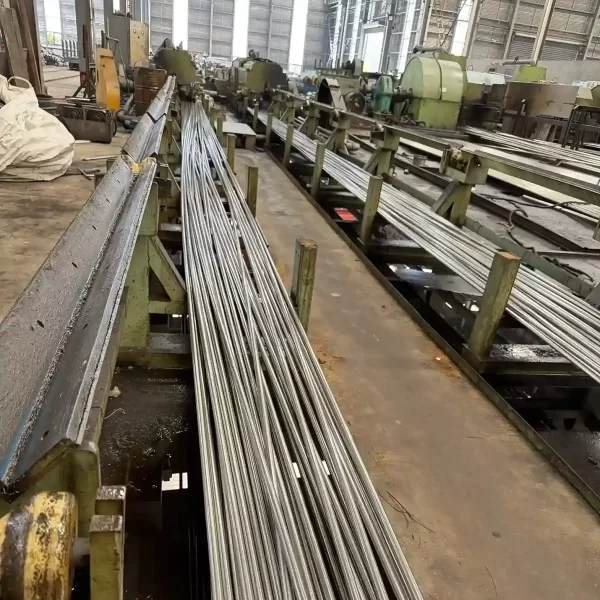
We schedule tube output around the drawing benches and the annealing furnaces, because those two steps set the achievable lead time. Consequently, the figures below describe the capacity behind a quoted date. In addition, we campaign mixed-grade orders where the anneal temperatures allow it.
Tube drawing, annealing, and testing lines sit under one roof.
Cold-drawing benches, pilger mills, and annealing furnaces run daily.
Pipe and tube output across the three 800-series grades.
Metallurgists who confirm grade, grain size, and test requirements with you.
Seamless pipe, heat-exchanger tube, and welded product on one qualified route.
We release a tube length only when the ordered test set has proven out on the heat that produced it. In addition, the pressure test and the dimensional check carry a record for every piece. Consequently, no nonconforming length can hide inside a shipment.
Spectrometer analysis verifies carbon, the Al+Ti total, and the balance against the ordered UNS limits.
Tensile and hardness results come from material in the condition you will receive, not from an as-cast reference sample.
The inspection bench measures outside diameter, wall thickness, ovality, and straightness to the tolerance class of the governing standard.
We file hydrostatic, eddy-current, or ultrasonic results against the piece count and issue them with the certificate package.
The tubular range splits by standard rather than by size alone, since each route carries its own dimensional and testing rules. Meanwhile, the grade question stays the same across all of them.
Hot-worked and cold-drawn pipe to ASTM B407 for pressure piping, manifolds, and furnace connections.
Request Availability →Close-tolerance tube to ASTM B163 for shell-and-tube exchangers, condensers, and feedwater heaters.
Request Availability →Large-diameter pipe to ASTM B514 with B775, used where the seamless range runs out.
Request Availability →Welded tube to ASTM B515 with B751 for lower-pressure exchanger and furnace duty.
Request Availability →Bent to your bundle drawing with controlled ovality through the bend for exchanger assembly.
Request Availability →Long coils for reformer pigtails and for field runs where a straight length takes several welds.
Request Availability →Reformer and cracking furnaces take most of the tubular tonnage, since the tube wall sits between hot gas and a pressure boundary. Furthermore, the same properties serve superheater and nuclear steam-generator duty, where the demand is longer life rather than a higher ceiling.
Discuss Your Application →Radiant coil tube and transfer-line exchanger tubing that runs carburizing gas at 750–900 °C.
Outlet pigtail tube, collector headers, and transfer piping on steam-methane reforming units.
Tubing for superheater and reheater sections in conventional, combined-cycle, and waste-to-energy boilers.
Heat-transfer tube for pressurized water reactors, where the design life runs into decades.
Radiant tube, muffles, and retorts for carburizing, nitriding, and annealing furnaces.
Shell-and-tube exchangers in petrochemical and chemical service, including nitric acid and VCM process streams.
Protection tube for thermocouples and sampling probes in hot furnace atmospheres.
High-temperature syngas and steam lines where thermal cycling rules out a lower-alloy choice.
Detailed technical information including chemical composition, mechanical properties, standards and available dimensions.
All three grades sit on one composition table, and the tubular standards adopt it unchanged. Carbon, the Al+Ti total, and the annealed grain size are the only fields that move between the designations. In addition, the mill test certificate governs final acceptance.
| Element | Alloy 800 (UNS N08800) | Alloy 800H (UNS N08810) | Alloy 800HT (UNS N08811) |
|---|---|---|---|
| Nickel (Ni) | 30.0–35.0% | 30.0–35.0% | 30.0–35.0% |
| Chromium (Cr) | 19.0–23.0% | 19.0–23.0% | 19.0–23.0% |
| Iron (Fe) | 39.5% min. | 39.5% min. | 39.5% min. |
| Carbon (C) | 0.10% max. | 0.05–0.10% | 0.06–0.10% |
| Aluminium (Al) | 0.15–0.60% | 0.15–0.60% | 0.25–0.60% |
| Titanium (Ti) | 0.15–0.60% | 0.15–0.60% | 0.25–0.60% |
| Aluminium + Titanium | 0.30–1.20% | 0.30–1.20% | 0.85–1.20% |
| Copper (Cu) | 0.75% max. | 0.75% max. | 0.75% max. |
| Manganese (Mn) | 1.50% max. | 1.50% max. | 1.50% max. |
| Silicon (Si) | 1.00% max. | 1.00% max. | 1.00% max. |
| Sulfur (S) | 0.015% max. | 0.015% max. | 0.015% max. |
| Annealed Grain Size | Not specified | ASTM 5 or coarser | ASTM 5 or coarser |
The minimums below come from the tube and pipe tables, and they differ between B407 and B163 only in how each standard names the condition. Consequently, the ordered temper decides which row applies to your delivery.
| Standard and Condition | Grade | Tensile Strength, min. | Yield Strength (0.2%), min. | Elongation, min. |
|---|---|---|---|---|
| B407 seamless — cold-drawn, annealed | N08800 | 75 ksi (520 MPa) | 30 ksi (205 MPa) | 30% |
| B407 seamless — hot-worked, annealed or as-hot-worked | N08800 | 65 ksi (450 MPa) | 25 ksi (170 MPa) | 30% |
| B407 seamless — hot-worked or cold-worked, annealed | N08810 / N08811 | 65 ksi (450 MPa) | 25 ksi (170 MPa) | 30% |
| B163 heat-exchanger tube — annealed | N08800 | 75 ksi (517 MPa) | 30 ksi (207 MPa) | 30% |
| B163 heat-exchanger tube — cold-worked | N08800 | 83 ksi (572 MPa) | 47 ksi (324 MPa) | 30% |
| B163 heat-exchanger tube — annealed | N08810 / N08811 | 65 ksi (448 MPa) | 25 ksi (172 MPa) | 30% |
| B514 welded pipe — as-welded or annealed | N08800 | 75 ksi (520 MPa) | 30 ksi (205 MPa) | 30% |
| B514 / B515 welded product — annealed | N08810 / N08811 | 65 ksi (450 MPa) | 25 ksi (170 MPa) | 30% |
Two footnotes belong with the table above. First, the yield strength requirement does not apply to material thinner than 0.020 in. (0.51 mm). Second, hydrostatic testing applies to tube with an outside diameter of 1/8 in. or more and a wall of 0.015 in. or more, calculated from P = 2St/D. The allowable fibre stress is 18,700 psi (130 MPa) for cold-drawn annealed N08800, and 16,600 psi (115 MPa) for hot-finished N08800 and for annealed N08810 and N08811.
The values below are typical for all three grades, since the carbon window does not change the physical base. In short, they serve design work rather than acceptance testing.
| Property | Value |
|---|---|
| Density | Approx. 7.94 g/cm³ |
| Melting range | Approx. 1357–1385 °C |
| Specific heat, 0–100 °C | Approx. 460 J/kg·°C |
| Modulus of elasticity at 20 °C | Approx. 196.5 GPa |
| Thermal conductivity at 20 °C | Approx. 11.5 W/m·K |
| Thermal expansion, 20–100 °C | Approx. 14.4 µm/m·°C |
| Electrical resistivity at 20 °C | Approx. 0.989 µΩ·m |
| Curie temperature | Approx. −115 °C |
| Magnetic behaviour | Non-magnetic at ambient temperature |
| Hardness, annealed | Approx. 138 HB |
Each tubular route carries its own ASTM specification, and the welded routes pair with a general-requirements document that governs testing and tolerances. Therefore, quote the form first and the grade second, since the form decides which standard applies. Reference ASTM International for the current text of any specification named here.
| Standard / Designation | Scope |
|---|---|
| ASTM B407 / ASME SB407 (with B829) | Seamless pipe and tube — UNS N08800, N08810, N08811 |
| ASTM B163 / ASME SB163 | Seamless condenser and heat-exchanger tube |
| ASTM B514 (with B775) | Welded pipe — general requirements under B775 |
| ASTM B515 (with B751) | Welded tube — general requirements under B751 |
| ASTM B408 / ASME SB408 | Rod and bar, for tube sheet and support hardware |
| ASTM B564 / B366 | Forgings, and wrought pipe fittings |
| ASME Code Case 1325 | Elevated-temperature design allowables for 800H, Sections I and VIII Divisions 1 and 2 |
| ASME Code Case 1983 | 800H design allowables to 1800 °F (982 °C), Section VIII Division 1 |
| ASME Code Case 1987 | Maximum allowable stresses for 800HT |
| ASME Code Cases N-201 / N-253 / N-254 | Nuclear construction under Section III, including steam-generator tubing |
| UNS N08800 / N08810 / N08811 | Material designations for Alloy 800, 800H and 800HT |
| W.Nr. 1.4876 / 1.4958 / 1.4959 | European designations, EN X10NiCrAlTi32-20 / X5NiCrAlTi31-20 / X8NiCrAlTi32-21 |
| EN 10095 / DIN 17459 / DIN 17460 | European heat-resisting materials standards, by product form |
| BS 3074 (NA 15 series) | British seamless tube designation for the 800 series |
| JIS NCF 800 / NCF 800H / NCF 800HT | Japanese designations for the series |
| ISO FeNi32Cr21AlTi (NW8800 / NW8810 / NW8811) | ISO designations, the HC and HT suffixes marking the 800H and 800HT compositions |
| ISO 6207 | Seamless tube in nickel and nickel alloys |
Sizes below describe the routes we normally produce, and the standard sets the seamless ceiling rather than our preference. Meanwhile, welded product covers the larger diameters that seamless tube cannot reach.
| Product Form | Typical Supply | Length |
|---|---|---|
| Seamless pipe | 6–219 mm OD | Random or cut to length |
| Seamless heat-exchanger tube | 6–76 mm OD | Cut to length |
| Seamless tube, heavy wall | 6–219 mm OD, wall to 25 mm | Cut to length |
| Welded pipe | 12–2032 mm OD | Random or cut to length |
| Welded tube | 12–152 mm OD | Cut to length |
| U-bent tube | 6–76 mm OD, bend radius to drawing | Per bundle drawing |
| Coiled tube | 6–38 mm OD | Coil, or cut to length |
The next operation decides the tube finish, and pickling is the usual default for furnace and exchanger work. Note that 800H and 800HT receive their finish after solution annealing, so a later pass does not disturb the coarse grain.
| Surface Condition | Typical Use |
|---|---|
| Solution annealed and pickled | Standard delivery condition for 800H and 800HT tube, with the ASTM 5 or coarser grain in place |
| Hot-finished | As-produced surface for lengths that will be machined or welded at the ends only |
| Cold-drawn | Close wall and diameter control with a brighter surface for exchanger tube |
| Bright annealed | Oxide-free finish produced in a controlled atmosphere for clean service |
| Ground or polished | Reduced roughness for product-contact or visible tube surfaces |
| U-bent and stress relieved | Bent tube for exchanger bundles, with the bend zone treated as the drawing requires |
Get detailed information including specifications, standards, dimensions and material properties.
The governing standard fixes the tubular route, so the specification question comes before the price. As a result, we ask for the form and the grade together, and then confirm the test level you need.
Share the form, grade, size, wall, quantity, and the standard you are ordering against.
We check whether the duty calls for B407, B163, B514, or B515, and flag any clause that changes the price.
We write the hydrostatic, eddy-current, ultrasonic, or PMI requirements into the quotation rather than adding them later.
Price, lead time, and the document list arrive in one reply, with the packing method stated.
Melting, forming, drawing, and the grade-specific anneal run in sequence, with grain size checked before release.
The laboratory performs the ordered pressure and nondestructive tests, and we file the results against the piece count.
Marked lengths and coils leave in export packing, and the paperwork travels with the consignment.
Feedback from buyers and engineers who source nickel alloy materials from Southerly Alloy.
“The reformer pigtail coils arrived with the anneal and grain size already documented, and the ovality through the bends matched the bundle drawing.”
“We asked for eddy-current records on every exchanger tube, and the certificate package listed them length by length without a follow-up request.”
“Mixing welded and seamless in one order caused no problem, and each line carried its own standard designation.”
Our production and inspection processes are certified to international standards, and every delivery ships with EN 10204 3.1 mill test certificates.
Quality Management System
Pressure Equipment Directive
Material Standards Compliance
Mill Test Certificates
ASTM B407 / ASME SB407, and heat-exchanger tube moves to ASTM B163 / ASME SB163. Buyers order welded product to B514 for pipe or B515 for tube.
Once the wall carries load above about 593 °C, and especially where the design life runs into tens of thousands of hours. Therefore, creep rather than yield governs the wall thickness above that line.
Yes, for 800H and 800HT. Both grades require ASTM 5 or coarser in the annealed condition. Furthermore, the tube standards test it per lot.
Not directly. However, welded product reaches larger diameters and costs less per metre at those sizes, while seamless tube carries the higher pressure rating and avoids a weld seam in the pressure boundary.
Hydrostatic testing follows P = 2St/D, with an allowable fibre stress of 18,700 psi (130 MPa) for cold-drawn annealed N08800. In addition, we run eddy-current or ultrasonic testing when the order asks for it.
Yes. Send the bundle drawing or the coil length. In addition, we confirm the bend radius, the ovality limit, and the heat treatment of the bend zone.
One length or one coil for most stock sizes.
FOB is our usual basis, and we can quote EXW or CIF when you prefer those terms.
Stock sizes move in 7-15 days, and grain-controlled 800H or 800HT tube takes about 25 days.
Both, with 3.1 issued as standard on every heat and 3.2 arranged through a third party on request.
Send the form, grade, size, wall, quantity, and standard to receive price, lead time, and the document list in one reply. In addition, tell us the duty temperature, because that answer decides whether grade 800 is enough.
We stock Incoloy 800, 800H and 800HT pipe and tube in common sizes and produce to your specification, and we accept short trial lengths on many stock items.