01
Monel K-500 Seamless Pipe
Hot-finished and cold-drawn pipe for process lines and seawater systems.
Request Availability →Seamless and welded nickel-copper pipe that carries Monel 400 corrosion resistance at roughly triple the yield strength.
The precipitation cycle runs before shipment, so strength arrives with the tube rather than at your site.
Moreover, permeability stays close to unity along the whole length, which suits instrument and survey lines.
Because B865 writes the acceptance figures, your incoming inspection can compare numbers instead of guessing.
Monel K-500 pipe and tube takes the UNS N05500 chemistry through a full precipitation cycle before shipment. Consequently strength arrives with the tube, and buyers skip a heat treatment at their own works. Seawater lines, cooling loops, and instrument sheaths are the usual destinations.
Dimensions and examination follow BS 3074 NA18 or DIN 17751, and the chemistry comes from ASTM B865. Because no ASTM document writes a seamless tube specification for N05500, we name the reference list before booking. Also, the aged acceptance values travel on the mill certificate.
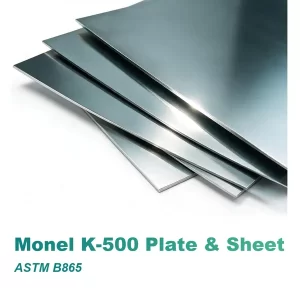
The Monel K-500 hub holds the full grade data, and Monel K-500 Plate and Sheet covers the flat-rolled side of the same alloy.
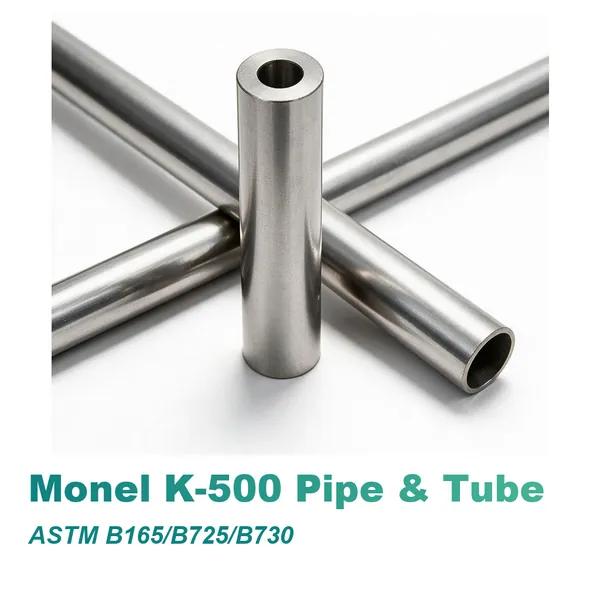
Monel K-500 pipe and tube brings age-hardened nickel-copper strength to seawater and process lines. Southerly Alloy supplies seamless pipe, heat-exchanger tube, and small-diameter instrument tubing to ASTM B865 chemistry with the aged acceptance values from the same document, in solution-annealed or fully aged condition, with NACE hardness control and EN 10204 3.1 records. Pump discharge lines, cooling loops, and non-magnetic sensor sheaths are the usual destinations.
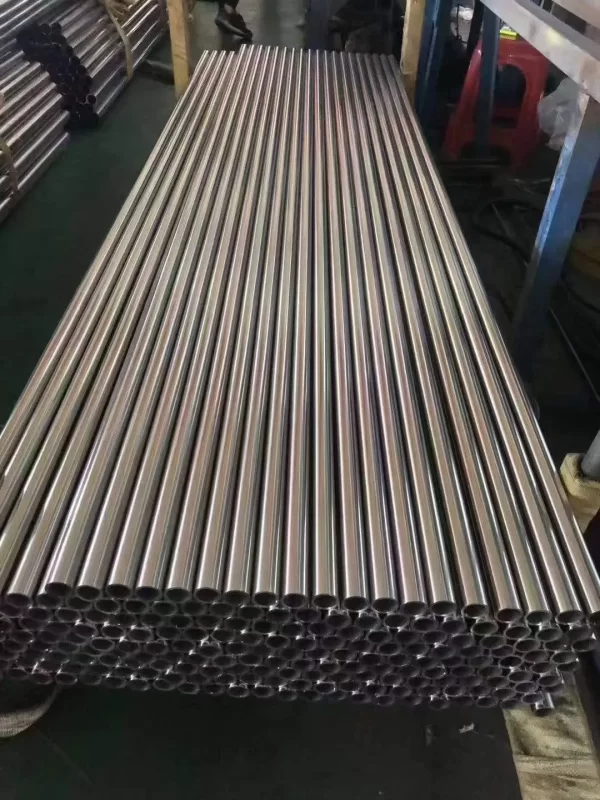
Flowing seawater and brine meet a wall that resists pitting while holding design pressure.
Aluminium and titanium precipitate during heat treatment, so the wall carries load at roughly three times Monel 400 yield.
Instrument sizes run down to 1.6 mm outside diameter, and we hold wall tolerance on a drawn tube.
Straight, U-bend, and coiled forms serve bundles where thermal duty and corrosion meet together.
Because permeability stays low end to end, sensor sheaths and survey lines read clean.
De-aerated hydrofluoric acid and alkaline streams fall inside the working range, while oxidizing acids do not.
Both routes leave the plant under one release procedure, so the ordered form changes the drawing sequence rather than the paperwork.
However, sour, mercury-bearing, and hydrofluoric duty needs review, since aged tube cracks more readily than Monel 400 in some media.
A tube order lives or dies on the reference list. Since no ASTM seamless specification names this grade, we settle the governing documents before quoting rather than after. The four points below sit behind every quotation.
We state which document governs chemistry, which governs dimensions, and which governs examination.
Then, the release file names the aging cycle behind each heat, so your incoming checks compare like with like.
Where sour duty applies, we attach per-heat hardness results so your MR0175 review can close.
Finally, we select hydrostatic, eddy-current, or ultrasonic testing against the service rather than the price.
A nickel-copper melt takes aluminium and titanium additions to reach the UNS N05500 balance. The tube then takes shape by piercing and drawing, and the aging cycle then follows the final draw. Eight steps carry the route.
Cathode nickel and copper are weighed to the N05500 window, and aluminium plus titanium enter as master alloys.
An electric furnace melts the weighed charge, and slag practice holds gas pickup and oxide inclusions down.
Casting practice then limits segregation, and the cropped ingots travel to the piercing line.
The piercer opens the billet, and rolling brings the shell to the wall that drawing needs.
Afterwards, draw benches reduce the shell over a mandrel to the ordered diameter and wall.
A rapid quench from about 980 °C keeps aluminium and titanium in solution ahead of the aging step.
The tube then holds near 595 °C for 8 to 16 hours before a slow furnace cool toward 480 °C.
Finally, eddy-current, hydrostatic, and dimensional checks close the route before the certificate prints.
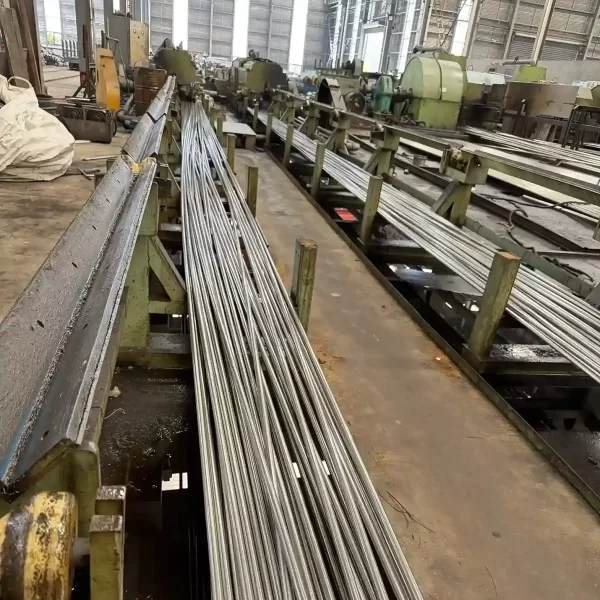
Standard sizes and custom walls both leave this plant, and the aging plan is fixed before the first billet is pierced. Therefore the figures below describe the capacity that stands behind a quotation. Mixed-condition runs travel as one campaign.
Melting, piercing, drawing, and tube examination sit under one roof.
Pilger mills, draw benches, and eddy-current units serve the tube line.
Nickel-copper and nickel alloy tube leaves in stock and custom sizes.
Metallurgists match aging condition and examination level to the intended duty.
Hot-worked, cold-worked, and annealed stock each take their own aged band.
Nothing leaves the bay until the ordered requirements stand proven on the heat. Because tube hides its inside surface, we test the bore rather than trusting the outside diameter alone.
The laboratory confirms the N05500 balance and prints aluminium and titanium before drawing starts.
Also, eddy-current testing scans the full length for discontinuities that a visual check would miss.
Hydrostatic testing follows the ordered specification, and we record the holding pressure and time.
Furthermore, every aged length is tested against the ordered band, and sour-service orders target 35 HRC maximum.
Seamless and welded routes both leave the plant, and the ordered form decides the drawing sequence as much as the price. Meanwhile, each form below ships with its own dimensions and examination record.
Hot-finished and cold-drawn pipe for process lines and seawater systems.
Request Availability →Precision drawn tube for condensers, coolers, and instrument runs.
Request Availability →Fabricated pipe for larger bores where a welded seam suits the duty.
Request Availability →Straight lengths sized for retubing existing bundles.
Request Availability →Bent bundles receive stress relief before aging, so the bend stays sound.
Request Availability →Small bore lines deliver pressure and impulse signals without magnetic interference.
Request Availability →Fine bore stock serves sensing elements and control devices.
Request Availability →Long continuous coils suit umbilical and subsea control lines.
Request Availability →Seawater and process duty take most of this tube, and instrument work follows behind. In return, a single alloy covers both the pressure boundary and the signal line on the same skid.
Discuss Your Application →Once-through and closed loops carry flowing seawater without a corrosion allowance.
De-aerated acid and alkaline streams meet a wall that resists attack.
Tube bundles retube coolers and condensers where carbon steel fails early.
Small bore runs carry pressure signals with no magnetic interference.
Survey and logging tools keep their readings clean inside a K-500 housing.
Hardness-controlled tube serves H2S-bearing completions under NACE guidance.
Multi-stage flash and reverse-osmosis trains use the alloy against hot brine.
De-aerated HF stays within range, and we review the concentration with you.
Detailed technical information including chemical composition, mechanical properties, standards and available dimensions.
ASTM B865 supplies the limits below for UNS N05500, and the same table applies to tube as to bar. Aluminium and titanium decide the aging response, so both appear on the certificate. Therefore the mill test certificate governs final acceptance.
| Element | Content |
|---|---|
| Nickel (Ni) plus Cobalt (Co) | 63.0% min. |
| Copper (Cu) | 27.0–33.0% |
| Aluminium (Al) | 2.30–3.15% |
| Titanium (Ti) | 0.35–0.85% |
| Iron (Fe) | 2.0% max. |
| Manganese (Mn) | 1.5% max. |
| Carbon (C) | 0.18% max. |
| Silicon (Si) | 0.50% max. |
| Sulfur (S) | 0.010% max. |
The aged conditions below carry the acceptance values that B865 publishes, and we apply them to tube by agreement. Before aging, the same document accepts by hardness alone, with a 185 HB ceiling on annealed stock. Hence the ordered condition decides the test plan.
| Condition / Section | Tensile Strength, min. | Yield Strength (0.2%), min. | Elongation, min. |
|---|---|---|---|
| Hot-worked and age-hardened, all sizes | ≥140 ksi (965 MPa) | ≥100 ksi (690 MPa) | 20% |
| Annealed and age-hardened, rounds to 25.4 mm (1 in.) | ≥130 ksi (895 MPa) | ≥90 ksi (620 MPa) | 20% |
| Annealed and age-hardened, rounds over 25.4 mm (1 in.) | ≥130 ksi (895 MPa) | ≥85 ksi (585 MPa) | 20% |
Cold-worked tube drawn to a finished size can also be quoted against the cold-worked aged rows of the same table, and we name the chosen row in writing.
Figures below are typical room-temperature values offered for design work rather than acceptance. Moreover, permeability stays low along the full length of a tube.
| Property | Value |
|---|---|
| Density | Approx. 8.44 g/cm³ |
| Melting range | Approx. 1315–1350 °C |
| Modulus of elasticity | Approx. 179 GPa |
| Thermal conductivity at 20 °C | Approx. 17.5 W/m·K |
| Specific heat at 20 °C | Approx. 419 J/kg·K |
| Electrical resistivity at 20 °C | Approx. 0.615 µΩ·m |
| Thermal expansion, 20–100 °C | Approx. 13.7 µm/m·K |
| Magnetic behaviour | Essentially non-magnetic at ambient temperature |
No ASTM seamless tube specification names UNS N05500, and the table below therefore separates what each document governs. Consequently we confirm the reference list with you before the order is booked.
| Standard / Designation | Scope |
|---|---|
| ASTM B865 | Source of the UNS N05500 chemistry and the aged acceptance values |
| BS 3074 NA18 | British nickel-copper seamless tube standard |
| DIN 17751 | Nickel-copper seamless pipe and tube |
| DIN 17743 | Wrought nickel-copper alloys — chemical composition |
| AMS-QQ-N-286 | Federal specification for K-500 product forms |
| UNS N05500 | Material designation for Monel K-500 |
| W.Nr. 2.4375 / NiCu30Al | European designation for Monel K-500 |
| NACE MR0175 / ISO 15156-3 | Material guidance for H2S-bearing service |
Welded pipe is quoted against an agreed technical specification, since B725 and B730 apply to UNS N04400 rather than to this grade.
Ranges below describe normally produced tube, and exact availability follows wall, length, and quantity. In addition, tolerances track the document named for the ordered form.
| Product Form | Typical Supply | Length |
|---|---|---|
| Seamless Pipe | 6–219 mm outside dia. | Random or fixed |
| Seamless Tube | 6–101.6 mm outside dia. | Fixed or random |
| Heat-Exchanger Tube | 6–25.4 mm outside dia., wall 0.5–2 mm | Fixed |
| Instrument Tubing | 1.6–25.4 mm outside dia., wall 0.2–2 mm | Coil or straight |
| Welded Pipe | 12.7–610 mm outside dia. | Random or fixed |
Walls outside these ranges go through a route review, and we quote them once the drawing is clear.
Finish follows the next operation, whether the tube will be bent, welded, or installed as delivered. Additionally, bore condition matters as much as the outside surface.
| Surface Condition | Typical Use |
|---|---|
| Hot-finished | Pipe that will be machined or welded before service |
| Annealed and pickled | Scale-free tube ready for fabrication |
| Cold drawn | Close wall tolerance with a bright outside surface |
| Bright annealed | Oxide-free bore for instrument and food lines |
| Age-hardened | Full-strength tube delivered ready to install |
| U-bend and stress relieved | Bundles bent before aging so the bend stays sound |
| Eddy-current tested | Tube released with a full-length examination record |
| Passivated | Clean surface for critical process duty |
Get detailed information including specifications, standards, dimensions and material properties.
One coordinator keeps the order moving from enquiry to loading, and the reference list is agreed in writing first. Because no ASTM tube specification names this grade, that step matters more here than elsewhere.
Name the grade, form, outside diameter, wall, length, quantity, and delivery condition.
We confirm which document governs chemistry, dimensions, and examination for your order.
A single reply carries price, lead time, and the paperwork scope.
We log the aging condition, examination level, and commercial terms before piercing starts.
The mill draws the tube, solution-anneals it, and runs the aging cycle the order names.
Eddy-current, hydrostatic, and dimensional checks close the route on every length.
The paperwork travels with the bundle, and we confirm delivery terms before the truck leaves.
Feedback from buyers and engineers who source nickel alloy materials from Southerly Alloy.
“Tube arrived fully aged with hardness records attached, so we skipped an in-house heat treatment and fitted the bundle straight away.”
“The reference list came in writing before we placed the order, which cleared our client's document review on the first pass.”
“Small-bore instrument tubing held its wall tolerance, and the non-magnetic test satisfied our logging-tool customer.”
Our production and inspection processes are certified to international standards, and every delivery ships with EN 10204 3.1 mill test certificates.
Quality Management System
Pressure Equipment Directive
Material Standards Compliance
Mill Test Certificates
ASTM B865 supplies the chemistry and the aged acceptance values, while BS 3074 NA18 or DIN 17751 covers dimensions and examination.
No. B622 lists a fixed set of nickel and nickel-cobalt grades, and N05500 is not among them.
Most orders leave solution annealed or fully aged, and we name the condition and its test plan on the quotation.
Yes, in flowing seawater. Stagnant water and crevices deserve review, since the alloy pits under deposits.
Continuous service holds to roughly 480 °C, and exposure above that ceiling overages the precipitates over time.
The weld metal cannot age harden, so the joint stays softer than the parent tube unless you use a matching high-strength filler.
Stock sizes start at one length, and we scale from there for cut lengths or full bundles.
We quote FOB by default, and EXW or CIF terms are open on request.
Yes. Every heat ships with a 3.1 certificate, and we arrange third-party witness for 3.2 when the project asks.
Ready lengths ship in 7–15 days, and custom walls or U-bend bundles need roughly 25 days.
Send the form, outside diameter, wall, length, quantity, and delivery condition, and a single reply carries price, lead time, and paperwork scope. We confirm the governing standard and the aging route before production, so the tube you approve is the tube that loads.
Both seamless and welded routes stay open for order, and a trial length before volume keeps risk low.