01
Hastelloy B-3 Round Bar
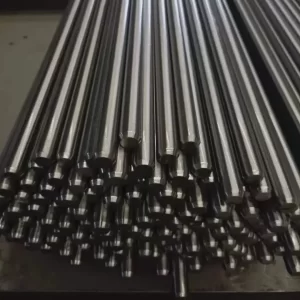
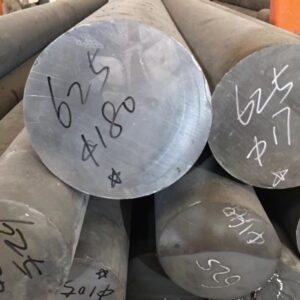
Machined shafts, valve stems, and reactor fittings start from these solid rounds, stocked and cut from 6 to 300 mm.
Request Availability →Thermally stable nickel-molybdenum bar and rod for reducing-acid service and fabrication-heavy projects.
The widened chromium window suppresses harmful phase precipitation during welding and fabrication heat.
Ductility survives thermal exposure, so welded sections avoid extra solution-annealing work.
Stock range, conditions and documents follow hydrochloric and sulfuric acid project needs.
Hastelloy B-3 bar and rod is supplied in UNS N10675 / W.Nr. 2.4600, a nickel-molybdenum alloy carrying 27.0–32.0% molybdenum inside a widened 1.0–3.0% chromium window. The chemistry resists hydrochloric, sulfuric, and phosphoric acid while suppressing brittle phases during fabrication.
Round, hex, square, and forged sections arrive solution annealed and rapid-quenched to ASTM B335 / ASME SB335, cut to order with heat-numbered EN 10204 3.1 papers. Our Hastelloy B-2 Bar and Rod page covers the preceding generation of this family.
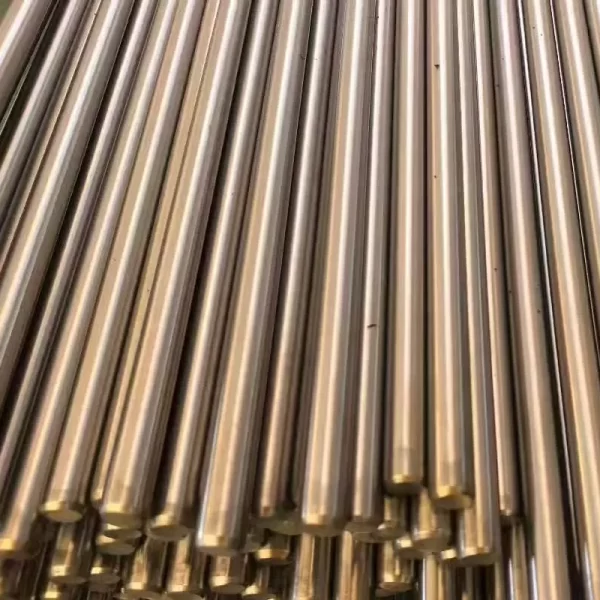
Hastelloy B-3 is the third-generation nickel-molybdenum grade, engineered so welding and fabrication heat no longer force premature embrittlement. Southerly Alloy supplies UNS N10675 bar and rod to ASTM B335 in solution-annealed and cold-finished conditions, with round, hex, square, and forged sections cut to order. Chemical reactors, acid plants, and welded-equipment builders are typical buyers of this bar.
The 1.0–3.0% chromium window suppresses Ni4Mo and other brittle phases during fabrication heat.
Handles every HCl concentration from dilute to boiling under reducing conditions.
Sulfuric, phosphoric, acetic, and formic media stay within range where oxidants are absent.
Greater ductility survives welding thermal cycles, easing fabrication of reactor internals.
Molybdenum at 27.0–32.0% drives resistance in pure reducing media.
Round, hex, square, flat, and forged bar are cut to your order.
Stock and custom diameters from 3 to 300 mm are finished to order.
EN 10204 3.1 mill certificates link each bar to its melting heat.
Each B-3 heat is verified against the N10675 window before it melts. Solution annealing, quenching, and testing then follow the route your specification names. That sequence keeps the thermally stable condition intact from melt to shipment.
Spectrometer results are checked against the B335 window before any bar is cut.
Tensile, hardness, and quench records travel with the heat number on every lot.
A small first lot proves finish and condition before the full campaign is scheduled.
Your welding sequence and thermal exposure are checked against grade limits before release.
The thermally stable behaviour of B-3 is set at the furnace itself. Chromium, iron, and cobalt are balanced into the N10675 window before hot reduction begins. Each lot is then solution annealed, rapidly quenched, and finished to your diameter.
Nickel, molybdenum, chromium, and iron are compounded inside the UNS N10675 window.
The melt is refined under vacuum to hold carbon and silicon at their ceilings.
Ingots are reduced through hot working that breaks up the cast structure.
Bars are held at 1065–1120 °C and quenched fast enough to freeze the corrosion-resistant condition.
Drawing, peeling, or centerless grinding reaches the ordered diameter and surface.
Pickling leaves the surface clean for downstream acid-plant fabrication.
Time in the 550–1050 °C range is tracked and minimised during every reheating step.
Chemistry, mechanical results, and dimensions are proven before the lot ships.
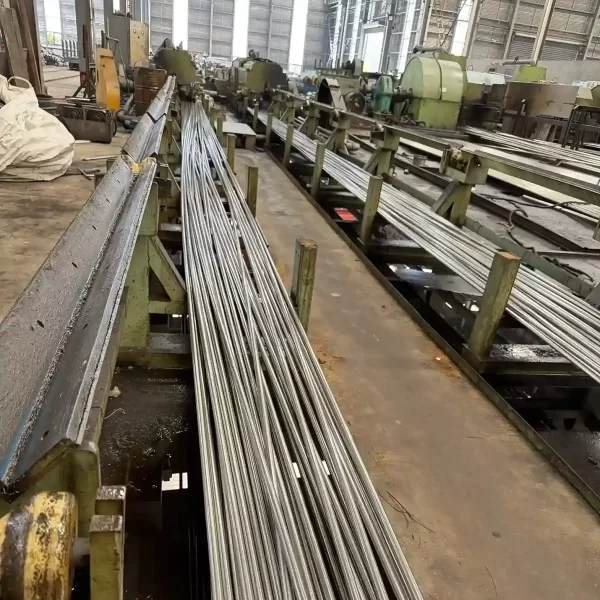
B-3 runs on the melting, quench, and finishing lines shared with our other nickel-molybdenum grades. Annealed bar therefore reaches your fabricator without fresh qualification. Order-specific diameters are quoted against the route that already exists.
One site houses the melt shop, quench facilities, and finishing bays.
Hot working, quenching, drawing, and grinding sit within this installed base.
Output covers both stocked sizes and order-specific melts.
Alloy specialists review thermal exposure and acid duty with your team.
Release depends on evidence, not assumption. Chemistry is measured against the N10675 window, and mechanical results are recorded on the condition you ordered. The certificate then ties every figure to one heat number.
Spectrometer output is compared with the B335 limits for every melt.
Tensile and hardness are tested on the annealed bar you actually receive.
Size, straightness, and surface state are verified before packing, with PMI added when the order calls for it.
Mill certificates name the melt, giving your QA team a single trace to audit.
Acid-plant fabrication starts from the section shape. B-3 is melted and finished into round, hex, square, flat, and forged bar. The condition is agreed form by form.
Machined shafts, valve stems, and reactor fittings start from these solid rounds, stocked and cut from 6 to 300 mm.
Request Availability →Fine diameters are drawn with tight straightness so fasteners and instrument parts machine clean.
Request Availability →The bright cold-drawn surface keeps diameter consistent across long automatic-lathe runs.
Request Availability →Drawing lifts yield above the annealed minimum for bars headed into precision shafting.
Request Availability →Hexagonal sections are held to across-flats sizes for bolting and valve flats.
Request Availability →Square sections support frames and fixtures inside reducing-acid plants.
Request Availability →Rolled flat in 3–100 mm thickness gives acid-duty hardware its base strip.
Request Availability →Heavy valve bodies and large sections come from open-die forging with a wrought structure.
Request Availability →Centerless grinding delivers the tight diameter and finish that shaft seals need.
Request Availability →Hastelloy B-3 bar earns its place where a component meets pure reducing acid and its fabrication includes welding. Herbicide, acetic acid, and ethylene glycol plants are classic homes for the grade; oxidizing streams are not.
Discuss Your Application →Hardware for HCl duty is cut from bar stock that handles the acid from dilute streams to boiling.
Shafts and fittings for reducing H₂SO₄ circuits within the concentration band agreed at quotation.
Reactor internals for the reducing organic acid circuits behind PTA and glycol plants.
Pump shafts and agitator fittings run in wet-process acid where chlorides stay absent.
Baffles, dip tubes, and agitator shafts turned from bar for welded reactor bodies.
Forged and rolled bar for vessel internals built to ASME SB335.
Tube-sheet and baffle bars machined for reducing-side service.
Steel-line racks and acid-recovery hardware are machined from B-3 where hot pickling acids run.
Detailed technical information including chemical composition, mechanical properties, standards and available dimensions.
The limits below follow ASTM B335 for UNS N10675 bar and rod, with nickel as the balance of the melt. Chromium at 1.0–3.0% is the chemistry change behind the grade's improved phase stability, and the mill test certificate governs final acceptance.
| Element | Content |
|---|---|
| Nickel (Ni) | Balance (≥ 65%) |
| Molybdenum (Mo) | 27.0–32.0% |
| Chromium (Cr) | 1.0–3.0% |
| Iron (Fe) | 1.0–3.0% |
| Tungsten (W) | 3.0 max |
| Cobalt (Co) | 3.0 max |
| Manganese (Mn) | 3.0 max |
| Carbon (C) | 0.01 max |
| Silicon (Si) | 0.10 max |
| Phosphorus (P) | 0.030 max |
| Sulfur (S) | 0.010 max |
Values below separate the ASTM B335 minimums from results typically measured on solution-annealed bar. The standard covers one annealed condition for the grade, so higher-strength cold-worked requirements are agreed at quotation.
| Condition | Tensile Strength | Yield Strength (0.2%) | Elongation | Hardness |
|---|---|---|---|---|
| Solution Annealed — ASTM B335 minimum | ≥110 ksi (760 MPa) | ≥51 ksi (350 MPa) | 40% | 100 HRB max. |
| Solution Annealed — typical values | 125 ksi (860 MPa) | 60 ksi (420 MPa) | 50% | ≤100 HRB (≈230 HB) |
B-3 is not age-hardenable, so strength above the annealed minimum comes only from cold work. The room-temperature typical results reflect solution-annealed lots released for chemical-plant machining.
Typical room-temperature values below support design work rather than acceptance testing. In addition, the alloy stays essentially non-magnetic, which suits instrument assemblies in acid duty.
| Property | Value |
|---|---|
| Density | Approx. 9.22 g/cm³ |
| Melting range | Approx. 1370–1418 °C |
| Modulus of elasticity | Approx. 216 GPa |
| Thermal conductivity at 21 °C | Approx. 11.2 W/m·K |
| Coefficient of thermal expansion, 20–100 °C | Approx. 10.6 µm/m·K |
| Specific heat, 0–100 °C | Approx. 373 J/kg·K |
| Electrical resistivity at 21 °C | Approx. 1.37 µΩ·m |
| Magnetic behaviour | Essentially non-magnetic at ambient temperature |
ASTM B335 governs B-3 bar and rod; ASME SB335 covers pressure equipment use. ASTM International publishes the full specification, and the designations below are cross-reference identifiers rather than separate approvals.
| Standard / Designation | Scope |
|---|---|
| ASTM B335 | Nickel-molybdenum alloy rod and bar — UNS N10675 |
| ASME SB335 | ASME edition for rod and bar |
| ASTM B333 | Plate, sheet and strip in the same grade |
| ASTM B564 / ASME SB564 | Nickel alloy forgings — UNS N10675 |
| ASTM B366 | Factory-made wrought fittings in the same grade |
| ASTM B619 / B622 / B626 | Welded pipe, seamless tube and welded tube in the same grade |
| DIN 17752 / 17753 / 17754 | Wrought nickel alloys — bar, wire and forging stock |
| UNS N10675 | Material designation for Hastelloy B-3 |
| W.Nr. 2.4600 / NiMo29 | European designation for Alloy B-3 |
Ranges below reflect normally produced sections, confirmed against condition, finish, and quantity at quotation. Tell us the form and the machined result you need, and we confirm the achievable diameter band with the quotation.
| Product Form | Typical Supply | Length |
|---|---|---|
| Round Bar | 6–300 mm dia. | Cut to length or random |
| Round Rod | 3–100 mm dia. | Cut to length |
| Bright Bar | 6–150 mm dia. | Cut to length or random |
| Square Bar | 10–150 mm | Cut to length or random |
| Hex Bar | 10–150 mm A/F | Cut to length or random |
| Flat Bar | 3–100 mm thick × 10–300 mm wide | Cut to length |
| Forged Bar | 100–500 mm dia. or forged section | Cut to length |
| Precision-Ground Rod | 3–100 mm dia., tight tolerance | Cut to length |
Each finish is chosen for the next operation, whether machining allowance, acid exposure, or a finished appearance. Availability follows diameter, condition, and order quantity, and we agree the finish with the order.
| Surface Condition | Typical Use |
|---|---|
| Solution annealed and pickled | Standard delivery for reducing-acid service |
| Hot-worked (as-rolled or forged) | Parts that will be machined to size |
| Cold drawn | Close diameter control with a brighter surface |
| Peeled | Uniform diameter with a machined skin for further turning |
| Centerless ground | Tight diameter and straightness for shafting |
| Polished | Reduced roughness for product-contact and visible parts |
| Rough turned | Machining allowance held on large or forged bar |
Get detailed information including specifications, standards, dimensions and material properties.
One contact tracks your Hastelloy B-3 bar order from enquiry to shipment. Thermal-exposure requirements are settled before any bar is cut. Most enquiries receive a complete quotation in a single reply.
Give the acid environment, diameters, lengths, and quantity you need.
We confirm the annealed or cold-finished route against your machining plan.
Price, lead time, and documents arrive together for sign-off.
Grade, dimensions, and inspection level are recorded before melting is scheduled.
The heat is melted, annealed, and quenched, then tested against the ordered condition.
Certificates and export documents move with the bar under the agreed delivery terms.
Feedback from buyers and engineers who source nickel alloy materials from Southerly Alloy.
“The B-3 shaft stock for our HCl cooler passed PMI on arrival, and the quench record matched the certificate.”
“Welded B-3 reactor internals held their ductility after fabrication, which our previous grade struggled to deliver.”
“Trial bars confirmed the ground finish first, so the full order for pickling-line fixtures followed without rework.”
Our production and inspection processes are certified to international standards, and every delivery ships with EN 10204 3.1 mill test certificates.
Quality Management System
Pressure Equipment Directive
Material Standards Compliance
Mill Test Certificates
ASTM B335 / ASME SB335.
W.Nr. 2.4600 / NiMo29.
Yes. All HCl concentrations are handled, from ambient up to boiling, while the stream stays reducing.
Improved phase stability limits harmful precipitation, so welded sections keep their ductility without extra solution annealing in most cases.
No. Ferric and cupric salts, wet chlorine, and hypochlorite attack the low-chromium structure.
Round bar runs 6–300 mm, rod starts at 3 mm, and hex, square, or flat sections reach 150 mm.
A single bar is accepted for common stocked diameters.
Mainly FOB; EXW and CIF quotes are available on request.
Stocked sizes ship in 7–15 days; made-to-order annealed bar needs about 25 days.
Yes. 3.1 mill certificates ship with every order, and 3.2 with third-party witness is arranged on request.
Send the acid duty, concentrations, and bar dimensions you need. The quotation returns with price, lead time, and the certificate set in one reply. Fabrication heat, condition, and inspection level are all confirmed in writing before melting starts.