
01
Monel K-500 Round Bar
Solid stock from 6 to 500 mm feeds shafts, stems, and machined fittings.
View Monel K-500 Round Bar →Age-hardened nickel-copper bar and rod that roughly triples Monel 400 yield strength for shafts, fasteners, and downhole tools.
First, the certificate prints both age-hardening elements per heat, so the aging response is documented rather than assumed.
Because sour-gas service caps hardness at 35 HRC, aged bar is tested against the ordered band before release.
Moreover, low permeability survives machining, which keeps downhole survey instruments honest.
Monel K-500 bar and rod carry seawater duty into parts that Monel 400 lacks the strength to hold. Stock carries the UNS N05500 balance, an age-hardenable nickel-copper alloy with aluminium and titanium as the hardening additions. Therefore aging, not cold work, sets the strength.
Sections follow ASTM B865 and ASME SB865 in annealed, age-hardened, and cold-drawn conditions. Hence the ordered condition decides both the price and the incoming test plan.
The Monel K-500 page files the full property set for this grade, while Monel 400 covers the solid-solution base. Where sour-gas hardness caps apply, we add NACE MR0175 evidence to the release file.

Monel K-500 bar and rod takes the UNS N05500 balance and adds aluminium and titanium, so an aging cycle lifts yield strength to about three times the Monel 400 level. Supply runs to ASTM B865 in annealed, age-hardened, and cold-drawn conditions, with NACE hardness control and EN 10204 3.1 heat records on request. Marine shafts, high-strength fasteners, and non-magnetic downhole tools are the usual destinations.

Aluminium and titanium precipitates lift yield near 100 ksi, roughly three times the Monel 400 level, without plating or cladding.
Also, shaft and fastener surfaces keep their film in flowing seawater while carrying design loads.
Besides, HF and other non-oxidizing streams stay within reach under controlled conditions.
Permeability stays low at ambient temperature, so survey tools read formation rather than the collar.
Hardened bar resists cyclic loads and thread galling in stems, shafts, and fasteners.
No ductile-brittle transition appears, so strength and ductility survive deep-cold service.
However, some media make aged stock more prone to stress corrosion cracking, so we review HF, mercury, and sour duty with you.
Finally, solution treatment plus a controlled aging cycle lands hardness where the order asks.
K-500 orders live or die on the aging route. Because condition decides strength, hardness, and document scope together, we settle it at quotation rather than after cutting.
We confirm annealed, age-hardened, or cold-drawn delivery against your duty before we price the bar.
Then, the release file names the aging cycle per heat, so your incoming checks compare like with like.
Equally, where sour gas applies, we add per-heat hardness data that satisfies MR0175 review.
Finally, price, condition, hardness band, and documents appear in one reply.
Nickel and copper melt with aluminium and titanium into the UNS N05500 balance. Then solution treatment and a controlled aging cycle build the strength. Because the aging route is part of the order, test results trace to it.
We weigh nickel and copper to the N05500 window, and aluminium and titanium join for the hardening response.
Electric furnace practice melts the charge, and slag controls keep gas pickup and oxides down.
Next, casting controls limit segregation, and cropped ingots feed the first forging pass.
Forging and rolling break down the ingots, and each pass tightens the wrought structure.
Rapid quenching from about 980 °C holds aluminium and titanium in solution before aging.
We hold stock near 595 °C for 8 to 16 hours, then furnace-cool slowly toward 480 °C.
Afterwards, drawing, peeling, or grinding lands final diameter and surface.
Finally, we check chemistry, hardness, tensile, and dimensions against the purchase specification.
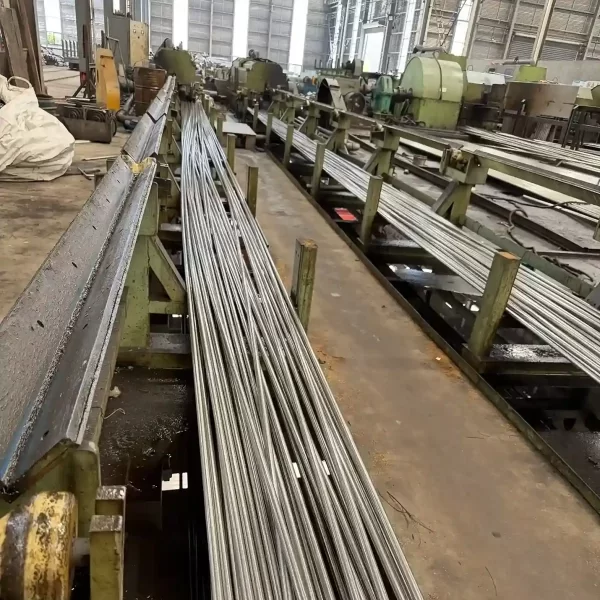
Standard and custom diameters both leave this route, and we fix the aging plan before melting starts. Therefore the figures below show the capacity behind that commitment. Mixed-condition production runs as a single campaign.
Melting, aging, drawing, and inspection workshops stand under one roof.
Hot-working, cold-finishing, and inspection equipment serves the bar line.
The plant ships nickel-copper and nickel alloy bar in stock and custom sizes.
Metallurgists fix condition, tolerance, and document scope during quotation.
Annealed, age-hardened, and cold-drawn stock leaves one route.
Nothing ships before the ordered B865 requirements stand proven on the heat. Because chemistry, hardness, and dimensions all key to the heat number, incoming checks stay quick.
The lab verifies the N05500 balance and prints aluminium and titanium before finishing starts.
Also, we test aged bar against the ordered band, and NACE orders target 35 HRC max.
We measure diameter, straightness, and length against the B865 tolerance class.
Certificates tied to heat numbers accompany every shipment for your file.
Every K-500 form below opens its own page, and each one carries the condition and tolerance that suit it. In addition, we quote all of them against the same heat and the same document set.
Solid stock from 6 to 500 mm feeds shafts, stems, and machined fittings.
View Monel K-500 Round Bar →Squares and rectangles cut to your width and thickness for blocks and frames.
View Monel K-500 Square Bar →Across-flats sizes serve nuts, bolting, and multi-flat machining.
View Monel K-500 Hex Bar →Flat and rectangular sections for tank stiffeners and skid frames.
View Monel K-500 Flat Bar →Moreover, heavy diameters and custom sections arrive with a sound wrought structure.
View Monel K-500 Forged Bar →Bright-drawn surfaces suit automatic lathes and visible components.
View Monel K-500 Bright Bar →Besides, drawing adds a stronger base before aging, so the cycle lands higher.
View Monel K-500 Cold-Drawn Bar →Fully aged stock released at the ordered hardness band and the NACE cap.
View Monel K-500 Age-Hardened Bar →Ground surfaces deliver the diameter and straightness that shafting needs.
View Monel K-500 Centreless-Ground Rod →Furthermore, fully threaded bar and studs certified to F468 and F467.
View Monel K-500 Threaded Rod →Annealed and spring-temper wire, aged where the finished part calls for it.
View Monel K-500 Wire →ERNiCu-7 and ENiCu-7 filler for joints in both Monel grades.
View Monel K-500 Welding Wire →Offshore and oil and gas projects take most K-500 bar, and marine yards follow close behind. Meanwhile, chemical plants buy it where strength shortens shaft sizes.
Discuss Your Application →Propeller and pump shafts carry load in flowing seawater.
High-strength studs and bolts resist seawater and cyclic wave load.
Non-magnetic downhole tools keep survey readings clean in H2S-bearing brine.
Hardened stems and seats resist wear and galling in corrosive flow.
In return, one part carries both strength and seawater resistance where design margins run thin.
Reducing and alkaline media meet smaller, stiffer shaft sections.
Elastic parts keep strength in corrosive, moderate-temperature duty.
Evaporator fixtures and fasteners stand up to brine concentration.
Detailed technical information including chemical composition, mechanical properties, standards and available dimensions.
ASTM B865 fixes the limits below for UNS N05500 bar and rod, and nickel balances the melt. Aluminium and titanium drive the age-hardening response. Hence the mill test certificate decides final acceptance.
| Element | Content |
|---|---|
| Nickel (Ni) plus Cobalt (Co) | 63.0% min. |
| Copper (Cu) | 27.0–33.0% |
| Aluminium (Al) | 2.30–3.15% |
| Titanium (Ti) | 0.35–0.85% |
| Iron (Fe) | 2.0% max. |
| Manganese (Mn) | 1.5% max. |
| Carbon (C) | 0.18% max. |
| Silicon (Si) | 0.50% max. |
| Sulfur (S) | 0.010% max. |
ASTM B865 sets the minimums below by condition and section size for age-hardened bar. Unaged stock follows hardness acceptance instead, capped at 185 HB annealed. Therefore confirm the ordered condition before comparing quotes.
| Condition / Section | Tensile Strength, min. | Yield Strength (0.2%), min. | Elongation, min. |
|---|---|---|---|
| Hot-worked and age-hardened, all sizes | ≥140 ksi (965 MPa) | ≥100 ksi (690 MPa) | 20% |
| Cold-worked and age-hardened, rounds 6.4–25.4 mm (1/4–1 in.) | ≥145 ksi (1000 MPa) | ≥110 ksi (760 MPa) | 15% |
| Cold-worked and age-hardened, rounds 25.4–76.2 mm (1–3 in.) | ≥140 ksi (965 MPa) | ≥100 ksi (690 MPa) | 17% |
| Cold-worked and age-hardened, rounds 76.2–101.6 mm (3–4 in.) | ≥135 ksi (930 MPa) | ≥95 ksi (655 MPa) | 20% |
| Annealed and age-hardened, rounds to 25.4 mm (1 in.) | ≥130 ksi (895 MPa) | ≥90 ksi (620 MPa) | 20% |
| Annealed and age-hardened, rounds over 25.4 mm (1 in.) | ≥130 ksi (895 MPa) | ≥85 ksi (585 MPa) | 20% |
Rounds over 108 mm (4-1/4 in.) carry a 17% elongation minimum, and the hardness rows in the standard serve for information only.
In short, typical room-temperature values below aid design rather than acceptance. K-500 stays essentially non-magnetic, and its Curie point sits far below ambient temperature.
| Property | Value |
|---|---|
| Density | Approx. 8.44 g/cm³ |
| Melting range | Approx. 1315–1350 °C |
| Modulus of elasticity | Approx. 179 GPa |
| Thermal conductivity at 20 °C | Approx. 17.5 W/m·K |
| Specific heat at 20 °C | Approx. 419 J/kg·K |
| Electrical resistivity at 20 °C | Approx. 0.615 µΩ·m |
| Thermal expansion, 20–100 °C | Approx. 13.7 µm/m·K |
| Curie temperature | Approx. -101 °C (-150 °F) |
| Magnetic behaviour | Essentially non-magnetic at ambient temperature |
ASTM B865 governs bar and rod, and ASME SB865 serves pressure equipment. ASTM International publishes both, and the designations below work as cross-reference identifiers rather than separate approvals. Also name the standard together with condition and section in your inquiry.
| Standard / Designation | Scope |
|---|---|
| ASTM B865 | Nickel-copper-aluminium alloy bar, rod and forgings — UNS N05500 |
| ASME SB865 | ASME edition for bar, rod and forgings |
| SAE AMS 4676 | Nickel-copper alloy bars, forgings and rings |
| SAE AMS-QQ-N-286 | Federal specification for K-500 bar, wire and forgings |
| UNS N05500 | Material designation for Monel K-500 |
| W.Nr. 2.4375 / NiCu30Al | European designation for Monel K-500 |
| JIS NW 5500 | Japanese designation |
| BS 3076 NA18 | British nickel-copper bar standard |
| DIN 17743 / DIN 17752 | Nickel-copper wrought alloys — chemistry and bar |
| NACE MR0175 / ISO 15156-3 | Material guidance for H2S-bearing service |
Ranges below describe normally produced sections, and exact availability follows condition, finish, and quantity. Tolerances follow ASTM B865 for the ordered condition. Name diameter, section, length, and finish in the inquiry.
| Product Form | Typical Supply | Length |
|---|---|---|
| Round Bar | 6–500 mm dia. | Cut to length or random |
| Round Rod | 3–50 mm dia. | Cut to length |
| Bright Bar | 6–150 mm dia. | Cut to length or random |
| Square Bar | 10–150 mm | Cut to length or random |
| Hex Bar | 10–150 mm A/F | Cut to length or random |
| Flat Bar | 3–100 mm thick × 10–300 mm wide | Cut to length |
| Forged Bar | 100–500 mm dia. or forged section | Cut to length |
| Precision-Ground Rod | 3–100 mm dia., tight tolerance | Cut to length |
Sizes past these ranges go through a route review before we quote.
We select finish for the next operation, whether machining allowance, fabrication, or a finished look. Availability follows diameter, condition, and order quantity. In addition, we confirm each finish with the order rather than assume it from stock.
| Surface Condition | Typical Use |
|---|---|
| Hot-worked (as-rolled or forged) | Parts that will be machined to size |
| Annealed and pickled | Scale-free surface for fabrication |
| Cold drawn | Close diameter control with a bright surface |
| Age-hardened | Full-strength bar for shafts, fasteners and trim |
| Stress relieved | Straightness and dimensional stability for drawn bar |
| Peeled | Uniform diameter with machined skin for further turning |
| Centreless ground | Tight diameter and straightness for shafting |
| Polished | Reduced roughness for product-contact and visible parts |
Get detailed information including specifications, standards, dimensions and material properties.
One coordinator keeps a K-500 order moving from inquiry to loading. Because condition drives everything, the aging route is agreed in writing first.
Give grade, B865 condition, diameter, length, quantity, and finish.
We match the aging route and tolerance class to your duty.
One reply carries price, lead time, and the document list.
We log grade, dimensions, inspection level, and terms before cutting.
The mill works, solution-anneals, and ages the heat to the ordered condition.
Certificates and export papers ride with the bar, and we confirm terms with you.
Feedback from buyers and engineers who source nickel alloy materials from Southerly Alloy.
“Age-hardened bar arrived inside the agreed hardness band, and our NACE file review cleared on the first pass.”
“Non-magnetic stock kept survey interference out of our tool string, and diameters ran true on every collar.”
“Aged shaft stock machined predictably after we roughed it before aging, and the final size held after treatment.”
Our production and inspection processes are certified to international standards, and every delivery ships with EN 10204 3.1 mill test certificates.
Quality Management System
Pressure Equipment Directive
Material Standards Compliance
Mill Test Certificates
ASTM B865 governs the bar, and ASME SB865 applies in pressure service.
Minimum orders start at one bar in stock diameters, and we scale from there.
Quotations default to FOB, with EXW and CIF available when you ask.
Finished weight drives the price, and we lock copper and aluminium rates at the quotation date.
Ready sizes leave in 7–15 days, and custom diameters need roughly 25 days.
Yes. 3.1 certificates accompany each heat, and 3.2 witness follows on request.
Yes. Age-hardened bar arrives with hardness records, and NACE orders target the 24–35 HRC band.
We recommend rough machining before aging, because the section contracts slightly during the cycle.
Hydrofluoric acid, mercury, and sour streams deserve a review, since aged material is more prone to stress corrosion cracking in some media.
Shipments carry CI, PL, B/L, and the MTC, and origin certificates follow on request.
Send grade, B865 condition, diameter, quantity, and finish, and one reply carries price, lead time, and the document list. We fix condition and hardness band before production, so the bar you approve is the bar that loads.
Both stock and custom diameters stay open for order, and a trial bar before volume keeps risk low.