01
Nickel 200 / 201 Bar and Rod
Round, square, hex, and forged sections to ASTM B160 for machined and fabricated parts.
View Nickel 200 / 201 Bar and Rod →Commercially pure wrought nickel in two carbon grades, split by a 315 °C service boundary.
Carbon at 0.15% caps Nickel 200 near 315 °C; in contrast, the 0.02% limit in Nickel 201 carries service to about 677 °C.
Above all, concentrated caustic and molten alkali salt sit inside the envelope, and chlorides raise no stress-corrosion risk.
In addition, roughly 70 W/m·K of thermal conductivity and a 360 °C Curie point serve parts that carry current, heat, or a magnetic field.
Nickel 200 and Nickel 201 are commercially pure wrought nickel grades that differ in carbon alone. Specifically, UNS N02200 allows up to 0.15% carbon, while UNS N02201 caps the same element at 0.02%.
Three supply routes carry both grades under one ASTM family. Nickel 200 / 201 Bar and Rod covers B160 sections, Nickel 200 / 201 Pipe and Tube covers B161 and B163 tubular product, and Nickel 200 / 201 Plate and Sheet covers B162 flat-rolled stock.
Southerly Alloy is a professional supplier and exporter of both grades. Moreover, technical review, quotation, documentation, and export handling stay with one contact from enquiry through shipment.
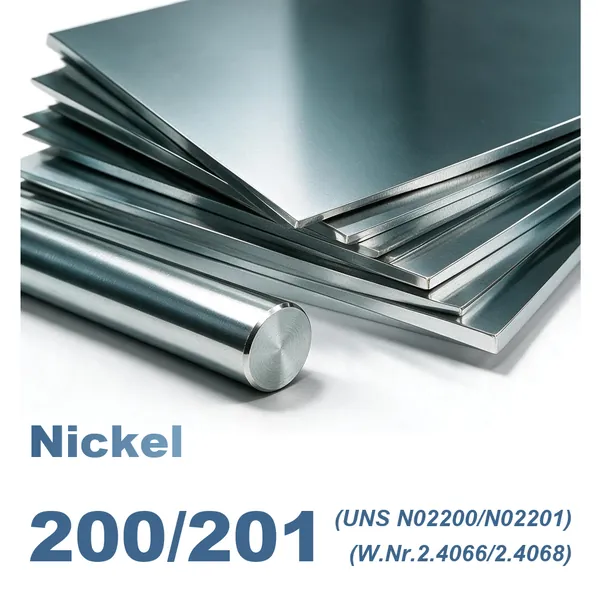
Nickel 200 and Nickel 201 share one chemistry and one standard family, and carbon is the only element that separates them. The 0.15% limit in UNS N02200 gives way to 0.02% in UNS N02201, which moves the graphitization threshold from roughly 315 °C to about 677 °C. Both grades resist caustic and reducing media, conduct heat and current well, and stay workable by cold forming. Southerly Alloy is a professional supplier and exporter of both grades in bar, tube, and flat-rolled product, with EN 10204 3.1 documentation.
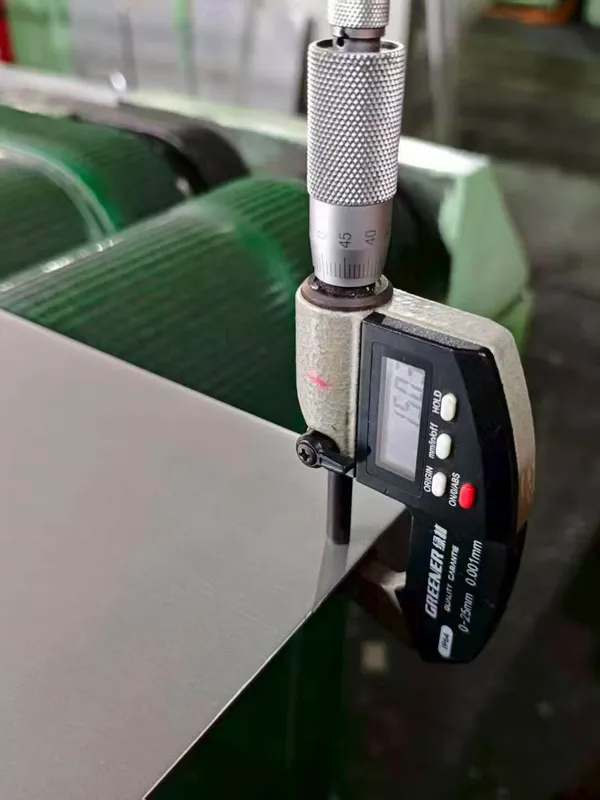
Above all, sodium hydroxide, potassium hydroxide, and molten alkali salt sit inside the envelope at every concentration.
Neutral and alkaline salt solutions bring no stress-corrosion cracking, which sets these grades apart from stainless steel.
Heat passes at roughly 70 W/m·K, and resistivity stays near 0.09 µΩ·m; consequently, one part can carry both duties.
In addition, deep drawing, spinning, and severe forming run without intermediate annealing on either grade.
Both grades stay magnetic below a Curie point of about 360 °C, which suits electromagnetic and switching parts.
The 0.02% carbon cap removes the graphitization route that limits Nickel 200 above 315 °C.
Likewise, bar, tube, and flat-rolled product share a single composition table across B160, B161, B162, and B163.
Wet hydrofluoric acid and oxidizing acids fall outside the envelope, and grade 201 also sees sulfide attack above 315 °C.
Selection between these two grades turns on service temperature, since both meet the same media. The four points below, therefore, cover the corrosion envelope, the thermal ceiling, fabrication behavior, and specification coverage.
First, caustic, potash, and molten alkali salt sit inside the envelope, and chlorides bring no stress-corrosion cracking.
Indeed, carbon decides the ceiling here, so 315 °C separates a low-cost 200 part from a 201 part that holds to 677 °C.
Both grades cold-form and weld with ERNi-1 filler, although the lower-carbon grade anneals at a reduced temperature.
Finally, bar, tube, and flat-rolled product draw on one composition table, so a project keeps a single heat family throughout.
Southerly Alloy supplies Nickel 200 / Nickel 201in multiple product forms according to application, dimensions and applicable international standards.
Round, square, hex, and forged sections to ASTM B160 for machined and fabricated parts.
View Nickel 200 / 201 Bar and Rod →Seamless pipe and heat-exchanger tube to ASTM B161 and ASTM B163.
View Nickel 200 / 201 Pipe and Tube →Flat-rolled product to ASTM B162 in plate, sheet, and strip.
View Nickel 200 / 201 Plate and Sheet →Caustic plants and electrochemical equipment draw on these grades most often. In addition, the same properties serve electrical parts, heat-transfer hardware, and product-contact equipment in food and pharmaceutical work.
Discuss Your Application →Vessels, tubes, and internals in sodium hydroxide concentration plants.
Current-carrying parts and cell hardware that meet hot caustic at plant temperature.
Terminals, connectors, and housings for transistors and batteries.
Tubesheets, spacers, and thermal parts where heat crosses the wall.
Conductive racks and anode hardware for plating and electrochemical lines.
Product-contact parts that need a clean nickel surface.
Equipment handling stearic and oleic acid streams in soap and oleochemical plants.
Tanks, valve trim, and piping for caustic and potash duty below the threshold.
Detailed technical information including chemical composition, mechanical properties, standards and available dimensions.
Limits follow the ASTM composition table shared by B160, B161, B162, and B163. Specifically, the nickel figure comes by difference and includes cobalt. A purchase specification and its mill certificate govern final acceptance.
| Element | Nickel 200 (UNS N02200) | Nickel 201 (UNS N02201) |
|---|---|---|
| Nickel (Ni), min. | 99.0% | 99.0% |
| Copper (Cu), max. | 0.25% | 0.25% |
| Iron (Fe), max. | 0.40% | 0.40% |
| Manganese (Mn), max. | 0.35% | 0.35% |
| Carbon (C), max. | 0.15% | 0.02% |
| Silicon (Si), max. | 0.35% | 0.35% |
| Sulfur (S), max. | 0.01% | 0.01% |
Acceptance values below come from the standard that governs each form, in inch-pound and metric units. However, requirements shift with condition and section size, and the tubular and flat-rolled tables carry their own footnotes.
| Form / Grade / Condition | Tensile Strength, min. | Yield Strength (0.2%), min. | Elongation, min. |
|---|---|---|---|
| B160 bar, Nickel 200, cold-worked rounds ≤ 25.4 mm (1 in.) | ≥80 ksi (550 MPa) | ≥60 ksi (415 MPa) | 10% |
| B160 bar, Nickel 200, hot-worked, all sizes | ≥60 ksi (415 MPa) | ≥15 ksi (105 MPa) | 35% |
| B160 bar, Nickel 200, annealed, all sizes | ≥55 ksi (380 MPa) | ≥15 ksi (105 MPa) | 40% |
| B160 bar, Nickel 201, annealed, all sizes | ≥50 ksi (345 MPa) | ≥10 ksi (70 MPa) | 40% |
| B161 tube, Nickel 200, annealed, outside dia. ≤ 127 mm (5 in.) | ≥55 ksi (380 MPa) | ≥15 ksi (105 MPa) | 35% |
| B161 tube, Nickel 200, stress-relieved, all sizes | ≥65 ksi (450 MPa) | ≥40 ksi (275 MPa) | 15% |
| B161 tube, Nickel 201, annealed, outside dia. ≤ 127 mm (5 in.) | ≥50 ksi (345 MPa) | ≥12 ksi (80 MPa) | 35% |
| B163 tube, Nickel 200, annealed | ≥55 ksi (380 MPa) | ≥15 ksi (105 MPa) | 40% |
| B162 plate, Nickel 200, annealed | ≥55 ksi (380 MPa) | ≥15 ksi (100 MPa) | 40% |
| B162 sheet and strip, Nickel 200, annealed | ≥55 ksi (380 MPa) | ≥15 ksi (100 MPa) | 40% |
| B162 plate, Nickel 201, annealed | ≥50 ksi (345 MPa) | ≥12 ksi (80 MPa) | 40% |
| B162 sheet and strip, Nickel 200, hard temper | ≥90 ksi (620 MPa) | ≥70 ksi (480 MPa) | 2% |
Elongation requirements do not apply below a 2.4 mm (3/32 in.) section on bar. B162 waives the yield requirement under 0.51 mm (0.020 in.) thickness, and strip below 0.25 mm carries no tensile requirement.
Typical values for annealed material at room temperature, given for design work rather than acceptance testing. The two grades diverge most in thermal conductivity and electrical resistivity.
| Property | Nickel 200 (N02200) | Nickel 201 (N02201) |
|---|---|---|
| Density | Approx. 8.89 g/cm³ | Approx. 8.89 g/cm³ |
| Melting range | Approx. 1435–1446 °C | Approx. 1435–1446 °C |
| Specific heat at 20 °C | Approx. 456 J/kg·K | Approx. 456 J/kg·K |
| Curie temperature | Approx. 360 °C (680 °F) | Approx. 360 °C (680 °F) |
| Modulus of elasticity | Approx. 205 GPa | Approx. 207 GPa |
| Thermal conductivity at 20 °C | Approx. 70.3 W/m·K | Approx. 79.3 W/m·K |
| Electrical resistivity at 20 °C | Approx. 0.096 µΩ·m | Approx. 0.085 µΩ·m |
| Thermal expansion, 20–100 °C | Approx. 13.3 µm/m·K | Approx. 13.2 µm/m·K |
| Poisson's ratio | Approx. 0.29 | Approx. 0.29 |
| Magnetic behaviour | Ferromagnetic at room temperature | Ferromagnetic at room temperature |
Both grades appear in one set of specifications, split by product form. Therefore, the European and ISO designations below serve cross-reference, while ASTM International standards named on the order govern acceptance.
| Standard / Designation | Scope |
|---|---|
| ASTM B160 / ASME SB160 | Rod and bar — UNS N02200 and UNS N02201 |
| ASTM B161 / ASME SB161 | Seamless pipe and tube |
| ASTM B163 / ASME SB163 | Seamless condenser and heat-exchanger tube |
| ASTM B162 / ASME SB162 | Plate, sheet, and strip |
| ASTM B725 / B730 | Welded pipe and welded heat-exchanger tube |
| ASTM B564 / ASME SB564 | Forgings |
| ASTM B366 / ASME SB366 | Fittings |
| SAE AMS 5553 | Low-carbon nickel sheet and strip 0.03–0.65 mm — grade 201 only, plate excluded |
| DIN 17740 | Wrought nickel — chemical composition |
| DIN 17750 / ISO 6208 | Flat-rolled product — plate, sheet, and strip |
| DIN 17751 / ISO 6207 | Seamless pipe and tube |
| DIN 17752 / ISO 9723 | Bar and rod |
| DIN 17753 / ISO 9724 | Wire |
| DIN 17754 / ISO 9725 | Forgings |
| BS 3072 / BS 3073 (NA12) | Flat-rolled nickel product |
| BS 3074 (NA12) | Seamless pipe and tube |
| VdTÜV 345 | Wrought nickel — technical delivery conditions |
| W.Nr. 2.4066 / 2.4068 | European designations for Nickel 200 and Nickel 201 |
Ranges below reflect the sections normally produced to these standards. Availability moves with condition, finish, and order quantity, and we confirm every dimension at quotation.
| Product Form | Typical Supply | Length |
|---|---|---|
| Bar and Rod | 6–500 mm dia. | Cut to length or random |
| Seamless Pipe | 6–219 mm outside dia. | Random or fixed |
| Heat-Exchanger Tube | 10–426 mm outside dia. | Fixed |
| Plate | 4.76–50 mm thick | Up to 6000 mm |
| Sheet | 0.5–4.76 mm thick | Up to 2500 mm |
| Strip | 0.13–3.2 mm thick | Coil |
Finish follows the operation that comes next, whether that is machining, welding, or a finished product surface. Consequently, the same grade can arrive in several conditions against one order.
| Surface Condition | Typical Use |
|---|---|
| Hot-worked and descaled | Bar and plate that will be machined further |
| Annealed and pickled | Scale-free stock for chemical plant and fabrication work |
| Cold-drawn or cold-rolled | Close tolerance with a smooth, bright surface |
| Bright annealed | Oxide-free finish for electronic and instrument parts |
| Centreless ground | Tight diameter and straightness on bar and rod |
| Polished | Low roughness for product-contact and electrode parts |
Get detailed information including specifications, standards, dimensions and material properties.
They share one composition table and differ in carbon content. However, UNS N02201 takes the lower carbon path, which raises the graphitization threshold and suits hotter duty.
Above about 315 °C (600 °F) for continuous duty. By contrast, ASME Section VIII Division 1 approves Nickel 201 to 1250 °F (677 °C).
Carbon stays in solid solution up to a limit, and beyond 315 °C the excess leaves solution as graphite along grain boundaries. As a result, that network embrittles the metal over time.
B160 for bar, B161 and B163 for tube, B162 for plate, sheet, and strip, B725 and B730 for welded product. Moreover, compositions match across all of them.
Yes. Above 315 °C it is sensitive to sulfide-bearing atmospheres, where intergranular embrittlement can set in. However, wet hydrofluoric acid lies outside the envelope for both grades.
One bar, one tube, or one plate for many standard sizes. Also, trial quantities ship on the same documentation as full orders.
FOB is our usual basis, with EXW and CIF available. Moreover, we fix the term and port when the quotation goes out.
Stock items leave within 7–15 days of order confirmation. In addition, made-to-order sizes run about 25 days, and we confirm the date in writing.
Every heat ships with an EN 10204 3.1 mill certificate. Meanwhile, we arrange a 3.2 certificate with third-party endorsement when your project calls for it.
ERNi-1 to AWS A5.14 for GTAW and GMAW, or ENi-1 to AWS A5.11 for shielded metal arc work. Then interpass temperature stays below 150 °C.
Send the grade, product form, ASTM standard, size, quantity, and delivery condition. We reply with price, lead time, and the document list in one message.
Both grades come from stock sizes, or we make them to your drawing. Therefore, plate, sheet, and strip orders quote against B162, while tubular orders quote against B161 and B163.