01
Hot-Rolled Plate
Annealed or as-rolled plate from 3 mm upward for vessel shells, tube sheets, and furnace furniture.
Request Availability →Rolled plate, sheet, and strip to ASTM B409, in as-rolled or solution-annealed condition.
We quote plate, sheet, and strip against the grade and the thickness you need, so one order covers a vessel shell and its internal baffles.
800H and 800HT flat product starts at 2.92 mm, and we flag that floor before your drawing is built around a thinner gauge.
Cut-to-size and circular blanks leave with the heat number intact on every piece, which removes a cutting step from your shop floor.
Incoloy 800 / 800H / 800HT plate and sheet comes as rolled flat product in all three designations. ASTM B409 governs every thickness, and grade 800 serves up to 593 °C while the controlled-carbon grades take over above that line.
Pressure vessels, furnace internals, and flue-gas ducting take most of this flat product, and cut-to-size blanks move straight to the forming press. Southerly Alloy works as a professional supplier and exporter across all three forms, and the Incoloy 800 / 800H / 800HT material page holds the grade data behind the plate order. Above all, the section thickness decides which grade can be supplied at all.
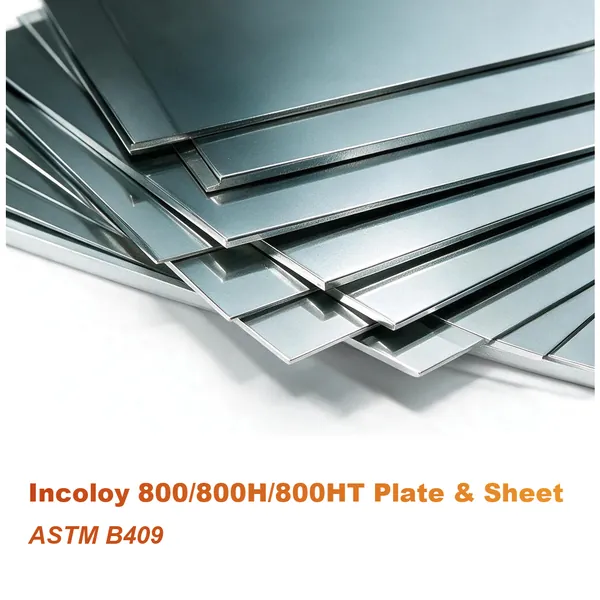
Incoloy 800 / 800H / 800HT plate and sheet covers flat-rolled product in all three designations, ordered to ASTM B409 with B906 tolerances. Grade 800 serves up to 593 °C and takes a deep-drawing quality option that the controlled-carbon grades cannot match below 2.92 mm. From there, 800H and 800HT bring the coarse-grain anneal that creep duty above 593 °C demands. Southerly Alloy works as a professional supplier and exporter across plate, sheet, and strip, and every order ships with EN 10204 3.1 documentation.
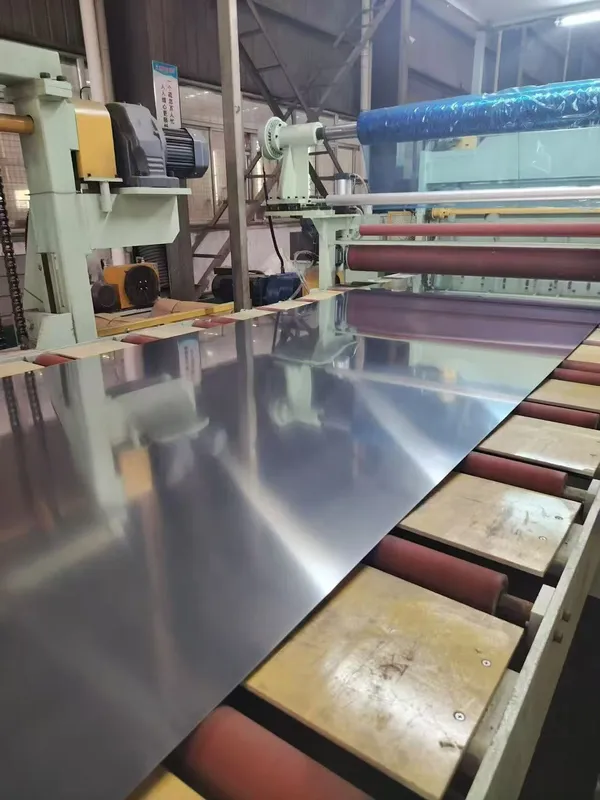
Rolled plate, sheet, and strip in all three designations, ordered against one specification with B906 tolerances.
Grade 800 plate ships either as-rolled at 550 MPa or annealed at 520 MPa, and we confirm the temper on the offer.
Grade 800 sheet and strip ordered to severe-forming quality carries its own grain size and hardness limits under Table 3.
800H and 800HT sheet and strip begin at 2.92 mm, where the coarse-grain anneal takes hold.
Each 800H and 800HT lot reports a grain size rating against the No. 5 or coarser requirement.
Plate cut to your blank drawing keeps the heat number traceable from the mill through to the press.
A chromium oxide scale slows surface scaling, and the nickel-rich matrix holds back carbon ingress.
Plate enquiries turn on thickness and temper as much as grade, so we confirm both before quoting. In addition, one coordinator stays with the file from the drawing to the packing list. Consequently, the lead time in the offer is one we can hold.
We state the UNS number, the delivery condition, and the governing standard on the offer, so nothing depends on a later exchange.
Where a drawing calls for thin 800H or 800HT sheet, we raise the 2.92 mm floor before the order is placed.
Plate leaves our works cut to size, which keeps the heat number traceable on every blank in the bundle.
Plate travels on wooden saddles and sheet in edge-protected bundles, so the finish arrives as it left.
Flat product adds rolling, levelling, and cut-to-length steps that tubular routes never see, and each one holds a control point. Therefore, the sequence below runs from melt to a blanked and marked plate. Moreover, the route logs every result against the heat.
Melting fixes nickel, chromium, and iron inside the UNS window, with carbon and Al+Ti set for the ordered grade.
Breakdown rolling turns the cast ingot into a slab, and that slab feeds the plate mill on the next pass.
Reversing mills reduce the slab in successive passes until the ordered thickness is reached, with the rolling direction recorded.
800H takes 1121 °C minimum and 800HT takes 1149 °C minimum, which grows the grain to the size that creep service needs.
A specimen from each lot goes to the laboratory for ASTM E112 rating, and a fine grain becomes a rejection rather than a waiver.
The line levels the plate, shears or plasma-cuts it to size, and produces circular blanks where the drawing calls for them.
Heat number, grade, size, and standard go onto each piece, then the order travels on saddles or in edge-protected bundles.
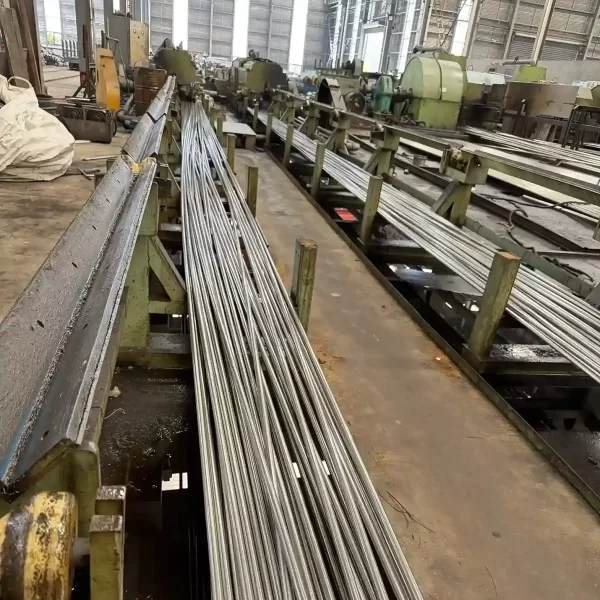
Plate output tracks the rolling schedule and the furnace campaign, and those two steps decide the date we can commit. Therefore, the numbers below describe the capacity behind an offer. Moreover, we group grades into one campaign wherever the anneal temperatures allow.
Plate rolling, levelling, and finishing lines share one site.
Reversing mills, levellers, and shearing lines work the flat-product route.
Flat-rolled output across the three 800-series grades.
Metallurgists who match grade, gauge, and grain size to the duty.
We hold a lot until the ordered tests prove out on the heat that made it. In addition, thickness and flatness readings travel with the piece record. As a result, one out-of-tolerance plate cannot slip through inside a bundle.
Spectrometer analysis holds carbon, the Al+Ti total, and each residual inside the limits of the ordered UNS number.
A specimen from every 800H and 800HT lot goes to the laboratory, and the result appears on the certificate.
Tensile and hardness results come from plate in the condition you receive, never from an as-cast reference.
Gauge and flatness readings go against the piece count and ship with the certification package.
The flat-product range splits by gauge and width rather than by grade, since the same three designations run across all of it. Meanwhile, one grade question runs across the whole range.
Annealed or as-rolled plate from 3 mm upward for vessel shells, tube sheets, and furnace furniture.
Request Availability →Sheet in widths to 1.42 m for ducting, linings, and formed panels that see furnace gas.
Request Availability →Smooth, close-gauge sheet for visible surfaces and for parts that will be deep drawn.
Request Availability →Narrow strip in widths to 305 mm for gaskets, seals, and progressive-die work.
Request Availability →Grade 800 sheet and strip held to the Table 3 grain and hardness limits for severe forming.
Request Availability →Plate profiled to your blank drawing, with the heat number carried on each piece.
Request Availability →Pressure vessels and furnace internals absorb most of this flat product, and a plate section often forms the pressure boundary itself. Furthermore, the same three grades serve flue-gas ducting and heat-treatment furniture, where resistance to scaling sets the service life.
Discuss Your Application →Plate for reactor vessels, columns, and drums in chemical and petrochemical plants.
Heavy plate drilled for tube bundles in shell-and-tube exchangers and condensers.
Plate and sheet for retorts, muffles, and radiant panels in carburizing and annealing furnaces.
Sheet linings for ducting and stacks in waste-to-energy and process plants.
Trays, baskets, and jigs that carry work through furnace cycles without scaling away.
Plate for nitric acid, VCM, and other process streams that rule out a lower-alloy choice.
Plate and sheet for steam-generator internals and auxiliary components in PWR service.
Detailed technical information including chemical composition, mechanical properties, standards and available dimensions.
One composition table serves plate, sheet, and strip alike, and the flat-rolled standards adopt it without change. Only carbon, the combined Al+Ti figure, and grain size move between the three designations. Moreover, the mill certificate remains the document of acceptance.
| Element | Alloy 800 (UNS N08800) | Alloy 800H (UNS N08810) | Alloy 800HT (UNS N08811) |
|---|---|---|---|
| Nickel (Ni) | 30.0–35.0% | 30.0–35.0% | 30.0–35.0% |
| Chromium (Cr) | 19.0–23.0% | 19.0–23.0% | 19.0–23.0% |
| Iron (Fe) | 39.5% min. | 39.5% min. | 39.5% min. |
| Carbon (C) | 0.10% max. | 0.05–0.10% | 0.06–0.10% |
| Aluminium (Al) | 0.15–0.60% | 0.15–0.60% | 0.25–0.60% |
| Titanium (Ti) | 0.15–0.60% | 0.15–0.60% | 0.25–0.60% |
| Aluminium + Titanium | 0.30–1.20% | 0.30–1.20% | 0.85–1.20% |
| Copper (Cu) | 0.75% max. | 0.75% max. | 0.75% max. |
| Manganese (Mn) | 1.50% max. | 1.50% max. | 1.50% max. |
| Silicon (Si) | 1.00% max. | 1.00% max. | 1.00% max. |
| Sulfur (S) | 0.015% max. | 0.015% max. | 0.015% max. |
| Annealed Grain Size | Not specified | ASTM 5 or coarser | ASTM 5 or coarser |
The minimums below follow the form column of the B409 table, and the temper you order decides which row applies to your delivery. Consequently, as-rolled plate carries the higher figures while annealed plate carries the softer ones.
| Form and Condition | Grade | Tensile Strength, min. | Yield Strength (0.2%), min. | Elongation, min. |
|---|---|---|---|---|
| B409 hot-rolled plate — annealed | N08800 | 75 ksi (520 MPa) | 30 ksi (205 MPa) | 30% |
| B409 hot-rolled plate — as-rolled | N08800 | 80 ksi (550 MPa) | 35 ksi (240 MPa) | 25% |
| B409 hot-rolled plate — annealed | N08810 / N08811 | 65 ksi (450 MPa) | 25 ksi (170 MPa) | 30% |
| B409 hot-rolled sheet — annealed | N08800 | 75 ksi (520 MPa) | 30 ksi (205 MPa) | 30% |
| B409 hot-rolled sheet — annealed | N08810 / N08811 | 65 ksi (450 MPa) | 25 ksi (170 MPa) | 30% |
| B409 cold-rolled sheet — annealed | N08800 | 75 ksi (520 MPa) | 30 ksi (205 MPa) | 30% |
| B409 cold-rolled sheet — annealed | N08810 / N08811 | 65 ksi (450 MPa) | 25 ksi (170 MPa) | 30% |
| B409 cold-rolled strip — annealed | N08800 | 75 ksi (520 MPa) | 30 ksi (205 MPa) | 30% |
| B409 cold-rolled strip — annealed | N08810 / N08811 | 65 ksi (450 MPa) | 25 ksi (170 MPa) | 30% |
Three footnotes shape the table above. First, the yield requirement does not apply below 0.020 in. (0.51 mm). Second, N08810 and N08811 sheet and strip are available only at 0.115 in. (2.92 mm) and heavier, and the strip elongation minimum drops away below 0.010 in. (0.25 mm). Third, as-rolled plate may take a stress relief after final rolling, and plate ordered as suitable for hot forming carries no tensile or hardness requirement when the purchaser names grade 800 or 800H.
These values hold for all three designations, because the carbon window leaves the physical base untouched. Therefore, they serve design calculations rather than acceptance testing.
| Property | Value |
|---|---|
| Density | Approx. 7.94 g/cm³ |
| Melting range | Approx. 1357–1385 °C |
| Specific heat, 0–100 °C | Approx. 460 J/kg·°C |
| Modulus of elasticity at 20 °C | Approx. 196.5 GPa |
| Thermal conductivity at 20 °C | Approx. 11.5 W/m·K |
| Thermal expansion, 20–100 °C | Approx. 14.4 µm/m·°C |
| Electrical resistivity at 20 °C | Approx. 0.989 µΩ·m |
| Curie temperature | Approx. −115 °C |
| Magnetic behaviour | Non-magnetic at ambient temperature |
| Hardness, annealed | Approx. 138 HB |
Plate, sheet, and strip answer to one ASTM specification, and the general-requirements document B906 carries the tolerances and test methods behind it. In addition, both AMS documents stop at the grade 800 window. Look to ASTM International for the current text of any specification named here.
| Standard / Designation | Scope |
|---|---|
| ASTM B409 / ASME SB409 (with B906) | Rolled plate, sheet, and strip — UNS N08800, N08810, N08811 |
| ASTM B906 | General requirements for flat-rolled product: tolerances, sampling, and test methods |
| SAE AMS 5871 | Alloy 800 sheet, strip, and plate, solution heat treated — UNS N08800 in 0.25–50.8 mm thickness |
| SAE AMS 5766 | Alloy 800 bars, forgings, and forging stock, solution heat treated — UNS N08800 |
| ASTM B408 / ASME SB408 | Rod and bar, for tube sheets, support hardware, and fasteners |
| ASTM B407 / ASME SB407 | Seamless pipe and tube, for the rest of the vessel package |
| ASTM B564 / B366 | Forgings, and wrought pipe fittings |
| ASME Code Case 1325 / 1983 | Elevated-temperature design allowables for 800H, Sections I and VIII |
| ASME Code Case 1987 | Maximum allowable stresses for 800HT |
| ASME Section VIII Divisions 1 and 2 | Design codes that carry the plate allowables into vessel calculations |
| UNS N08800 / N08810 / N08811 | Material designations for Alloy 800, 800H and 800HT |
| W.Nr. 1.4876 / 1.4958 / 1.4959 | European designations, EN X10NiCrAlTi32-20 / X5NiCrAlTi31-20 / X8NiCrAlTi32-21 |
| EN 10095 / DIN 17459 | European heat-resisting materials standards for flat product |
| BS 3072 / BS 3073 (NA 15 series) | British flat-product designations for the 800 series |
| JIS G 4902 (NCF 800 / 800H / 800HT) | Japanese flat-product designations for the series |
| ISO FeNi32Cr21AlTi (NW8800 / NW8810 / NW8811) | ISO designations, the HC and HT suffixes marking the controlled-carbon grades |
| ISO 6208 | Plate, sheet, and strip in nickel and nickel alloys |
The gauge range below reflects what the flat-product route normally rolls, and availability follows grade, temper, and quantity. Meanwhile, cut-to-size work covers the sections that fall outside a standard plate.
| Product Form | Typical Supply | Length and Width |
|---|---|---|
| Hot-rolled plate | 3–100 mm thick | Up to 6000 mm long |
| Hot-rolled sheet | 1.5–3.5 mm thick | Up to 1420 mm wide |
| Cold-rolled sheet | 0.5–3.0 mm thick | Up to 1420 mm wide |
| Cold-rolled strip | 0.13–3.2 mm thick | Up to 305 mm wide |
| 800H and 800HT sheet and strip | 2.92 mm and heavier | Per the standard width range |
| Plate cut to size | 3–100 mm thick, profiled to drawing | Per blank drawing |
| Circular blanks | 3–100 mm thick, 100–2000 mm dia. | Per blank drawing |
Finish follows the next forming or welding operation. Meanwhile, the flat-product route offers more surface options than tube does. Note that 800H and 800HT sheet leaves the works solution annealed, which keeps the coarse grain intact.
| Surface Condition | Typical Use |
|---|---|
| Solution annealed and pickled | Standard delivery for 800H and 800HT plate, with the ASTM 5 or coarser grain in place |
| Hot-rolled, as-rolled | Plate for parts that will be machined or formed after delivery |
| Annealed and descaled | Plate and sheet for welding and fabrication without a further surface step |
| Cold-rolled and bright annealed | Smooth sheet and strip for visible panels and formed parts |
| Drawing and spinning quality | Sheet and strip held to the Table 3 grain and hardness limits for severe forming |
| Ground or polished | Reduced roughness for product-contact surfaces and visible plate |
| Sheared or plasma-cut edges | Profiled plate with edges prepared for the next fabrication step |
Get detailed information including specifications, standards, dimensions and material properties.
The form and the gauge together decide which specification applies, so we settle both before quoting a price. Therefore, tell us the section you need and the service temperature, and we will confirm the grade.
Share the form, grade, thickness, width, length, quantity, and the specification you are buying against.
We confirm that the order runs to B409 with B906 tolerances, and we flag any clause that moves the price.
As-rolled or annealed, and whether the certificate must report a grain size, become part of the quotation.
Price, delivery date, and the document list return together, with the packing method spelled out.
Melting, rolling, and the grade-specific anneal run in sequence, with grain size checked before release.
The laboratory runs the ordered mechanical and dimensional tests, and the results join the certification package for that lot.
Blanked and marked plate leaves in export packing, and the documents travel with the load.
Feedback from buyers and engineers who source nickel alloy materials from Southerly Alloy.
“The cut-to-size blanks arrived with the heat number stamped on every piece, so our shop skipped the marking step altogether.”
“We ordered 800H plate at 3 mm, and the summary flagged the minimum gauge before we committed, which saved a redesign.”
“As-rolled plate came alongside the annealed option in one offer, so we could weigh the two tempers side by side.”
Our production and inspection processes are certified to international standards, and every delivery ships with EN 10204 3.1 mill test certificates.
Quality Management System
Pressure Equipment Directive
Material Standards Compliance
Mill Test Certificates
ASTM B409 / ASME SB409 for rolled plate, sheet, and strip, with B906 carrying the general requirements. In addition, bar moves to B408 and seamless tube to B407.
ASTM B409 limits UNS N08810 and N08811 to 0.115 in. (2.92 mm) and heavier in sheet and strip form. Below that gauge, the controlled-carbon grades are not available.
No. The coarse-grain clause names UNS N08810 and N08811 only. Therefore, grade 800 carries no annealed grain size limit unless your order specifies one.
As-rolled 800 plate carries the higher minimums at 550 MPa tensile and 240 MPa yield. Therefore, choose it where strength matters more than ductility, and annealed where forming comes first.
Hot-rolled plate runs from 3 mm to 100 mm on the standard route. Furthermore, heavier sections go forward as forged or rolled blanks.
Yes. Send the blank drawing with the grade and thickness. In addition, we quote the profiled plate with the heat number carried on each piece.
One plate or one sheet for most stock sizes.
FOB is our usual basis, and we can quote EXW or CIF when your order calls for those terms.
Stock plate moves in 7-15 days, and grain-controlled 800H or 800HT plate takes about 25 days.
Both. The 3.1 certificate accompanies every heat, and we arrange the 3.2 countersignature on request.
Send the grade, thickness, width, length, and quantity to receive price, lead time, and the document list in one answer. In addition, name the service temperature, since that number decides whether grade 800 will hold.
Incoloy 800, 800H and 800HT plate and sheet is stocked in common gauges or rolled to your specification, and short trial pieces come off many stock items.