
01
Hastelloy B-3 Bright-Drawn Bar
Drawn bar pairing a smooth skin with close size control.
Request Availability →Hastelloy B-3 bright bar for lathe work in fine chemical plants, where the diameter holds steady run after run.
ASTM B335 reaches five nickel-molybdenum numbers, and this Hastelloy B-3 bright bar is the one that carries 1.0–3.0% chromium by design.
Moreover, the slower precipitation in this Hastelloy B-3 bright bar lets most joints skip the post-weld anneal the older B grade needs.
Furthermore, we state the roughly 7% outer-fibre strain limit that sends this Hastelloy B-3 bright bar back to the furnace.
Hastelloy B-3 bright bar arrives in UNS N10675, the nickel-molybdenum grade built for hydrochloric acid up to boiling point. Chromium between 1.0 and 3.0% slows the embrittling phase, so welded joints in this bright bar usually enter service as welded.
Bright bar starts from annealed B335 stock, and the offer names the turning route and the finish. We supply this Hastelloy B-3 bright bar to ASTM B335 and ASME SB335 in hot-worked, annealed and cold-drawn states, with the ASTM B564 forging route above 88.9 mm. Every consignment of this bright bar leaves with a heat-number record, the anneal temperature actually used and a set of EN 10204 3.1 papers.
Meanwhile, the full chemistry window and the physical data behind this Hastelloy B-3 bright bar sit on our Hastelloy B-3 material page for cross-reference.
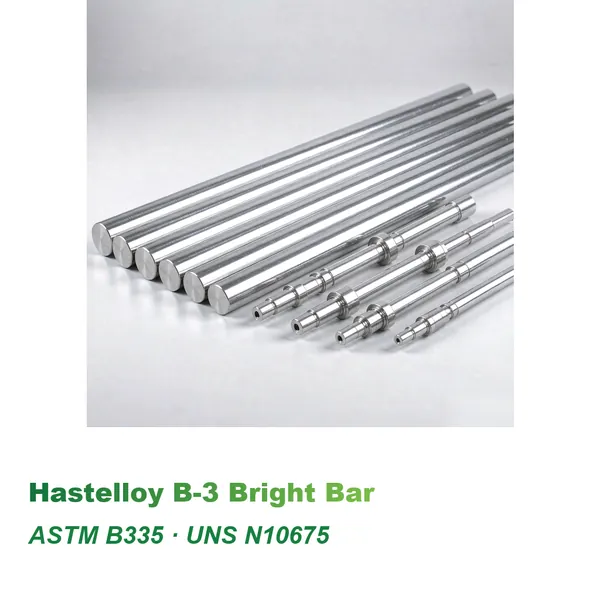
Hastelloy B-3 bright bar arrives in UNS N10675, the nickel-molybdenum grade that carries 1.0–3.0% chromium on purpose, which slows the embrittling phase enough that most welded joints enter service without a furnace pass. We supply ASTM B335 bright bar in bright-drawn, peeled and polished finishes for hydrogen chloride synthesis, acid regeneration and steel pickling hardware. Every Hastelloy B-3 bright bar consignment travels with heat-number traceability, EN 10204 3.1 mill test reports and full export documentation.
For example, 1.0–3.0% chromium in this Hastelloy B-3 bright bar retards the phase that embrittles the older B grade.
Specifically, the slower Ni3Mo kinetics mean most joints in this Hastelloy B-3 bright bar need no post-weld anneal.
Moreover, molybdenum at 27.0–32.0% carries this Hastelloy B-3 bright bar through hydrochloric acid at every concentration up to boiling.
Therefore, nitric acid, ferric ion and hypochlorite rule this Hastelloy B-3 bright bar out, so those lines belong with a chromium-rich alloy.
In addition, outer-fibre strain beyond roughly 7% sends this Hastelloy B-3 bright bar back through the anneal before welding.
Besides, an interpass ceiling of 93 °C lets multi-pass work in this Hastelloy B-3 bright bar finish without a furnace pass.
Consequently, ASTM B335 prints no hardness ceiling for this grade, so this Hastelloy B-3 bright bar is released on chemistry and tensile results.
Finally, the annealed matrix keeps this Hastelloy B-3 bright bar non-magnetic for instrument and seal work.
An automatic lathe reads a bright bar by how little the diameter drifts over a long run. Specifically, we fix the turning route and the finished tolerance band of this Hastelloy B-3 bright bar before quoting.
We record the medium, its concentration and its temperature for your Hastelloy B-3 bright bar before proposing a delivery state.
Specifically, EN 10204 3.1 papers, heat numbers and dimensional records follow each Hastelloy B-3 bright bar consignment.
In addition, this Hastelloy B-3 bright bar flows through a single process whether your shop welds it into a vessel or turns it on a lathe.
Quotations for this Hastelloy B-3 bright bar name the medium, the section, the finish and the document set rather than leaving them open.
Bar production for Hastelloy B-3 bright bar runs from charge balancing through to final packing. We log each stage of this Hastelloy B-3 bright bar route against its own heat number.
We take nickel, molybdenum and chromium as the charge for this Hastelloy B-3 bright bar and verify the analysis against B335.
First, the charge for this Hastelloy B-3 bright bar melts and refines under AOD practice that holds carbon low.
Next, forging and rolling reduce the ingot to this Hastelloy B-3 bright bar section.
Then, we hold this Hastelloy B-3 bright bar near 1066 °C and quench it in water.
After that, acid pickling leaves this Hastelloy B-3 bright bar scale-free for fabrication.
We then draw, turn or grind this Hastelloy B-3 bright bar to the ordered size and finish.
Subsequently, straightening brings this Hastelloy B-3 bright bar inside the ordered runout band.
Finally, chemistry, tensile and dimensional checks clear this Hastelloy B-3 bright bar for dispatch.
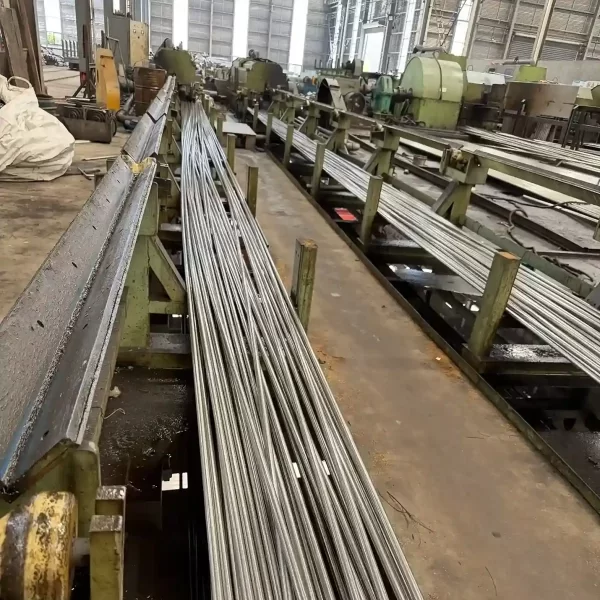
Stock lengths and made-to-order heats of Hastelloy B-3 bright bar leave on one production schedule. Moreover, we quote this Hastelloy B-3 bright bar inside our bar and rod program.
Hot working, annealing, drawing and pickling lines for Hastelloy B-3 bright bar share one site.
Units covering hot working, annealing, drawing and pickling for this Hastelloy B-3 bright bar.
Hastelloy B-3 bright bar output across stock and bespoke lots.
Metallurgists who set the anneal plan and the delivery state of this Hastelloy B-3 bright bar against your duty.
In addition, sealed export packing carries this Hastelloy B-3 bright bar to buyers on five continents.
Nothing leaves the yard until the heat behind your Hastelloy B-3 bright bar has cleared our ISO 9001 inspection route. In addition, we test this Hastelloy B-3 bright bar against the chemistry, tensile and surface the order names.
We confirm the grade and heat number of this Hastelloy B-3 bright bar against your purchase order.
Specifically, molybdenum, chromium and carbon in this Hastelloy B-3 bright bar go against the B335 table for your lot.
In addition, we report the tensile and yield results of this Hastelloy B-3 bright bar against the B335 minimums for every heat.
Every consignment of this Hastelloy B-3 bright bar ships with EN 10204 3.1 papers keyed to its heat.
We quote sections and delivery states for Hastelloy B-3 bright bar against the drawing rather than from a catalogue. In addition, the list below shows the Hastelloy B-3 bright bar forms ordered most often.
Drawn bar pairing a smooth skin with close size control.
Request Availability →Peeled bar carrying a machined skin and an even diameter.
Request Availability →Polished bar for reduced surface roughness on visible or contact parts.
Request Availability →Ground bar held to a close diameter and straightness band.
Request Availability →Bespoke bright stock finished against your drawing.
Request Availability →Hastelloy B-3 bright bar suits welded plant where a reducing acid stream meets no oxidant. In addition, the list below shows where this Hastelloy B-3 bright bar serves.
Discuss Your Application →Blanks turned on sliding-head lathes for acid plant instrument fittings.
Probe bodies machined from bright stock for acid process sampling points.
Plungers held to a close diameter for acid dosing pumps.
Holders machined for flow elements in acid transfer lines.
Stock turned into housings for sensors mounted on acid equipment.
Stems machined to a fine finish for control valves in chemical plants.
Bar drilled and finished into thermowells for acid process vessels.
Bespoke parts produced against your drawing from bright stock.
Detailed technical information including chemical composition, mechanical properties, standards and available dimensions.
Chromium sits deliberately between 1.0 and 3.0% in this bright bar, and that addition is what separates the UNS N10675 window from the earlier nickel-molybdenum grades. Consequently, molybdenum holds 27.0–32.0% while carbon stops at 0.01%, so the nickel-plus-molybdenum total of this bright bar lands between 94.0 and 98.0%.
For every element measured against its B335 limit behind this bright bar, open the composition breakdown kept on the Hastelloy B-3 material page.
Minimum room-temperature values below come from the rod table of ASTM B335 for UNS N10675. Consequently, the ordered state and the section size govern final acceptance of Hastelloy B-3 bright bar.
| Condition and Grade | Tensile Strength, min. | Yield Strength (0.2%), min. | Elongation, min. |
|---|---|---|---|
| Solution Annealed — UNS N10675 | ≥760 MPa (110 ksi) | ≥350 MPa (51 ksi) | 40% |
Reference data places the density of this bright bar at 9.22 g/cm³, with a melting range that closes near 1418 °C. Moreover, the annealed matrix leaves this bright bar essentially non-magnetic, and its elastic modulus settles near 216 GPa.
Meanwhile, the physical properties table on the Hastelloy B-3 material page holds the conductivity and expansion figures behind this bright bar.
The water-quenched anneal is the specification-defining step behind this Hastelloy B-3 bright bar, because Ni3Mo forms close to 650 °C and only a rapid quench after 1066 °C restores the corrosion resistance. Moreover, a section strained past roughly 7% at the outer fibre returns to that anneal before it can go back into a weld.
| Condition | Typical Treatment |
|---|---|
| Solution Annealed | Held near 1066 °C (1950 °F), then water quenched, because Ni3Mo begins to form close to 650 °C |
| Hot-Worked | Delivered as-rolled or as-forged, with the anneal agreed where the order calls for it |
| Cold-Drawn | Drawn after annealing, with the reduction logged so the higher proof stress is documented |
| Cold-Work Limit | Outer-fibre strain beyond roughly 7% sends the section back through the solution anneal before welding or service |
| Stress-Relief Caution | A relief pass inside the precipitation band still embrittles this grade, so residual-stress work needs a full anneal instead |
| Post-Weld Anneal | Most joints enter service as welded, because the slower Ni3Mo kinetics leave the as-welded zone usable |
ASTM B335 governs this bright bar under a title that names nickel-molybdenum rod, and the ASTM International document splits its two size clauses by delivery surface. Specifically, pickled or mechanically descaled stock runs below 19.05 mm while ground or turned stock runs above it. Therefore, the rod window for this bright bar closes at 88.9 mm and heavier sections change document.
| Standard | Product or Application |
|---|---|
| ASTM B335 / ASME SB335 | Nickel-molybdenum alloy rod with N10675 in the scope table |
| DIN 17752 / ISO 9723 | German and international bar documents |
| ASTM B564 / ASME SB564 | Forged bar and sections above the 88.9 mm rod ceiling |
Finally, the full standards list on the Hastelloy B-3 material page adds the plate, tube, fitting and flange documents plus the Chinese designation behind this bright bar.
Dimensions of Hastelloy B-3 bright bar follow the route, the document and the order quantity. Therefore, typical supply ranges sit in the table below, so please confirm your sizes in the inquiry.
| Product Form | Typical Supply | Length |
|---|---|---|
| Bright Bar | 7.94–88.9 mm dia. | Cut to length or random |
| Bright-Drawn Bar | 7.94–60 mm dia. | Cut to length |
| Peeled Bar | 20–88.9 mm dia. | Cut to length |
| Polished Bar | 8–80 mm dia. | Cut to length |
| Centreless-Ground Bar | 7.94–80 mm dia. | Cut to length |
| Custom Bright Bar | To drawing | Custom |
Available sizes of this Hastelloy B-3 bright bar depend on the route, the document, the state and the lot size. Please confirm the size, section and length you need for this bright bar in the inquiry.
Bright stock of this grade comes off ASTM B335 bar, and the drawing, peeling or polishing route decides both the surface and the size band. Moreover, the reduced skin that bright finishing leaves behind is cold work, so the strain figure on this bright bar is recorded and re-annealed where it passes the limit.
The surface you order decides how this bright bar behaves once it reaches a hydrogen chloride synthesis unit, an absorption tower or an acid regeneration loop. Moreover, most stock of this bright bar leaves the yard solution annealed and pickled. Therefore, we confirm the finish and the straightness band on this Hastelloy B-3 bright bar before we write the offer.
| Surface Condition | Typical Use |
|---|---|
| Bright Annealed | Protective-atmosphere annealing leaves this bright bar oxide-free for instrument and vacuum work. |
| Polished | A reduced-roughness surface on this bright bar for product-contact and visible parts. |
| Peeled | A machined skin on this bright bar at a uniform diameter, ready for a finishing cut. |
In addition, the surface finishes table recorded on the Hastelloy B-3 material page lists the remaining conditions quoted for this bright bar.
Related forms from the same heat cover Hastelloy B-3 Centreless-Ground Rod, Hastelloy B-3 Cold-Drawn Bar and Hastelloy B-3 Flat Bar when your bright bar order needs them.
Get detailed information including specifications, standards, dimensions and material properties.
One coordinator stays with your Hastelloy B-3 bright bar enquiry from the first question through to loading. Therefore, stock sizes of this Hastelloy B-3 bright bar dispatch inside fifteen days, while a fresh annealed heat runs about twenty-five.
Give us the medium, its concentration and its temperature, plus the size, quantity and standard this Hastelloy B-3 bright bar will face.
Then we set the annealing cycle, the delivery state and the tolerance band for this Hastelloy B-3 bright bar.
Pricing for this Hastelloy B-3 bright bar arrives by size, quantity and destination port.
You confirm the specification, the terms and the schedule of this Hastelloy B-3 bright bar in writing.
We book any third-party inspection or dimensional review of this Hastelloy B-3 bright bar before production starts.
This Hastelloy B-3 bright bar arrives with mill papers, a packing list and the certificate set.
Our production and inspection processes are certified to international standards, and every delivery ships with EN 10204 3.1 mill test certificates.
Quality Management System
Pressure Equipment Directive
Material Standards Compliance
Mill Test Certificates
ASTM B335 and ASME SB335 govern this Hastelloy B-3 bright bar, and the title of that standard names nickel-molybdenum rod with N10675 inside its scope.
Yes. Molybdenum at 27.0–32.0% carries this Hastelloy B-3 bright bar through hydrochloric acid at every concentration up to boiling, provided the stream carries no oxidant.
No. We do not release this Hastelloy B-3 bright bar against NACE MR0175, because an H2S-bearing stream can form low-melting nickel sulfide on a high-nickel surface.
ERNiMo-10 bare wire to AWS A5.14 joins this Hastelloy B-3 bright bar, with ENiMo-10 covered electrodes to AWS A5.11 for manual work.
Usually not. The slower Ni3Mo kinetics leave most joints in this Hastelloy B-3 bright bar serviceable as welded, which is the main reason buyers move up from the older B grade.
Once cold work strains the outer fibre beyond roughly 7%, this Hastelloy B-3 bright bar returns to the solution anneal before it can go back into a weld or into service.
A single bar covers many common sizes of this Hastelloy B-3 bright bar, so trial lengths are welcome before container orders.
We quote FOB as standard for this Hastelloy B-3 bright bar, and EXW, CIF or DAP terms follow once we fix the destination.
Expect 7 to 15 days for stock sizes of this Hastelloy B-3 bright bar, while a made-to-order annealed heat needs about 25 days.
Every heat of this Hastelloy B-3 bright bar ships with EN 10204 3.1, and we book a 3.2 endorsement through the order.
We quote Hastelloy B-3 bright bar by turn-down allowance, diameter band and surface finish. Send the finish you need and the quantity to price this Hastelloy B-3 bright bar.
We walk your Hastelloy B-3 bright bar inquiry through the anneal, the finish and the document scope, then quote on clear terms. Production then follows the signed sheet, and every consignment of this Hastelloy B-3 bright bar leaves with the complete paper set.