
01
Inconel 713C Master Alloy Bar
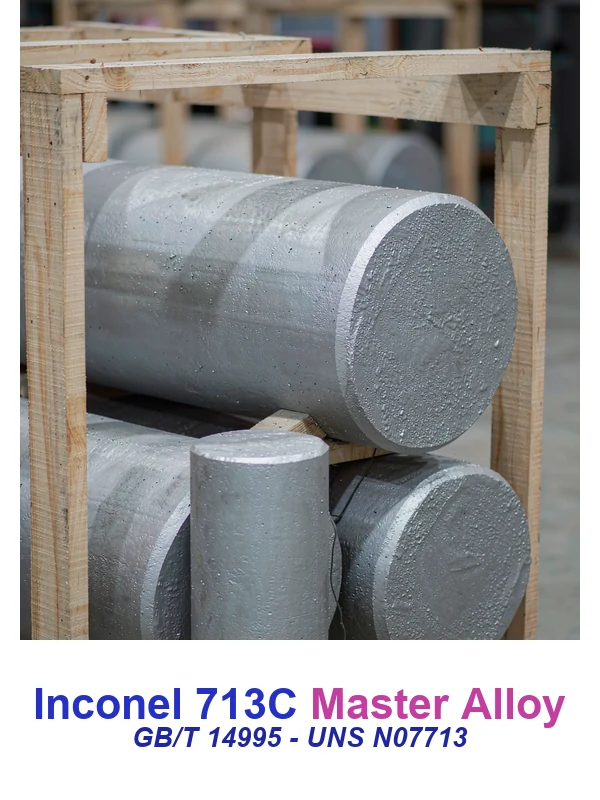
VIM-melted remelt bar and ingot for foundries, certified heat by heat against the agreed chemistry.
View Inconel 713C Master Alloy Bar →Grade hub for the UNS N07713 / K418 cast superalloy — composition, standards, and master alloy bar supply.
A gamma-prime fraction near 60% makes Inconel 713C impossible to forge, so every delivered form is cast or remelt stock.
Specifically, we coordinate VIM-melted master alloy bar for foundries that cast the grade in house.
Indeed, EN 10204 3.1 certificates with chemistry and gas data accompany every master alloy delivery.
Inconel 713C is a cast nickel-chromium superalloy, UNS N07713, strengthened by roughly 50 to 60% volume of gamma-prime precipitates. The alloy serves turbine blades, guide vanes, and turbocharger wheels near its 900 °C ceiling. Supply arrives almost entirely in the as-cast condition.
Because the gamma-prime content blocks forging, rolling, and extrusion, the grade has no wrought bar, plate, sheet, or tube form. As a result, buyers who arrive searching for those shapes usually settle on casting houses or on wrought alternatives such as Inconel 718. This page keeps that boundary up front, because honest scoping saves both sides a quotation cycle.
Supply divides into three routes. Foundries remelt our Inconel 713C Master Alloy Bar before casting their own parts. Casting buyers source finished investment castings to AMS 5391, and clean revert returns to the melt under controlled charging rules.
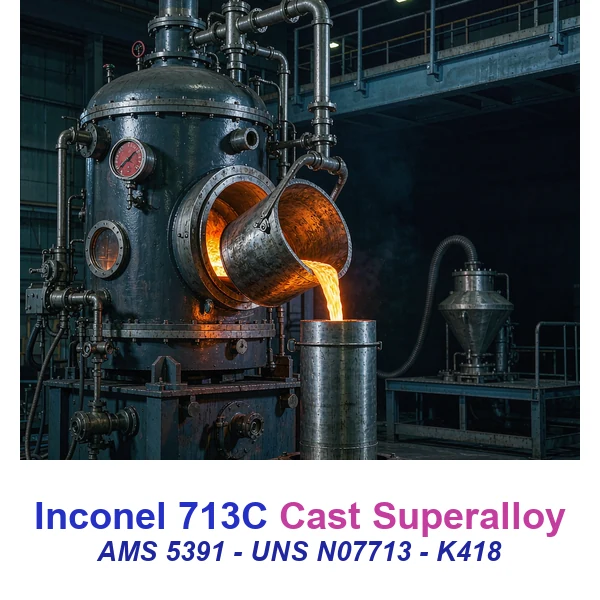
Inconel 713C is a cast-only nickel-chromium superalloy, UNS N07713, strengthened by a high gamma-prime fraction and used almost entirely in the as-cast condition. This page consolidates its composition, standards, and cast-form context for turbine blades, vanes, and turbocharger wheels. Southerly Alloy supplies the grade as VIM-melted master alloy bar for foundries, with EN 10204 3.1 certificates.
Specifically, aluminum near 6% and titanium near 0.8% build the Ni3(Al,Ti) precipitates that carry hot-section strength.
Moreover, stress-rupture performance stays useful through long exposure near the service ceiling.
Consequently, forging, rolling, and drawing are impractical, and supply runs through casting and remelt routes only.
In addition, the cobalt-free formulation holds cost down while keeping density near 7.9 g/cm³.
Vacuum induction melting controls oxygen and nitrogen before the melt reaches your crucible.
Indeed, melt fluidity fills blade sections and small vanes without misruns.
Meanwhile, repeated start-stop turbocharger cycles suit the carbide and gamma-prime structure.
Inconel 713C rewards buyers who scope the product form first, because the cast-only boundary decides the whole sourcing route. Southerly Alloy keeps that decision honest on every enquiry.
We state the cast-only boundary up front, so your drawing lands on a feasible route.
Every Inconel 713C master alloy bar lot carries heat chemistry, gas values and EN 10204 3.1 documents.
In addition, we map casting enquiries to AMS 5391 requirements so foundries receive the right remelt stock.
Where ductility or repair welding rules out casting, we quote Inconel 718 or 625 instead.
The grade supports two supply forms plus revert, and Inconel 713C never appears as wrought mill product. The cards below reflect that reality.
VIM-melted remelt bar and ingot for foundries, certified heat by heat against the agreed chemistry.
View Inconel 713C Master Alloy Bar →Blades, vanes, and turbocharger wheels cast to AMS 5391 by qualified casting houses.
Request Availability →Clean gating and runner returns that re-enter the melt under controlled charging rules.
Request Availability →The grade lives where high temperature, high load, and complex cast geometry arrive together. Form selection usually follows the casting house behind each part family.
Discuss Your Application →Automotive and diesel foundries cast turbine wheels from certified 713C heats at volume.
Investment casting shops pour rotor blades from vacuum melted UNS N07713.
Nozzle and guide vane castings draw on the same gamma-prime strengthened chemistry.
Meanwhile, integral turbine rotors for aero and industrial duty cast from single certified heats.
Industrial gas turbine houses pour vanes, segments and combustion hardware from VIM stock.
Furthermore, diesel and gas engine valve makers remelt the grade for hot-seat parts.
Heat-treatment shops cast rolls, muffles and fixtures that survive cyclic furnace duty.
Pilot melts qualify a new casting route on a single certified heat.
Detailed technical information including chemical composition, mechanical properties, standards and available dimensions.
Limits below reflect the chemistry window commonly certified for UNS N07713 across the AMS 5391 casting route and the K418 master alloy route. The governing order specification takes precedence for final acceptance of Inconel 713C product.
| Element | Content |
|---|---|
| Nickel (Ni) | Balance |
| Chromium (Cr) | 12.0–14.0% |
| Molybdenum (Mo) | 3.8–5.2% |
| Aluminum (Al) | 5.5–6.5% |
| Niobium + Tantalum (Nb + Ta) | 1.8–2.8% |
| Titanium (Ti) | 0.5–1.0% |
| Carbon (C) | 0.08–0.20% |
| Zirconium (Zr) | 0.05–0.15% |
| Boron (B) | 0.005–0.015% |
| Iron (Fe) | 2.50% max. |
| Silicon (Si) | 0.50% max. |
| Manganese (Mn) | 0.25% max. |
| Copper (Cu) | 0.50% max. |
| Sulfur (S) | 0.015% max. |
| Phosphorus (P) | 0.015% max. |
Master alloy bar carries no standard tensile acceptance, because the metal is remelted before it ever works. The row below describes typical as-cast investment castings poured from compliant heat, and casting acceptance follows the casting specification.
| Product Form | Condition | Tensile Strength | Yield Strength, 0.2% Offset | Elongation | Hardness |
|---|---|---|---|---|---|
| Investment castings | As-cast, typical | 900–1050 MPa (130–152 ksi) | 700–800 MPa (102–116 ksi) | 5–10% | 33–37 HRC |
Stress-rupture behavior, not room-temperature tensile, usually decides 713C casting life. Therefore, agree rupture test conditions on the casting drawing rather than relying on the row above.
| Property | Value |
|---|---|
| Alloy | Inconel 713C |
| UNS | N07713 |
| Werkstoff | 2.4671 |
| Density | Approx. 7.9 g/cm³ |
| Melting Range | Approx. 1260–1340 °C |
| Elastic Modulus | Approx. 200 GPa (room temperature) |
| Alloy Type | Nickel-chromium-molybdenum-aluminum-titanium |
| Strengthening | Gamma-prime precipitation, Ni3(Al,Ti) |
| Magnetic | Non-magnetic (austenitic) |
| Standard | Product / Application |
|---|---|
| SAE AMS 5391 | Nickel base investment castings, IN-713C (UNS N07713) |
| GB/T 14992 | Designation of the Chinese cast grade K418 |
| GB/T 14995 | Cast superalloy master alloy, ingot technical conditions |
| HB 5162 | K418 master alloy ingot for investment casting |
| GJB 5512.1 | Cast superalloy ingots for defense supply |
| UNS N07713 · W.Nr. 2.4671 · K418 | Material designations |
ASTM and AMS documents govern the casting route, while the Chinese master alloy standards govern ingot supply. Sources that attach AMS 5390 or ASTM B814 to this grade are in error, since AMS 5390 covers a Hastelloy X casting chemistry and ASTM B814 covers UNS N06920 plate.
| Product Form | Typical Supply Range |
|---|---|
| Master alloy bar | Ø30–200 mm dia., cut lengths to order |
| Foundry ingot | Formats sized to crucible and charge weight |
| Investment castings | To casting house drawings |
| Wrought bar, plate, sheet, or tube | Not produced, the grade is cast-only |
Overall, available dimensions depend on the melt route, the casting program and the order quantity. Confirm diameter, length and surface in the inquiry so we quote the correct route.
| Surface Condition | Typical Characteristics / Applications |
|---|---|
| As-Cast Skin | Standard master alloy surface for remelt charging |
| Peeled | Machined bright surface for clean charging and exact weighing |
| Ground | Diameter-corrected bar for foundries with tight melt budgets |
Get detailed information including specifications, standards, dimensions and material properties.
Turbine blades, guide vanes, integral cast rotors, and turbocharger wheels carry most of the volume. In addition, the grade appears in hot-section engine valves and in furnace tooling cast from the same chemistry.
No. The gamma-prime fraction near 60% blocks hot working, so the grade reaches buyers as master alloy bar, as investment castings, or as controlled revert.
SAE AMS 5391 governs the investment castings and anchors the chemistry window. On the master alloy side, GB/T 14995 and HB 5162 set the K418 ingot supply conditions.
K418 is the Chinese cast grade designation under GB/T 14992 for the same UNS N07713 chemistry. Foundries buying to the K418 system and buyers naming IN-713C receive the same remelt chemistry.
The as-cast state already carries the full gamma-prime strengthening, and homogenizing plus double aging only adds cost where rupture life demands it. Castings also cool in air, because thick sections crack under a water quench.
Reference rounds run from 30 to 200 mm diameter, cut to length, and other diameters follow the order.
A single bar can start a qualification melt, so small first orders are normal.
Quotations go out mainly on FOB terms, and EXW or CIF follow on request.
Melted-to-order heats run about 25 days from order confirmation, and scheduled campaign slots follow the agreed plan.
Yes. Each heat carries an EN 10204 3.1 certificate with chemistry and gas values, and 3.2 endorsement follows on request.
Send the grade, the form you need, and the casting route behind the enquiry. In return, the quotation carries the Incoterm, lead time, and documentation scope for the master alloy or the casting stock.