
01
Alloy 20 Cold-Drawn Wire
Drawn wire with the strength taken from the reduction rather than a furnace.
Request Availability →Cold-finished Alloy 20 wire inside the B473 wire window, in annealed coil or spring temper.
Copper holds the passive film of this Alloy 20 wire alive under reducing conditions, which is what carries it through sulfuric acid.
Moreover, niobium plus tantalum at eight times carbon stabilises this Alloy 20 wire, so a weld zone needs no post-weld anneal.
Furthermore, nickel at 32.0–38.0% puts chloride stress corrosion cracking out of reach for this wire.
Alloy 20 wire comes out of UNS N08020, the niobium-stabilised nickel-iron-chromium grade built around its copper content. Copper between 3.0% and 4.0% and nickel between 32.0% and 38.0% carry this Alloy 20 wire through acid duty.
Note A of B473 gives the wire form a tensile window of its own, 90.0 ksi to 120.0 ksi (620 to 830 MPa), with no yield or elongation attached. We supply this wire to ASTM B473 and ASME SB473 in hot-finished, annealed and cold-finished states, with the ASTM B462 forging route above the bar ceiling and ASTM B472 behind the billets. The heat number, the anneal and quench route we ran and the EN 10204 3.1 report travel with every wire consignment.
Meanwhile, the niobium addition is what lets a fabricated vessel of this wire go into service without a solution treatment after welding. The full chemistry window and the physical data behind this wire sit on our Alloy 20 material page, should you want to cross-reference them.
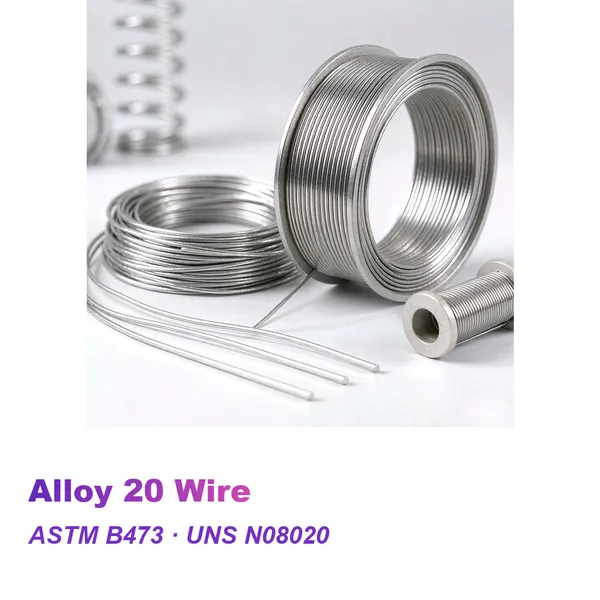
Alloy 20 wire comes out of UNS N08020, the niobium-stabilised nickel-iron-chromium grade whose copper content carries it through sulfuric acid. We supply ASTM B473 wire as cold-finished wire, annealed in coil or drawn to a spring temper for acid plant, pickling house liquor and tankhouse duty. Every Alloy 20 wire consignment travels with heat-number traceability, EN 10204 3.1 mill test reports and full export documentation.
For example, 3.0–4.0% copper in this wire keeps the passive film alive where a plain austenitic grade loses it.
Specifically, the copper addition lets this wire serve across a broad sulfuric acid range rather than only at one end.
Moreover, niobium plus tantalum at eight times carbon keeps the weld zone of this wire stable without a furnace pass.
Therefore, nickel above a third of the analysis gives this wire immunity to chloride stress corrosion cracking.
In addition, nothing in this wire responds to aging, so drawing is the only route above the annealed floor.
Besides, B473 carries no hardness column, so this wire clears on chemistry and tensile results alone.
Consequently, NACE MR0175 covers this wire at the condition that document names, and we document that condition per heat.
Finally, the austenitic matrix keeps this wire non-magnetic for instrument and seal work.
A wire order lives or dies on temper and on diameter tolerance, not on chemistry alone. In addition, we fix the temper, the coil weight and the tolerance band of this Alloy 20 wire before quoting.
We record the acid, its concentration and its temperature for your Alloy 20 wire before proposing a delivery state.
Specifically, each wire consignment carries EN 10204 3.1 papers, heat numbers and dimensional records.
In addition, this wire flows through one process whether your shop welds it into a vessel or turns it on a lathe.
Quotations for this wire name the acid, the section, the finish and the document set rather than leaving them open.
Producing Alloy 20 wire runs from charge balancing through to the final pack. We log each stage behind this Alloy 20 wire against its own heat number.
We charge nickel, chromium and copper to the B473 window before we draw this wire.
First, the charge for this wire melts and refines under AOD practice that brings carbon down to the ceiling.
Next, we add niobium so that this wire carries eight times the carbon content in the finished analysis.
Then, forging and rolling reduce the ingot to this wire section between 1230 °C and 925 °C.
After that, we hold this wire between 927 °C and 1010 °C so the niobium carbide goes back into solution.
We then drop this wire into the tank, because a slow pass through 600–900 °C would precipitate carbide and sigma.
Subsequently, pickling, turning or grinding brings this wire to the ordered size and surface.
Finally, we clear this wire for dispatch once chemistry, tensile and dimensional checks come back.
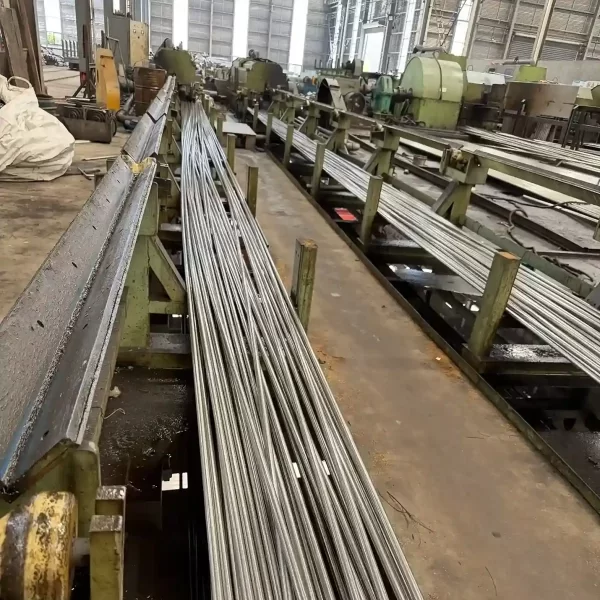
One schedule carries both stock lengths and bespoke heats of Alloy 20 wire. Besides, we quote this Alloy 20 wire through our bar and rod program.
Hot working, annealing, quenching and finishing lines behind the wire share this site.
Units for hot working, annealing, quenching and grinding of this wire.
Wire tonnage across stock lots and bespoke heats.
Metallurgists who write the anneal and quench plan that this wire follows.
In addition, sealed export packing sends this wire to buyers on five continents.
Nothing leaves until the heat behind your Alloy 20 wire clears our ISO 9001 route. In addition, the checks on this Alloy 20 wire follow the requirements the order names.
We match the grade and heat number on this wire to your purchase order before anything leaves the yard.
Specifically, copper, nickel and niobium in this wire go against the B473 table for your lot.
In addition, every heat of this wire carries reported tensile, yield and reduction-of-area values measured against the B473 floor.
The cooling record behind this wire travels with its EN 10204 3.1 papers.
The list below covers the variants we quote for Alloy 20 wire from your drawing rather than a stock list. In addition, this list covers the deliveries ordered most often for this Alloy 20 wire.
Drawn wire with the strength taken from the reduction rather than a furnace.
Request Availability →Dead soft wire annealed in coil for forming and cold heading.
Request Availability →Wire drawn to a spring temper for valve and instrument springs.
Request Availability →Coils wound to the weight and the pitch your feeder needs.
Request Availability →Diameter, temper and coil weight produced against your drawing.
Request Availability →Wire of this grade serves wherever a small section has to survive the same acid as the vessel around it. In addition, the list below sets out where this Alloy 20 wire serves.
Discuss Your Application →Spring stock for valves that open and close inside an acid stream.
Wire drawn to a spring temper for gauges on corrosive service.
Wire for small fasteners headed rather than machined.
Mesh stock for screens that separate solids out of an acid liquor.
Knitted wire for mist eliminators that catch acid droplets.
Wire for tying internals in place inside an acid vessel.
Core wire for covered electrodes used on acid plant repairs.
Wire that carries anode baskets in an acidic tankhouse.
Detailed technical information including chemical composition, mechanical properties, standards and available dimensions.
ASTM B473 prints one chemistry window for this wire, holding nickel between 32.0% and 38.0% and copper between 3.0% and 4.0%. Moreover, niobium plus tantalum in this wire has to reach eight times the carbon content.
Meanwhile, the full composition table on the Alloy 20 material page carries every limit behind this wire.
The wire form of this grade carries a tensile window of its own rather than the annealed or strain-hardened columns, and the figures below come from the B473 wire note and from published spring temper ranges. Consequently, the temper you order decides where this Alloy 20 wire lands.
| Condition | Tensile Strength | Yield Strength (0.2%) | Elongation | Reduction of Area |
|---|---|---|---|---|
| Wire, cold finished only — UNS N08020 | 620–830 MPa (90–120 ksi) | No requirement | No requirement | No requirement |
| Stabilised Annealed — UNS N08020 | ≥551 MPa (80 ksi) | ≥241 MPa (35 ksi) | 30% | 50% |
| Spring Temper, published commercial range | 1200–1800 MPa (174–261 ksi) | Not specified | Not specified | Not specified |
Published design data puts the density of this wire near 8.08 g/cm³ and its melting range between 1385 °C and 1443 °C. In addition, a modulus close to 193 GPa and a relative permeability near 1.004 leave this wire non-magnetic in service.
Therefore, the physical properties table on the Alloy 20 material page holds the conductivity, the resistivity and the expansion figures for this wire.
The water quench is the step that defines this Alloy 20 wire, because the section has to leave the stabilising anneal fast enough to keep carbide and sigma phases out of the grain boundaries. Moreover, the forging band finishes above 925 °C for a different reason: this grade risks incipient melting near 1200 °C.
| Condition | Typical Treatment |
|---|---|
| Stabilised Annealed | Held between 927 °C and 1010 °C, then water quenched, so the niobium carbide returns to solution |
| Hot-Worked | Forged between 1150 °C and 1230 °C, finishing above 925 °C because the section risks incipient melting near 1200 °C |
| Slow-Cool Caution | Passing slowly through 600–900 °C precipitates carbide and sigma phases, so the quench follows the anneal without delay |
| Strain Hardened | Cold drawn after the anneal, with the strength taken from the reduction rather than from a furnace |
| Cold-Forming Limit | Heavy cold forming sends the section back through the stabilising anneal before it enters service |
| Stress-Relief Caution | A relief pass inside the sensitising band costs corrosion resistance, so the alternative is settled before it is booked |
| Post-Weld Anneal | Most joints enter service as welded, because niobium at eight times the carbon content keeps the weld zone stable |
ASTM B473 is the only document in the series that reaches the wire form, and it defines wire apart from bar for this wire, issued by ASTM International. Besides, no aerospace specification covers this wire.
| Standard | Product or Application |
|---|---|
| ASTM B473 / ASME SB473 | Cold-finished wire, the only ASTM route into this form |
| ASTM A262 Practice A | Intergranular corrosion test applied on every heat |
| NACE MR0175 / ISO 15156-3 | Sour service, at the condition that document sets |
Beyond that, the standards table on the Alloy 20 material page carries the European designations and the flat-product call-outs for this wire.
The table below lists the wire sizes we ship most often, while the route, the document and the lot size decide what else is possible. Please confirm your own size, section and length with the inquiry.
| Product Form | Typical Supply | Length |
|---|---|---|
| Wire | 0.5 in (12.7 mm) and below, cold finished | Coils, spools or cut lengths |
| Cold-Drawn Wire | Strain hardened by the drawing reduction | Coils or spools |
| Annealed Wire | Dead soft annealed in coil | Coils |
| Spring Temper Wire | About 1200-1800 MPa (174-261 ksi) | Coils |
| Layer-Wound Coil | Wound to suit the feeder on your line | Coils |
| Custom Wire | To drawing | Custom |
ASTM B473 treats wire as a form of its own: cold finished only, 0.5 in (12.7 mm) and below, and carrying a tensile window of 90.0 ksi to 120.0 ksi (620 to 830 MPa) with no yield, elongation or reduction-of-area requirement attached to it. In addition, we agree the temper, the coil weight and the diameter tolerance band at order entry.
The surface you order on this wire decides how the part feeds, seals and resists attack. Consequently, we settle the condition of this wire before the price goes out.
| Surface Condition | Typical Use |
|---|---|
| Cold Drawn Wire | Drawing takes this wire to the finished diameter and sets its tensile inside the B473 window. |
| Annealed in Coil | A soft coil of this wire for forming, weaving and mesh work. |
| Spring Temper Coil | A tempered coil of this wire for springs, lockwire and tension members. |
In contrast, the surface finishes table on the Alloy 20 material page lists the further conditions open to this wire.
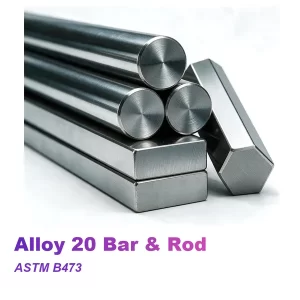
Related forms from the same heat cover Alloy 20 Bright Bar, Alloy 20 Centreless-Ground Rod and Alloy 20 Forged Bar when your wire order needs them.
Get detailed information including specifications, standards, dimensions and material properties.
A single coordinator stays with your Alloy 20 wire enquiry from the first question to the loading bay. In addition, stock of this Alloy 20 wire leaves inside fifteen days, and a freshly annealed heat takes about thirty.
Send the acid, its concentration and its temperature together with the size, quantity and standard this wire faces.
Then we lock the anneal cycle, the delivery condition and the tolerance band on this wire.
Pricing for this wire comes back by size, quantity and destination port.
We need your written confirmation of the specification, the terms and the schedule for this wire.
Next we schedule any third-party inspection or dimensional review of this wire before production starts.
This wire reaches you with mill papers, a packing list and the certificate set.
Our production and inspection processes are certified to international standards, and every delivery ships with EN 10204 3.1 mill test certificates.
Quality Management System
Pressure Equipment Directive
Material Standards Compliance
Mill Test Certificates
ASTM B473 and ASME SB473 cover this Alloy 20 wire, with the ASTM B462 forging route taking over above the bar ceiling.
No. B473 prints tensile, yield, elongation and reduction of area with no hardness column, so we release this wire on those four figures.
Yes. NACE MR0175 covers this grade, and the condition it sets for your wire is what we document per heat.
ER320LR bare wire to AWS A5.9 joins this wire, with E320LR covered electrodes to AWS A5.4 for manual work.
A slow pass through 600–900 °C precipitates carbide and sigma at the grain boundaries, so each wire heat leaves the anneal straight into the tank.
Usually not. Niobium at eight times the carbon content stabilises the matrix, so most wire joints stay serviceable as welded.
Trial lengths of this wire are welcome, and one piece covers most stock sizes.
Trade terms for this wire open on FOB, and EXW, CIF or DAP follow once we know the destination port.
Stock sizes of this wire ship in 7 to 15 days, while a made-to-order annealed heat needs about 30 days.
EN 10204 3.1 papers cover every heat of this wire, and we can arrange a 3.2 endorsement.
We price Alloy 20 wire on diameter, temper and coil weight. Send those three figures for this Alloy 20 wire.
Your wire inquiry passes through the anneal, the finish and the document scope before any price goes out. We build to the signed sheet, and the full paper set travels with this wire.