
Alloys for Gas Turbines: A Material Selection Guide
Which nickel alloys go into a gas turbine — and why. A component-by-component guide to Inconel 718, 625, X-750, 601, 600 and Incoloy 800H/HT, with the temperature band and ASTM specification behind each choice.
Gas turbines ask more of their materials than almost any other machine: rotating parts spend their lives just below the point where creep would slowly stretch them, while combustor hardware sits in an oxidising gas stream that can exceed 1,000 °C. Carbon steels and stainless steels give up long before either duty is met, which is why nickel superalloys carry the hot end of every modern gas turbine.
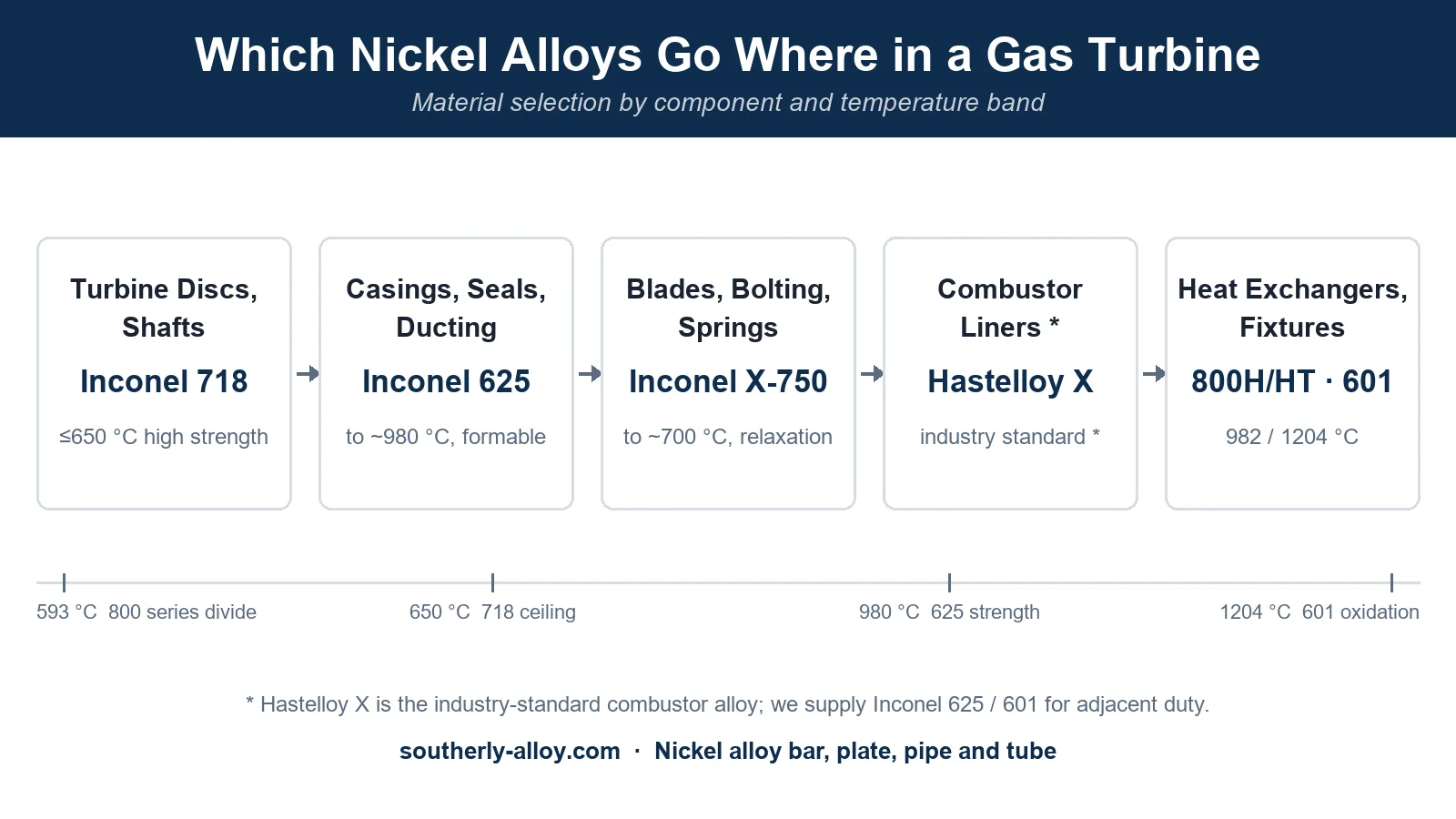
The short answer to which alloys are used in gas turbines is this: Inconel 718 for turbine discs, shafts and fasteners up to about 650 °C, Inconel 625 for casings, rings, seals and ducting that must be formed and welded, Inconel X-750 for blades, bolting and springs that live under sustained load, and Incoloy 800H/HT or Inconel 601 for the auxiliary hot zones around the engine. The rest of this guide explains how those choices follow from three failure modes, and maps each alloy to the ASTM specification and product form you can actually order.
Why Nickel Superalloys Dominate Gas Turbines
Three failure mechanisms decide material life in a turbine, and all three escalate steeply with temperature:
- Creep – under sustained centrifugal and thermal stress, a part slowly elongates. Above roughly 0.4 of the melting point in Kelvin, creep rather than yield strength sizes the part. Nickel’s face-centred cubic structure and its thermally stable precipitates push this regime far above what ferritic steels tolerate.
- Oxidation and hot corrosion – combustion gas attacks the surface, and sulphur in the fuel accelerates the attack once protective scales break down. Chromium, aluminium and molybdenum are the alloying elements that build and maintain those scales.
- Thermal fatigue – every start-up and shutdown drives the metal through a heating and cooling cycle. Alloys with high thermal stability resist the microstructural coarsening that turns these cycles into cracks.
A practical dividing line sits near 650 °C. Below it, precipitation-hardened Inconel 718 is the default rotating-part alloy because it combines high strength with good weldability and moderate cost. Above it, creep and environmental attack separate the alloys: solid-solution grades such as Inconel 625 hold ductility and weldability, while iron-nickel grades such as Incoloy 800H hold design strength in creep-controlled service. Knowing which side of that line your component lives on is the first step of the selection.
Alloy Selection by Turbine Component
The table below is the core of this guide: for each duty in a gas turbine, the dominant requirement, the first-choice alloy we supply, and the governing specification.
| Component / duty | Dominant requirement | First-choice alloy | Governing spec |
|---|---|---|---|
| Turbine discs, shafts, spools (≤650 °C) | High strength + weldability | Inconel 718 (UNS N07718) | ASTM B637 / AMS 5662, 5663 |
| Casings, rings, seals, ducting | Formability + corrosion resistance | Inconel 625 (UNS N06625) | ASTM B443 / B444 / B446 / B564 |
| Blades, bolting, springs | Sustained load, relaxation resistance | Inconel X-750 (UNS N07750) | ASTM B637 / AMS 5667 |
| Combustor liners, transition ducts | Oxidation resistance in hot gas | Hastelloy X (industry standard) | ASTM B435 / AMS 5754 |
| Heat exchangers, fixtures, exhaust hardware | Creep strength above 593 °C | Incoloy 800H / 800HT | ASTM B407 / B408 / B409 |
| Burner nozzles, radiant tubes, thermowells | Oxidation resistance to 1,204 °C | Inconel 601 (UNS N06601) | ASTM B166 / B167 / B168 |
Each row is expanded in the sections that follow.
Turbine Discs, Shafts and Rotating Hardware: Inconel 718 to 650 °C
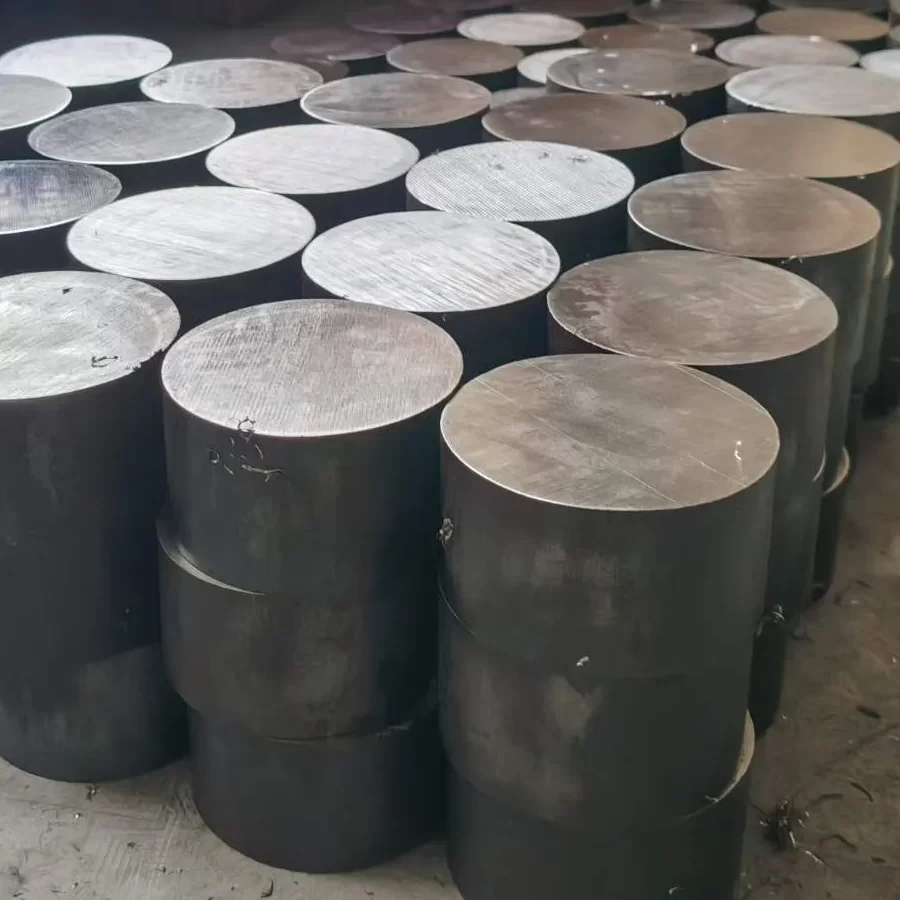
Inconel 718 is the workhorse of the turbine hot section and the single most specified nickel superalloy in the world. Its strength comes from a double-aging treatment that precipitates Ni3Nb (gamma double prime) and Ni3(Al,Ti) (gamma prime) phases, which is why aged bar to ASTM B637 carries minimum tensile of 1,275 MPa and minimum yield of 1,034 MPa — properties a solid-solution alloy cannot reach without an order-of-magnitude jump in cost.
Three practical points matter when specifying it:
- Condition is part of the order. AMS 5662 covers solution-treated, precipitation-hardenable bar; AMS 5663 covers bar already aged to final strength; AMS 5664 uses a higher solution temperature for better stress-rupture life above 650 °C, which is the route most rotating gas-turbine hardware takes.
- Temperature ceiling is about 650 °C. Above that, creep governs, and 718 progressively gives way to Waspaloy or Rene 41 in aerospace discs — alloys outside the scope of industrial bar supply chains like ours.
- Flat and tubular forms carry their own specs: ASTM B670 plate and sheet, and B983 for seamless pipe and tube.
For industrial gas turbines, 718 round bar, square bar, hexagon and forged sections cover discs, shafts, spacer rings and high-strength bolting. In some machines the same grade is also forged into blades and vanes whose duty stays inside the 650 °C band; blade manufacturing — closed-die forging, airfoil machining and coating — is a separate chain from the bar and forging-stock supply described here, where the material rather than the finished part is the deliverable.
Casings, Rings, Seals and Ducting: Inconel 625
Where 718 answers “how strong”, Inconel 625 answers “how fabricable”. Strengthened in the solid solution by molybdenum and niobium, it needs no aging treatment, which keeps it ductile, easy to form, and weldable without post-weld cracking risk — exactly the combination a casing, bellows, seal ring or transition duct requires. It also holds useful strength and outstanding oxidation resistance in gas up to about 980 °C.
Form and specification travel together:
- ASTM B443 plate and sheet for casings, liners and fabricated ducting (Grade 1 annealed ≥827 MPa tensile)
- ASTM B444 seamless and B705 welded product for pipe and tubing
- ASTM B446 bar and B564 forgings for rings and machined seal components, available as bar and rod
Blades, Bolting and Springs: Inconel X-750
Inconel X-750 is the older precipitation-hardened member of the family, strengthened almost entirely by gamma-prime Ni3(Al,Ti). What distinguishes it in turbine service is relaxation resistance: a bolt or spring loaded at 500–700 °C must keep pressing, year after year, and X-750 is formulated precisely to lose as little preload as possible. That is why it remains the standard answer for turbine blades in older industrial engines, high-temperature bolting, wave washers and springs.
It is governed by the same ASTM B637 as 718 bar (AMS 5667/5668/5669 name the aerospace conditions), and we supply it as bar and rod alongside plate, wire and ring forms.
Combustor Liners and Transition Ducts: Hastelloy X — and What We Supply Instead
For completeness: the alloy most often named for combustor liners and flame tubes is Hastelloy X (UNS N06002, sheet and plate to ASTM B435, AMS 5754), a nickel-chromium-molybdenum-iron grade prized for standing still in 900–1,100 °C oxidising gas. We do not stock Hastelloy X, and we would rather say so plainly than pretend otherwise.
For the duties adjacent to it, we do supply two practical alternatives:
- Inconel 625 sheet and plate for combustor-adjacent ducting, transition pieces and exhaust hardware where duty temperatures sit below the Hastelloy X band but fabrication and welding dominate — see the 625 section above.
- Inconel 601 for combustor and exhaust components in strongly oxidising flow. Its 1.0–1.7% aluminium forms a tightly adherent Al2O3 scale that resists spalling under thermal cycling, and the alloy carries oxidation resistance to 1,204 °C (2,200 °F) — supplied to ASTM B166 (bar), B167 (seamless pipe and tube) and B168 (plate and sheet).
Auxiliary Hot Zones: Incoloy 800H/HT, Inconel 601 and Inconel 600
Around the engine core, a second family of duties runs hot but at lower stress: recuperators and heat exchangers, exhaust hardware, heat-treatment fixtures, thermowells and burner fittings. Here the iron-nickel-chromium grades earn their place on cost as much as on capability.
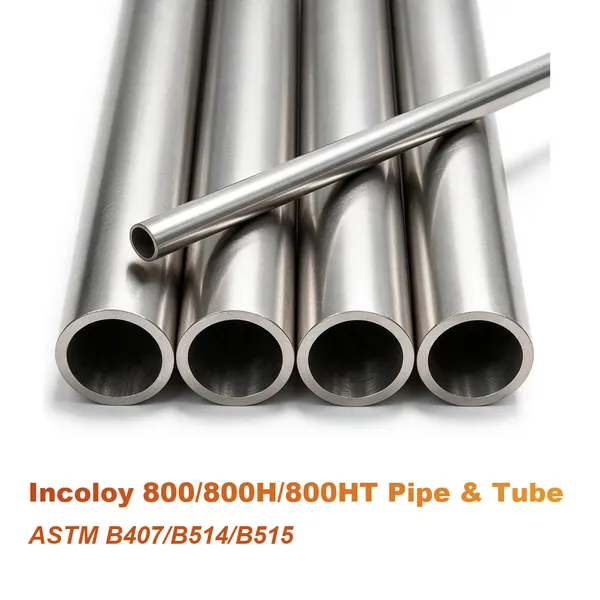
Incoloy 800H and 800HT are the creep-controlled members of the 800 series. Plain alloy 800 tops out near 593 °C in normal service; above that line, 800H (UNS N08810) and 800HT (UNS N08811) hold design values through a controlled carbon window and a deliberately coarse ASTM 5 grain structure, with ASME Code Cases 1325 and 1983 tabulating allowables up to 982 °C. Seamless pipe to ASTM B407, bar to B408 and plate to B409 cover the usual forms — the same trio that serves ethylene cracking furnaces at 750–900 °C.
Inconel 601 takes the oxidising duties (already covered above), while Inconel 600 remains in service as the legacy choice for furnace and fixture hardware — still supplied to ASTM B163, B166, B167 and B168, though most new designs now default to 601 for its superior oxidation behaviour.
Property Comparison at a Glance
| Alloy | UNS | Strengthening | Service temperature (guideline) | Min. tensile, aged/annealed bar | Density |
|---|---|---|---|---|---|
| Inconel 718 | N07718 | Precipitation (γ″ + γ′) | High strength to ~650 °C | 1,275 MPa (B637) | 8.19 g/cm³ |
| Inconel 625 | N06625 | Solid solution (Mo, Nb) | Strength and oxidation to ~980 °C | 827 MPa (B446 Gr 1) | 8.44 g/cm³ |
| Inconel X-750 | N07750 | Precipitation (γ′) | Spring/bolt duty to ~700 °C | per B637 condition | 8.31 g/cm³ |
| Inconel 601 | N06601 | Solid solution (Al) | Oxidation to 1,204 °C | per B166 condition | 8.11 g/cm³ |
| Incoloy 800H/HT | N08810/N08811 | Solid solution + grain control | Creep design values to 982 °C | 450 MPa (B408 annealed) | 7.94 g/cm³ |
| Inconel 600 | N06600 | Solid solution | Legacy fixture duty to ~1,093 °C | per B166 condition | 8.47 g/cm³ |
Treat the temperature column as a screening guide, not a design allowable: the governing value always comes from the specification, the product form and the code case that applies to your part.
Standards and Supply Forms
| Alloy | Bar & rod | Plate & sheet | Pipe & tube |
|---|---|---|---|
| Inconel 718 | ASTM B637 — view bar | ASTM B670 — view plate | ASTM B983 — view pipe |
| Inconel 625 | ASTM B446 — view bar | ASTM B443 — view plate | ASTM B444/B705 — view pipe |
| Inconel X-750 | ASTM B637 — view bar | — | — |
| Inconel 601 | ASTM B166 — view bar | ASTM B168 — view plate | ASTM B167 — view pipe |
| Inconel 600 | ASTM B166/B167/B168/B163 — grade page | ||
| Incoloy 800H/HT | ASTM B408 — view bar | ASTM B409 — view plate | ASTM B407 — view pipe |
Mill test certificates to EN 10204 3.1 accompany every heat, and AMS-condition deliveries are quoted on request for aerospace-facing orders.
Frequently Asked Questions
What alloys are used in gas turbine engines?
The dominant nickel superalloys are Inconel 718 for discs, shafts and fasteners, Inconel 625 for casings, rings, seals and ducting, Inconel X-750 for blades, bolting and springs, and Hastelloy X for combustor liners. Around the engine, Incoloy 800H/HT and Inconel 601 serve heat exchangers, exhaust hardware and fixtures. Single-crystal cast alloys occupy the very hottest blade rows, but those are casting-house products rather than wrought mill supply.
Why is Inconel 718 the default choice for turbine discs?
Because it combines yield strength above 1,034 MPa in the aged condition with good weldability and a supply chain that covers bar, forging stock, plate and tube under one UNS number. Its double-aged Ni3Nb precipitates hold that strength to about 650 °C, which spans the duty of most industrial turbine rotating hardware.
Inconel 718 vs 625: which is better for gas turbines?
Neither is universally better — they answer different questions. 718 is precipitation hardened and wins on strength to about 650 °C, but it must be aged and is less forgiving to fabricate. 625 is solid solution and wins on formability, weldability and corrosion resistance, with useful strength to about 980 °C. Rotating, high-stress parts take 718; fabricated casings, ducting and seals take 625.
What temperature can Inconel 718 withstand?
As a guideline, Inconel 718 maintains its aged strength in service to about 650 °C (1,200 °F). Above that, creep and microstructural degradation progressively reduce load-bearing capability, and AMS 5664-condition material or higher-temperature alloys such as Waspaloy take over. In oxidation terms the alloy remains serviceable beyond that, but strength — not scale resistance — is what limits rotating parts.
What is the difference between Inconel 718 and X-750?
Both are precipitation-hardened nickel-chromium grades under ASTM B637, but 718 is strengthened mainly by Ni3Nb (gamma double prime) and delivers higher overall strength, while X-750 is strengthened by Ni3(Al,Ti) (gamma prime) and is prized for relaxation resistance in springs and bolting. In practice: discs and shafts take 718; springs, wave washers and high-temperature bolts take X-750.
How to Specify: What to Send with Your RFQ
Buyers lose the most time not on price but on specification gaps. An RFQ for turbine-grade material closes fastest when it names five things:
- The duty, not just the grade. The part (disc, shaft, casing, spring), the continuous service temperature, and whether the load is steady or cyclic. This lets the supplier confirm the condition — 718 for a rotating disc follows AMS 5664 logic, while the same bar for a bolt may ship aged under AMS 5663.
- The specification and condition. ASTM B637 for 718 or X-750 bar, B446 for 625, B408 for 800H — plus the delivery condition: solution treated for further processing, or solution treated and aged for final strength.
- Size, tolerance and surface. Diameter or thickness range, tolerance class, and whether the route is hot-finished, peeled, ground or forged.
- Documentation. EN 10204 3.1 mill test certificates as standard; heat-treatment charts for any aged delivery; grain-size reporting to ASTM E112 for 800H/HT, where ASTM 5 or coarser is part of acceptance.
- Inspection scope. Tensile and hardness as standard; ultrasonic testing or PMI where the part is flight- or pressure-critical.
Send those five lines and the quotation moves from clarification to pricing in one round.
Source the Alloys, Not Just the Answer
Southerly Alloy supplies and exports Inconel 718, 625, X-750, 601, 600 and Incoloy 800H/HT in bar, plate, sheet, pipe and tube to the ASTM specifications listed above, with EN 10204 3.1 certification on every heat. If you are specifying material for a turbine component, send us the duty temperature, the stress case and the target specification — we will come back with the grade, condition and delivery route that match. Request a quote or download the grade datasheets from our material pages.