
Case Study: Improving Hardness of Inconel 901 Alloy to Meet Customer Requirements
A real production case showing how we achieved customized hardness requirements for Inconel 901 superalloy through controlled forging, heat treatment, and precision machining.
1. Customer Requirement Overview
Last year, we received an order from a US customer requesting Inconel 901 alloy plates with a target hardness of 38 HRC. According to standard material data, the typical hardness range of Inconel 901 superalloy is around 30–35 HRC.
This meant the requirement was significantly higher than the normal specification, presenting a clear technical challenge in terms of heat treatment control and material processing.
After internal engineering evaluation, we confirmed that with optimized forging and aging processes, the target hardness could be achieved. Therefore, we accepted the order.
2. Raw Material Preparation and Forging Strategy
Although the order was relatively small, material control remained critical. The final cutting dimension requirements had to be strictly guaranteed.
The customer required approximately 25 kg of finished material. However, to ensure machining stability after forging and heat treatment, we increased the forging block weight to 35 kg.
We requested raw material suppliers to provide pre-forged material with multiple forging cycles to ensure uniform structure and stable mechanical response in later processing stages.
This stage required extensive coordination and resulted in a longer procurement cycle, slightly delaying the original delivery schedule.
The forging process involved repeated heating, forging, and annealing cycles. Due to small batch size limitations, the material had to be processed together with other production batches, which further extended the timeline.
Eventually, after approximately three weeks, we received the forged block with an actual weight of 38.3 kg.
3. Hardness Testing and Heat Treatment Process
After receiving the forging, we conducted spectral analysis and hardness testing to verify material composition and initial mechanical properties.
The chemical composition met specifications, although sulfur content showed a slightly elevated value within acceptable limits.
Initial hardness test results were:
- 32 HRC
- 32 HRC
- 34 HRC
This confirmed a significant gap between the actual condition and the required 38 HRC target.
We then proceeded with solution treatment followed by controlled aging treatment to increase precipitation strengthening in the alloy matrix.

The artificial aging process involved heating the material to a controlled temperature range to promote precipitation hardening. This significantly improved hardness, wear resistance, and mechanical stability.
After several days of process optimization, final hardness results from 8 samples were:
- 39 HRC
- 38 HRC
- 38–39 HRC
- 38 HRC
- 40–41 HRC
- 39–40 HRC
All results met or exceeded the customer’s requirement of 38 HRC.
4. Cutting and Machining Process
Due to the high hardness after heat treatment, conventional turning and sawing methods were no longer suitable.
We therefore adopted wire cutting technology to ensure precision machining and dimensional accuracy.
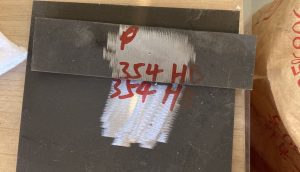
Throughout the machining process, we recorded on-site videos for quality traceability and transparency.
After wire cutting, final surface grinding was performed to achieve required finish quality before delivery.
5. Delivery and Customer Feedback
The finished product was shipped via express delivery after final inspection.
After receiving the materials, the customer began machining operations and later confirmed full satisfaction with both hardness consistency and dimensional accuracy.
6. Summary and Technical Reflection
This case demonstrates how strict process control, material engineering, and heat treatment optimization can achieve non-standard hardness requirements for Inconel 901 alloy.
Despite challenges in scheduling and multi-stage processing, coordinated effort between engineering, production, and quality teams ensured successful delivery.
It also highlights a key principle in superalloy manufacturing: final mechanical properties are not fixed by base composition alone, but can be significantly influenced through controlled forging and aging processes.
In high-performance nickel alloy production, precision in every step determines final success, especially when meeting customized mechanical requirements.